Grant Park North

Why it's listed
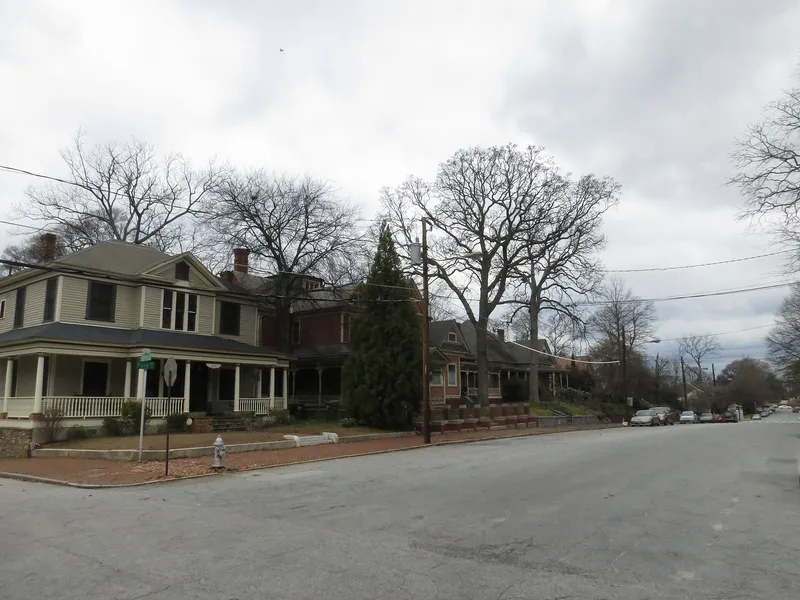
Grant Park North is a small in-town Atlanta neighborhood of late Victorian houses, most of one story, with porch woodwork, stained and leaded glass, and a scattering of Queen Anne and Eastlake forms. Brick or octagonal paver sidewalks, mature oak street trees and stone and brick retaining walls give the streets a consistent look. A few 1920s and early 1930s corner stores and a church are included. The area grew from land sold by Col. Lemuel P. Grant, who donated park land to the city in 1883. The city limits expanded in 1885, and new streetcar and street links followed. Most building took place between 1895 and 1910. Residents in 1900 included railroad workers, shopkeepers, clerks, a physician and a minister. The neighborhood lost favor in the 1920s as newer suburbs opened, then revived from the 1970s through restoration by owner-occupants. It was listed for its architecture, landscape design and role in Atlanta's early community planning.
Significance in brief: The nomination argues the district is significant in architecture for its late Victorian houses with Eastlake, Queen Anne and eclectic elements. It is significant in landscape architecture for its street trees, sidewalk paving, retaining walls and street grid. It is also significant in community planning as one of Atlanta's earliest in-town neighborhoods, reflecting the city's post-Reconstruction growth.
Machine-generated summary. This summary was generated by a language model from the official nomination document and has not been reviewed line by line by an editor. It may contain errors. Check the source document before relying on any detail. Source: nomination document (PDF) · National Archives catalog entry. NRHP reference 86000462, listed March 17, 1986. Summary generated October 2026 (model claude-sonnet-5-5, prompt v1.0-2026-10-29, confidence high).
Key facts
| Address | Roughly bounded by Woodward Ave., Boulevard, I-20, and Hill St., Atlanta |
|---|---|
| County | Fulton County |
| Listed | March 17, 1986 |
| Reference number | 86000462 |
| Resource type | District |
| Period of significance | c.1880-1930 |
| Architect / builder | numerous |
| Architectural style | Late Victorian, including Queen Anne and Eastlake elements |
| Criteria |
|
| Areas of significance | Community Planning and Development, Architecture |
| Level of significance | Local |
| Status (as stated in the nomination) | Generally in good condition, with individual buildings ranging from excellent to deteriorated; mostly single-family housing, some converted to multi-family use, and many houses restored by owner-occupants. |
| Acreage | 28.5 |
| Coordinates | 33.74499, -84.37572 (NPS GIS) |
What listing means for this property
This is a historic district. Buildings within its boundary are either contributing (they add to the district's significance) or non-contributing. Owners of contributing income-producing buildings can claim the 20% federal rehabilitation tax credit; homeowners should look at state credits. National Register districts impose no design review by themselves; a local historic district ordinance, if one exists, does (the difference explained).
General information, not legal or tax advice. Rules change; confirm with your State Historic Preservation Office or a qualified adviser.
Sources and further reading
- National Park Service, National Register of Historic Places database (snapshot May 2026), reference 86000462.
- Nomination form (PDF, National Archives) — catalog entry
- Wikidata Q141759986
- This listing as JSON
Last updated October 2026. Found an error? See the editorial policy for how to report it.