Oakland Cemetery

Why it's listed
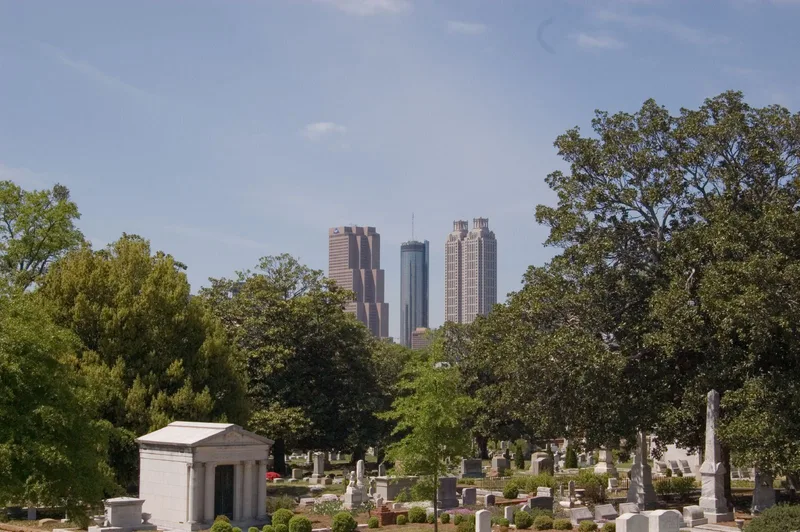
Oakland Cemetery is an 88-acre burial ground in southeastern Atlanta, the city's oldest surviving one. It was founded in 1850 with a six-acre purchase and enlarged over later decades. A brick wall and gates from 1896 enclose hilly grounds with winding drives, old magnolia and chestnut trees, and a few surviving iron benches and lot fences. Inside are a watch house, an 1899 Romanesque Revival office building, and distinct Confederate, Jewish and Black sections. The cemetery is notable for its Victorian funerary art, from simple arched stones to elaborate mausolea. These carry Gothic, classical, Eastlake and Egyptian motifs, and the Kontz and Peck memorials are singled out. The interment records date to 1853 and include the first mayor, Moses Formwalt, as well as author Margaret Mitchell Marsh and golfer Bobby Jones. The grounds follow the rural cemetery ideal of a landscaped place for visiting and reflection. Atlanta began a restoration and museum program there in 1975.
Significance in brief: The nomination argues that Oakland is an important historical and cultural record of Atlanta, holding the graves of citizens from the first mayor onward. Its hilly, park-like grounds follow the rural cemetery movement's ideal. It also holds a large collection of Victorian cemetery art, including monuments, mausolea and ironwork. Its separate Confederate, Jewish and Black sections reflect the segregated layout of the original lots.
Machine-generated summary. This summary was generated by a language model from the official nomination document and has not been reviewed line by line by an editor. It may contain errors. Check the source document before relying on any detail. Source: nomination document (PDF) · National Archives catalog entry. NRHP reference 76000627, listed April 28, 1976. Summary generated October 2026 (model claude-sonnet-5-5, prompt v1.0-2026-10-29, confidence high).
Key facts
| Address | 248 Oakland Ave., SE, Atlanta |
|---|---|
| County | Fulton County |
| Listed | April 28, 1976 |
| Reference number | 76000627 |
| Resource type | District |
| Period of significance | 1850-1925 |
| Architect / builder | Bruce and Morgan (entrance gate); G. W. Smith (main office building, 1899) |
| Architectural style | Late Victorian; Romanesque Revival office building; Victorian cemetery art with Gothic, classical, Eastlake and Beaux-Arts motifs |
| Areas of significance | Landscape Architecture, Art, Social History |
| Level of significance | State |
| Status (as stated in the nomination) | Rated good and unaltered. The form lists it as city-owned, with a restoration and museum program begun in 1975. The Hunter Street gate is the only one open to the public. |
| Acreage | 88 |
| Coordinates | 33.74878, -84.37221 (NPS GIS) |
What listing means for this property
This is a historic district. Buildings within its boundary are either contributing (they add to the district's significance) or non-contributing. Owners of contributing income-producing buildings can claim the 20% federal rehabilitation tax credit; homeowners should look at state credits. National Register districts impose no design review by themselves; a local historic district ordinance, if one exists, does (the difference explained).
General information, not legal or tax advice. Rules change; confirm with your State Historic Preservation Office or a qualified adviser.
Sources and further reading
- National Park Service, National Register of Historic Places database (snapshot May 2026), reference 76000627.
- Nomination form (PDF, National Archives) — catalog entry
- Wikipedia article (used for cross-checking only; text not reproduced here)
- Wikidata Q2008469
- This listing as JSON
Last updated October 2026. Found an error? See the editorial policy for how to report it.