Butler Street Colored Methodist Episcopal Church
Butler Street Colored Methodist Episcopal Church is a building in Atlanta, Fulton County, Georgia, listed on the National Register of Historic Places on May 9, 1983 (reference number 83000228). The National Park Service records its significance in Architecture at the local level.
Facts from the NPS National Register database (); nomination summary October 2026. Last updated . Sources for each fact.

Approximate location: the National Park Service places this pin arbitrarily within the property, not at a surveyed point (stated accuracy ±12 m).
Why it's listed
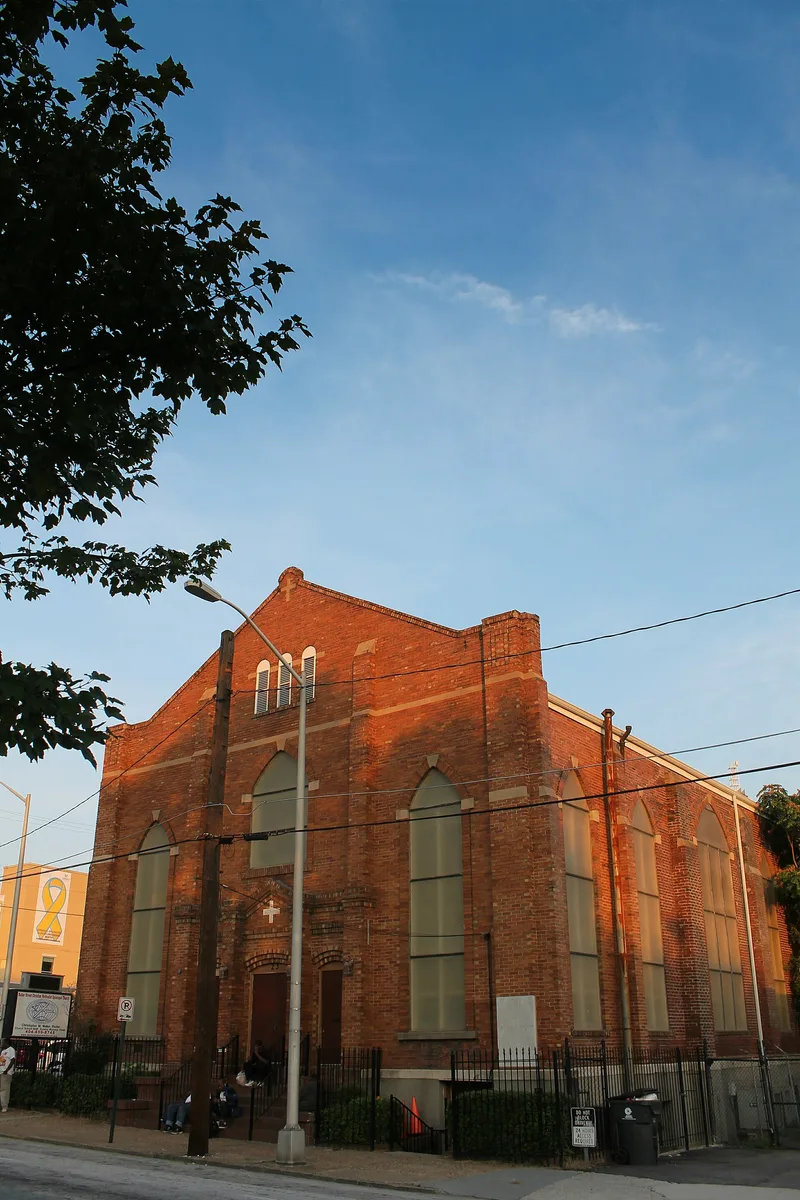
Butler Street Colored Methodist Episcopal Church is a tan brick, vernacular Neo-Gothic Revival building at 23 Butler Street, S.E., in Atlanta, just south of the Sweet Auburn Historic District. Completed in 1920, it was built by day laborers supervised by builder H. Whitworth. Its pointed-arched stained glass windows, pressed tin ceilings and wooden railings with Gothic tracery are the main architectural features. One window carries a pictured likeness of Bishop Lucius H. Holsey, a C.M.E. leader who helped found the congregation in 1882 and who died the year the church was finished. The congregation's first church, a wood building on land donated by businessman John T. Grant in 1884, was demolished to make way for the present structure. The church is one of several historic Black churches near Auburn Avenue, an area that flourished as a center of Black enterprise and social life between 1880 and 1930. It is still in religious use and remains largely unaltered.
Significance in brief: The nomination argues significance in architecture, religion and local history. The church is a vernacular Neo-Gothic building built for and by Atlanta's Black community, with notable pressed tin ceilings, stained glass and Gothic tracery railings. It is tied to Bishop Lucius H. Holsey, a prominent C.M.E. leader, and to the Sweet Auburn area, a major center of Black business and social life from 1880 to 1930.
Machine-generated summary. This summary was generated by a language model from the official nomination document and has not been reviewed line by line by an editor. It may contain errors. Check the source document before relying on any detail. Source: nomination document (PDF) · National Archives catalog entry. NRHP reference 83000228, listed May 9, 1983. Summary generated October 2026 (model claude-sonnet-5-5, prompt v1.0-2026-10-29, confidence high).
Key facts
| Official database NPS National Register database, ref. 83000228 , checked | |
|---|---|
| Address | 23 Butler St., SE, Atlanta |
| County | Fulton County |
| Listed | May 9, 1983 |
| Reference number | 83000228 |
| Resource type | Building |
| Areas of significance | Architecture |
| Level of significance | Local |
| National Historic Landmark | No |
| Acreage | 0.9 |
| Official document, machine-extracted Nomination form (National Archives) , checked | |
| Period of significance | 1900- (specific date 1920) |
| Architect / builder | Builder: H. Whirworth (spelled H. Whitworth in the narrative) |
| Architectural style | Vernacular Neo-Gothic Revival |
| Criteria |
|
| Status (as stated in the nomination) | Occupied; used as a religious building; condition marked good and unaltered, on its original site. |
| Official dataset NPS cultural-resource GIS (NRHP locations) | |
| Coordinates | 33.75384, -84.38063 |
| Computed Computed from NPS GIS district boundaries | |
| Within district | Sweet Auburn Historic District |
What listing means for this property
Religious properties are listed for their architectural or historical significance, not their religious use. Listing is honorary and does not restrict the congregation's use of the building. The federal rehabilitation credit is generally unavailable unless part of the building is income-producing; some state programmes and preservation grants do cover religious buildings. Federal funding or permits trigger Section 106 review.
General information, not legal or tax advice. Rules change; confirm with your State Historic Preservation Office or a qualified adviser.
Questions about Butler Street Colored Methodist Episcopal Church
When was Butler Street Colored Methodist Episcopal Church added to the National Register of Historic Places?
Butler Street Colored Methodist Episcopal Church was listed on May 9, 1983. Its National Register reference number is 83000228.
Is Butler Street Colored Methodist Episcopal Church a National Historic Landmark?
No. The National Park Service database (snapshot of May 2026) lists Butler Street Colored Methodist Episcopal Church on the National Register but does not record it as a National Historic Landmark.
Where is Butler Street Colored Methodist Episcopal Church?
23 Butler St., SE, Atlanta, Fulton County, Georgia; coordinates 33.75384, -84.38063.
Why is Butler Street Colored Methodist Episcopal Church historically significant?
According to a machine-generated summary of its nomination form: The nomination argues significance in architecture, religion and local history. The church is a vernacular Neo-Gothic building built for and by Atlanta's Black community, with notable pressed tin ceilings, stained glass and Gothic tracery railings. It is tied to Bishop Lucius H. Holsey, a prominent C.M.E. leader, and to the Sweet Auburn area, a major center of Black business and social life from 1880 to 1930. Check the nomination document before relying on any detail.
Who designed or built Butler Street Colored Methodist Episcopal Church?
The nomination form names Builder: H. Whirworth (spelled H. Whitworth in the narrative) as architect or builder (extracted by machine from the nomination; check the source document).
Is Butler Street Colored Methodist Episcopal Church in a historic district?
Yes. Its location falls within the Sweet Auburn Historic District, itself listed on the National Register. (Computed from National Park Service boundary data; the district nomination's own list of contributing resources may differ.)
Where can I read the original nomination for Butler Street Colored Methodist Episcopal Church?
The nomination form is a public record held by the National Archives: nomination document (PDF).
Sources and further reading
- National Park Service, National Register of Historic Places database (snapshot May 2026), reference 83000228.
- Nomination form (PDF, National Archives) — catalog entry
- Wikidata Q122441983
- This listing as JSON
Last updated October 2026. Found an error? See the editorial policy for how to report it.