Olivenhain Town Meeting Hall

Why it's listed
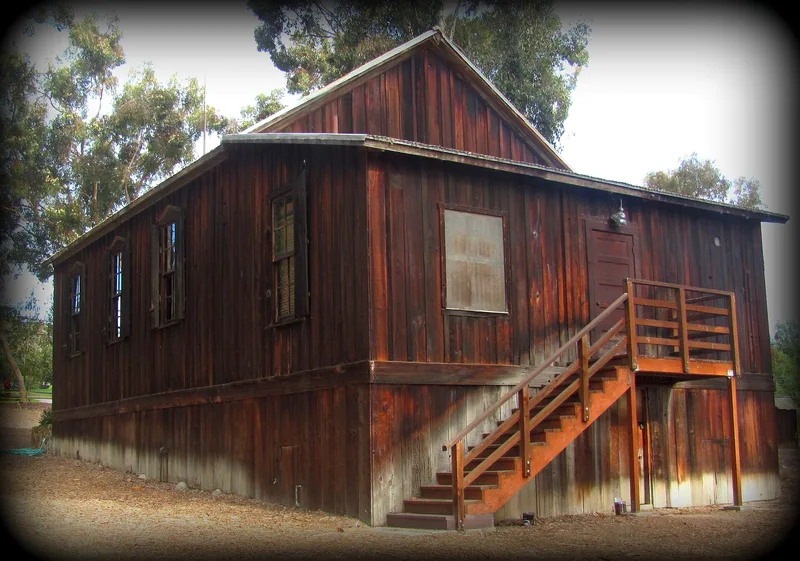
Built by local settlers between 1894 and 1895, this one-room redwood hall in Olivenhain, California, measures 28 by 36 feet and has vertical board-and-batten walls, a front-gabled roof and a double-door entry. It sits in a eucalyptus grove and has never been painted. A rear addition in 1916 added a kitchen and bathrooms, using redwood salvaged from a rival hall built by the community's younger residents. The shingle roof became corrugated tin in 1949, and concrete footings replaced decaying redwood pillars in the 1980s. Olivenhain was founded in 1884 by German colonists from Denver. Within this settlement of immigrant farmers, the hall became the place where dances, weddings, picnics, holiday celebrations, political meetings and discussions of planting and irrigation took place. Its significance rests on that central role in the community's social, governmental and recreational life between 1894 and 1943. The hall remains in constant use for community gatherings today.
Significance in brief: The hall is significant under Criterion A in social history, government and recreation. It served as the "nerve center" of Olivenhain, a colony of German immigrant farmers, hosting dances, weddings, picnics, business and political meetings, and agricultural discussions. Virtually all important civic and social decisions in the community were made there.
Machine-generated summary. This summary was generated by a language model from the official nomination document and has not been reviewed line by line by an editor. It may contain errors. Check the source document before relying on any detail. Source: nomination document (PDF) · National Archives catalog entry. NRHP reference 93001395, listed December 17, 1993. Summary generated October 2026 (model claude-sonnet-5-5, prompt v1.0-2026-10-29, confidence high).
Key facts
| Address | 423 Rancho Santa Fe Rd., Olivenhain |
|---|---|
| County | San Diego County |
| Listed | December 17, 1993 |
| Reference number | 93001395 |
| Resource type | Building |
| Period of significance | 1894-1943 |
| Architectural style | No style |
| Criteria |
|
| Areas of significance | Entertainment/Recreation, Politics/Government, Social History |
| Level of significance | Local |
| Status (as stated in the nomination) | Still in regular use for community functions such as Fourth of July celebrations, weddings and town meetings; structural footings were added in the 1980s with a state grant. |
| Acreage | 0.9 |
| Coordinates | 33.04334, -117.23520 (NPS GIS) |
What listing means for this property
National Register listing is honorary for a privately owned home: it does not by itself restrict what an owner may do with their own money, and it does not require public access. Restrictions come from local landmark or historic-district ordinances, which are separate (how they differ).
Owner-occupied houses are not eligible for the 20% federal rehabilitation tax credit, which applies to income-producing buildings, but many states offer credits for homeowners. Listing also opens the door to preservation easements and to buying a plaque. Start with what listing means for homeowners, renovating a listed house and selling one.
General information, not legal or tax advice. Rules change; confirm with your State Historic Preservation Office or a qualified adviser.
Sources and further reading
- National Park Service, National Register of Historic Places database (snapshot May 2026), reference 93001395.
- Nomination form (PDF, National Archives) — catalog entry
- Wikipedia article (used for cross-checking only; text not reproduced here)
- Wikidata Q9052120
- This listing as JSON
Last updated October 2026. Found an error? See the editorial policy for how to report it.