Park Street Historic Commercial District

Why it's listed
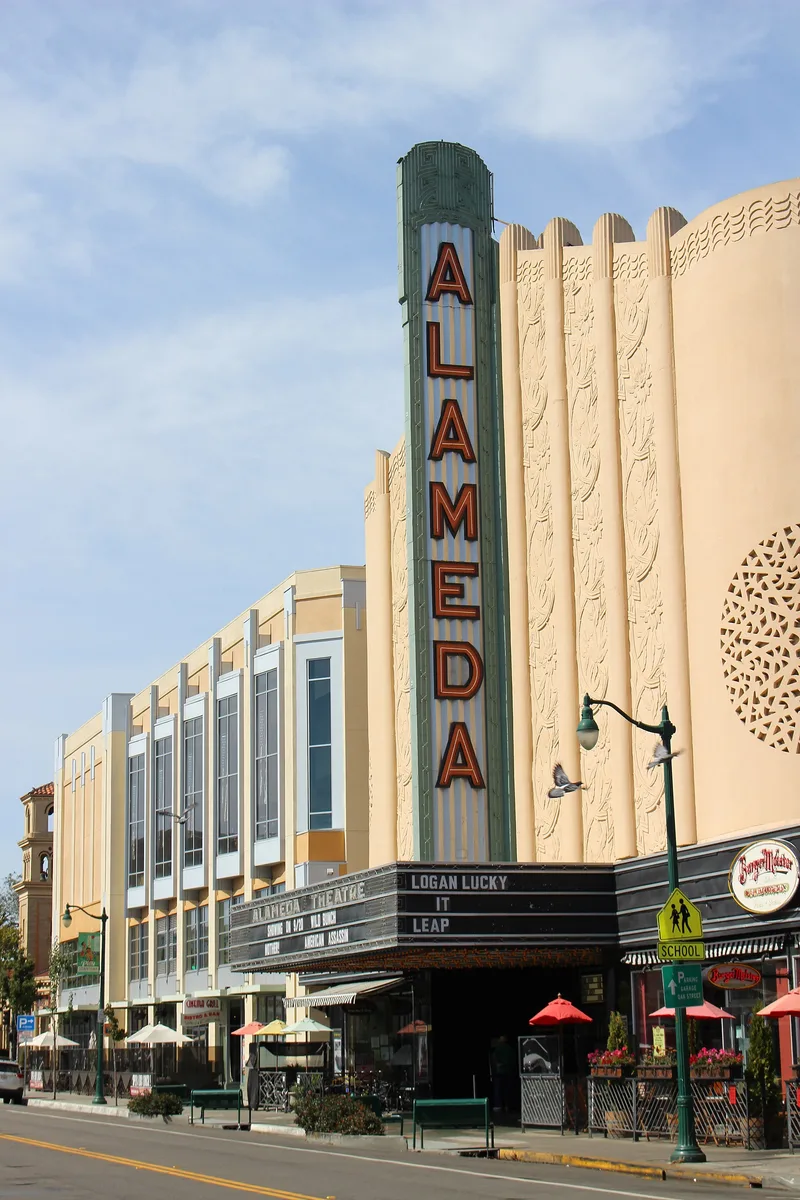
Park Street's downtown commercial strip in Alameda, together with portions of the cross streets, forms a district of 72 buildings, most of them one- or two-story brick or frame structures with storefronts below and apartments or other uses above. Nearly all contain at least one storefront, and 40 of them were built before 1910. Older groupings sit near the Encinal Avenue and Lincoln Avenue ends, where early commercial activity gathered around train-line cross traffic. A notable cluster of Victorian wood and brick buildings lines the north side of Santa Clara Avenue, including a Stick style building from 1892. Larger masonry landmarks anchor the district, among them the granite-faced Old Post Office of 1912, the Masonic buildings and two theatres. Banks at the main intersections use monumental neo-classical fronts, and several Park Street blocks carry neo-classical, Spanish Renaissance or Art Deco themes. The mix of eras and styles records the commercial growth of downtown Alameda over about six decades.
Significance in brief: The nomination presents the district as a largely intact historic commercial core, with 55 percent of its buildings dating before 1910. It includes a cluster of Victorian wood and brick buildings, large masonry institutional buildings, theatres, banks and Park Street blocks in neo-classical, Spanish Renaissance and Art Deco designs. Early commercial nodes grew near the cross traffic of train lines.
Machine-generated summary. This summary was generated by a language model from the official nomination document and has not been reviewed line by line by an editor. It may contain errors. Check the source document before relying on any detail. Source: nomination document (PDF) · National Archives catalog entry. NRHP reference 82002154, listed May 12, 1982. Summary generated October 2026 (model claude-sonnet-5-5, prompt v1.0-2026-10-29, confidence medium).
Key facts
| Address | Roughly bounded by Oak St., Park, Lincoln, and Encinal Aves., Alameda |
|---|---|
| County | Alameda County |
| Listed | May 12, 1982 |
| Reference number | 82002154 |
| Resource type | District |
| Architect / builder | Various; examples named include Frank Bauman, Joseph Leonard, Wm. A. Newman, McRae Brothers, J. H. Pickerell, William Knowles and Fleeter & Windlund |
| Architectural style | Mixed commercial styles, including Stick style Victorian, Queen Anne, Classical Revival, neo-classical, Spanish Renaissance, Art Deco, Moderne and Moorish |
| Areas of significance | Commerce, Entertainment/Recreation, Architecture, Social History |
| Level of significance | Local |
| Status (as stated in the nomination) | Condition is given as excellent to good, partly altered, with the district occupied and some buildings unoccupied; one listed storefront is noted as vacant. |
| Acreage | 6 |
| Coordinates | 37.76458, -122.24238 (NPS GIS) |
What listing means for this property
This is a historic district. Buildings within its boundary are either contributing (they add to the district's significance) or non-contributing. Owners of contributing income-producing buildings can claim the 20% federal rehabilitation tax credit; homeowners should look at state credits. National Register districts impose no design review by themselves; a local historic district ordinance, if one exists, does (the difference explained).
General information, not legal or tax advice. Rules change; confirm with your State Historic Preservation Office or a qualified adviser.
Sources and further reading
- National Park Service, National Register of Historic Places database (snapshot May 2026), reference 82002154.
- Nomination form (PDF, National Archives) — catalog entry
- Wikipedia article (used for cross-checking only; text not reproduced here)
- Wikidata Q49539411
- This listing as JSON
Last updated October 2026. Found an error? See the editorial policy for how to report it.