Oakland Waterfront Warehouse District

Why it's listed
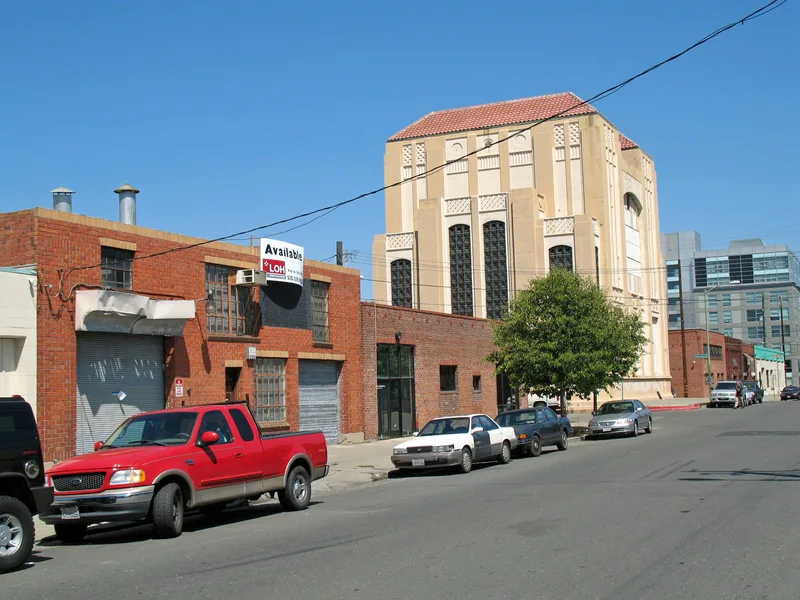
This 16-acre warehouse district in Oakland lies a few blocks northeast of the Port of Oakland's Inner Harbor, around 3rd, 4th and 5th Streets. It contains 24 contributing buildings and one contributing structure, the Posey Tube Oakland Portal. Most are one- to three-story brick, concrete and stucco warehouses with flat roofs, stepped parapets, industrial sash windows and truck doors. Fifteen of the contributing buildings date from 1917 to 1937, and the earliest warehouse, built in 1914 for the W.P. Fuller Paint Company, set the period of significance. Western Pacific Railroad's arrival in 1909 broke Southern Pacific's waterfront monopoly and drew businesses that built rail spurs and shipped goods across the western United States. Later warehouses, especially for wholesale grocers, sent packaged goods by water and helped broaden the port's cargo. Some buildings have been turned into offices and lofts, but the district keeps its overall character, and most of it appears as it did in 1954.
Significance in brief: The district is a cohesive group of utilitarian brick and concrete warehouses built to use the Western Pacific Railroad's 3rd Street tracks and the waterfront. The warehouses shipped goods by rail and water, which upgraded the Port of Oakland's cargo mix and aided the city's industrial development. Its period of significance starts with the 1914 W.P. Fuller Paint warehouse.
Machine-generated summary. This summary was generated by a language model from the official nomination document and has not been reviewed line by line by an editor. It may contain errors. Check the source document before relying on any detail. Source: nomination document (PDF) · National Archives catalog entry. NRHP reference 00000361, listed April 24, 2000. Summary generated October 2026 (model claude-sonnet-5-5, prompt v1.0-2026-10-29, confidence medium).
Key facts
| Address | Roughly bounded by I-880, Madison St., 2nd St., and Webster St., Oakland |
|---|---|
| County | Alameda County |
| Listed | April 24, 2000 |
| Reference number | 00000361 |
| Resource type | District |
| Period of significance | 1914-1954 |
| Architectural style | Other/Utilitarian; Late 19th and 20th Century Revivals/Beaux Arts; Modern Movement/Moderne; Modern Movement/Art Deco |
| Areas of significance | Industry, Architecture, Commerce |
| Level of significance | Local |
| Status (as stated in the nomination) | Some larger warehouses have been converted to offices and live-work lofts, while many industrial activities continue. Most of the district looks as it did in 1954. |
| Acreage | 16 |
| Coordinates | 37.79539, -122.27065 (NPS GIS) |
What listing means for this property
This is a historic district. Buildings within its boundary are either contributing (they add to the district's significance) or non-contributing. Owners of contributing income-producing buildings can claim the 20% federal rehabilitation tax credit; homeowners should look at state credits. National Register districts impose no design review by themselves; a local historic district ordinance, if one exists, does (the difference explained).
General information, not legal or tax advice. Rules change; confirm with your State Historic Preservation Office or a qualified adviser.
Sources and further reading
- National Park Service, National Register of Historic Places database (snapshot May 2026), reference 00000361.
- Nomination form (PDF, National Archives) — catalog entry
- Wikidata Q141631958
- This listing as JSON
Last updated October 2026. Found an error? See the editorial policy for how to report it.