Main Street Banking Historic District (Additional Documentation)
Also known as: Vdhr#127-6031

The pin is a point inside the NPS boundary polygon, not a surveyed location.
Why it's listed
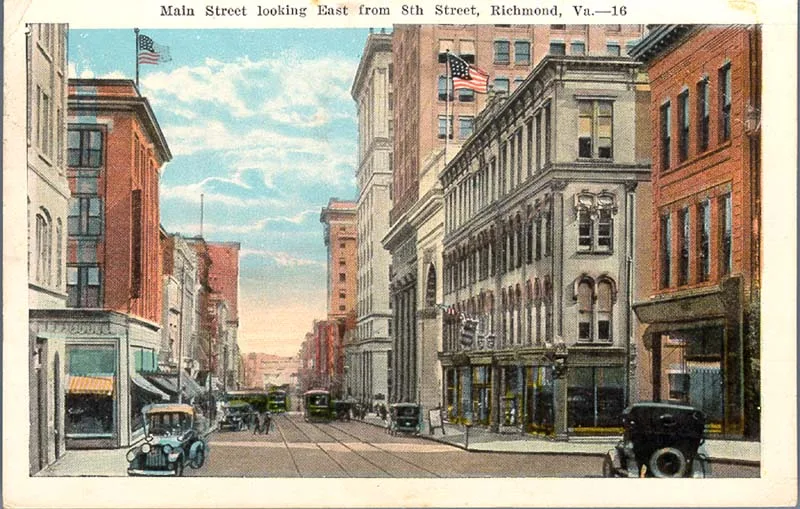
Five blocks of East Main Street in downtown Richmond, from 7th to 13th Streets, make up a historic district that has served as the city's banking center since 1817. The Evacuation Fire of 1865 destroyed nearly every antebellum building there except the 1858 Customs House, and the area was rebuilt soon afterward with Northern capital. The result is a dense group of brick, stone and cast-iron buildings. Italianate iron-front rows from the 1860s, including the Stearns Building and the Virginia Fire and Marine Insurance Company building, share the street with a Richardsonian Romanesque bank and early skyscrapers such as the nineteen-story First National Bank Building of 1912. Architects included Ammi Burnham Young, George H. Johnson, Charles H. Read and the firm Clinton & Russell. The district contains twenty-one contributing buildings, six of them already individually listed. Its significance rests on this architectural range and on its long role as Richmond's financial core, which continues today.
Significance in brief: The district holds a major collection of finely detailed brick and stone commercial buildings in styles including Italianate, Renaissance Revival, Beaux Arts, Classical Revival and Commercial, along with several of Richmond's earliest skyscrapers. It records the city's rebuilding as a banking center after the Civil War and its continued role as the financial core.
Machine-generated summary. This summary was generated by a language model from the official nomination document and has not been reviewed line by line by an editor. It may contain errors. Check the source document before relying on any detail. Source: nomination document (PDF) · National Archives catalog entry. NRHP reference 05000527, listed June 1, 2005. Summary generated October 2026 (model claude-sonnet-5-5, prompt v1.0-2026-10-29, confidence medium).
Key facts
| Address | 700 E Main St, 705-711 E Main St, 801 E Main St, 830-838 E Main St, Richmond |
|---|---|
| County | Richmond (city and county) |
| Listed | June 1, 2005 |
| Reference number | 05000527 |
| Resource type | District |
| Architect / builder | Ammi Burnham Young (Customs House); George H. Johnson; Charles H. Read; Clinton & Russell; Carl August Ruehrmund; Wyatt & Nolting; Alfred Charles Bossom; Charles M. Robinson; Mowbray & Uffinger |
| Architectural style | Late Victorian (Italianate, Renaissance Revival, Romanesque); Beaux Arts, Classical Revival; Commercial Style; Modern Movement (Art Deco, Post-Modern) |
| Areas of significance | Architecture, Commerce, Economics, Law |
| Level of significance | State, Local |
| Status (as stated in the nomination) | Financial institutions remain the dominant business in the area. The form lists current functions including hotel, financial institution, business, restaurant and government office, plus a vacant entry. The American National Bank Building was rehabilitated in 2003. |
| Acreage | 10 |
| Within district | James River and Kanawha Canal Historic District |
| Coordinates | 37.53845, -77.43629 (NPS GIS) |
What listing means for this property
This is a historic district. Buildings within its boundary are either contributing (they add to the district's significance) or non-contributing. Owners of contributing income-producing buildings can claim the 20% federal rehabilitation tax credit; homeowners should look at state credits. National Register districts impose no design review by themselves; a local historic district ordinance, if one exists, does (the difference explained).
General information, not legal or tax advice. Rules change; confirm with your State Historic Preservation Office or a qualified adviser.
Sources and further reading
- National Park Service, National Register of Historic Places database (snapshot May 2026), reference 05000527.
- Nomination form (PDF, National Archives) — catalog entry
- Wikipedia article (used for cross-checking only; text not reproduced here)
- Wikidata Q16894484
- This listing as JSON
Last updated October 2026. Found an error? See the editorial policy for how to report it.