Jackson Ward Historic District
Also known as: Jackson Ward; see also:Sixth Mount Zion Baptist Church

Why it's listed
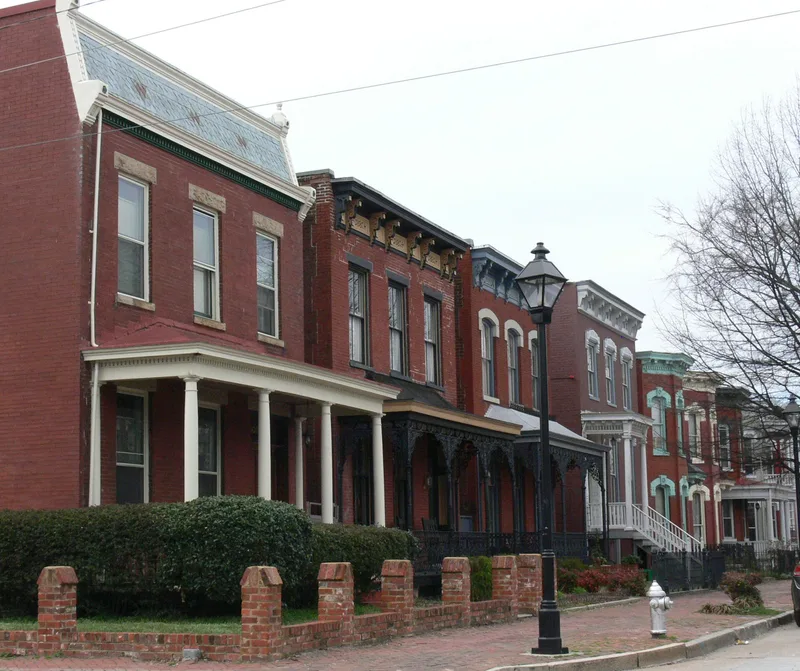
Jackson Ward is a compact neighborhood of about six hundred townhouses spread over forty-two blocks in central Richmond, Virginia. Ninety percent of the houses date from the nineteenth century, and about one hundred predate the Civil War. The streets hold Federal, Greek Revival, Italianate, Second Empire, Queen Anne and Eastlake dwellings, most built as middle-class housing in brick on narrow lots. Consistent scale, brick sidewalks laid in herringbone pattern and granite curbs unify the area. Clay Street, shaded by elms, contains one of the finest collections of ornamental cast iron in the country. Notable buildings include the 1863 Steamer Company No. 5 firehouse, the oldest remaining firehouse in Richmond, and the 1832 Dill House. Later documentation added the neighborhood's role in the civil rights era, naming law offices, medical offices, insurance companies, churches and homes linked to that movement. A high rate of resident ownership has helped keep the district stable.
Significance in brief: The district is a visually cohesive neighborhood containing nearly the full range of medium-size Richmond townhouse types from the early nineteenth to early twentieth century, including Federal, Greek Revival, Italianate, Second Empire, Queen Anne and Eastlake examples. Clay Street holds one of the finest collections of ornamental cast iron in the country. Additional documentation from 2002 extends the significance to the civil rights era, identifying buildings tied to Black business, professional and legal leadership.
Machine-generated summary. This summary was generated by a language model from the official nomination document and has not been reviewed line by line by an editor. It may contain errors. Check the source document before relying on any detail. Source: nomination document (PDF) · National Archives catalog entry. NRHP reference 76002187, listed July 30, 1976. Summary generated October 2026 (model claude-sonnet-5-5, prompt v1.0-2026-10-29, confidence medium).
Key facts
| Address | Roughly bounded by 5th, Marshall, and Gilmer Sts., and the Richmond-Petersburg Tpke., Richmond (Independent City) |
|---|---|
| County | Richmond (city and county) |
| Listed | July 30, 1976 |
| Reference number | 76002187 |
| Resource type | District |
| Architect / builder | Albert West (Hood Temple A.M.E. Zion Church); Addolph Dill (builder of the Dill Houses); Isaac Goddin (Taylor House); James M. Taylor (builder, 207-211 West Clay Street) |
| Architectural style | Federal, Greek Revival, Italianate, Second Empire, Queen Anne, Eastlake and Georgian Revival townhouses |
| Areas of significance | Commerce, Education, Black, Architecture, Politics/Government, Social History, Religion |
| Level of significance | National |
| National Historic Landmark | Yes, designated June 16, 1978 |
| Status (as stated in the nomination) | Condition is described as good and largely unaltered. Many houses are subdivided, resident ownership is unusually high, and the more dilapidated houses sit near the northern edge by the Turnpike. The district had no specific historic protection at the time of the nomination. |
| Acreage | 130 |
| Within district | James River and Kanawha Canal Historic District |
| Coordinates | 37.54867, -77.43966 (NPS GIS) |
What listing means for this property
This is a historic district. Buildings within its boundary are either contributing (they add to the district's significance) or non-contributing. Owners of contributing income-producing buildings can claim the 20% federal rehabilitation tax credit; homeowners should look at state credits. National Register districts impose no design review by themselves; a local historic district ordinance, if one exists, does (the difference explained).
General information, not legal or tax advice. Rules change; confirm with your State Historic Preservation Office or a qualified adviser.
Sources and further reading
- National Park Service, National Register of Historic Places database (snapshot May 2026), reference 76002187.
- Nomination form (PDF, National Archives) — catalog entry
- Wikipedia article (used for cross-checking only; text not reproduced here)
- Wikidata Q6117793
- This listing as JSON
Last updated October 2026. Found an error? See the editorial policy for how to report it.