First Battalion Virginia Volunteers Armory
Also known as: Leigh Street Armory; Monroe School, Monroe Center; VDHR No. 127-5676

Why it's listed
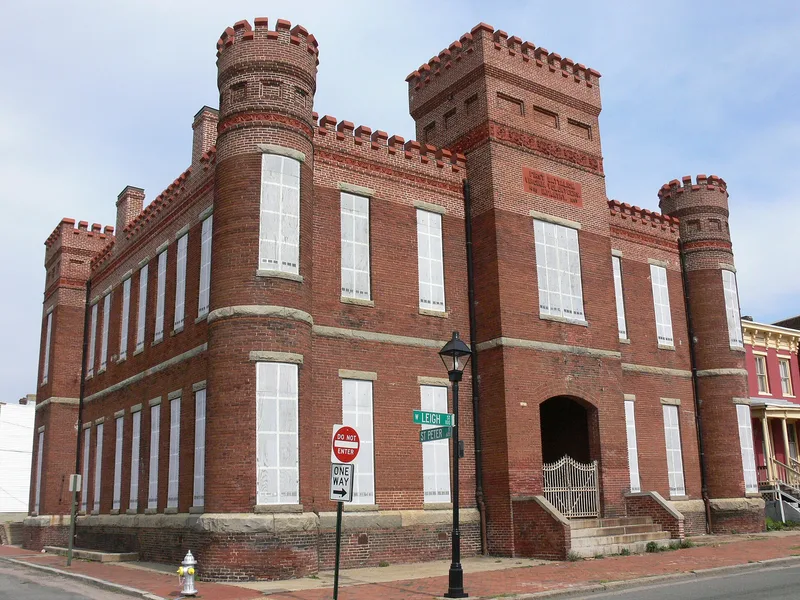
Built in 1895 at 122 West Leigh Street in Richmond's Jackson Ward, this brick armory was designed in the office of City Engineer Wilfred Cutshaw for the First Battalion Virginia Volunteers, a Black militia unit. Its four towers, terra cotta crenellations and granite trim give it the look of a fortress. The city contributed $10,000 toward construction, and the brickwork contract went to Armistead Walker, a Black mason. The militia was disbanded in 1899, and the building became Monroe School, an elementary school for Black children that operated for about forty years. During World War II it served as a reception center for African American servicemen, and later it housed a Black history museum. The nomination calls it the oldest armory in Virginia and the only 19th-century Black militia armory still standing in the country. A fire and later decay destroyed most of the interior, but the exterior remains largely intact after stabilization and demolition of a 1940s gymnasium addition.
Significance in brief: The nomination argues it is the oldest armory still standing in Virginia and the only one known to have been built for a Black militia unit in the state. It is also described as the oldest of three identified African American armories in the country. It later served as a school and as a World War II reception center for Black servicemen, and it is a surviving example of the castellated armory design.
Machine-generated summary. This summary was generated by a language model from the official nomination document and has not been reviewed line by line by an editor. It may contain errors. Check the source document before relying on any detail. Source: nomination document (PDF) · National Archives catalog entry. NRHP reference 09001158, listed December 23, 2009. Summary generated October 2026 (model claude-sonnet-5-5, prompt v1.0-2026-10-29, confidence high).
Key facts
| Address | 122 W. Leigh St., Richmond |
|---|---|
| County | Richmond (city and county) |
| Listed | December 23, 2009 |
| Reference number | 09001158 |
| Resource type | Building |
| Period of significance | 1895-1945 |
| Architect / builder | Cutshaw, Wilfred Emory |
| Architectural style | Late Victorian |
| Criteria |
|
| Areas of significance | Black, Architecture |
| Level of significance | Local |
| Status (as stated in the nomination) | Listed as vacant and not in use. The interior was lost to fire and rot, and the building has been stabilized with a temporary roof, plywood floors and plywood-covered window openings. |
| Acreage | 0.9 |
| Within district | James River and Kanawha Canal Historic District |
| Coordinates | 37.55008, -77.44138 (NPS GIS) |
What listing means for this property
For a publicly owned building or structure, listing mainly matters when federal funds, permits or licences are involved: projects then go through Section 106 review so effects on the property are considered. Listing also strengthens applications for preservation grants and, for leased income-producing uses, can enable the federal rehabilitation tax credit.
Noted as vacant in the nomination. Nomination documents can be decades old; current status may differ. If you are considering buying an empty listed property, read the due-diligence checklist.
General information, not legal or tax advice. Rules change; confirm with your State Historic Preservation Office or a qualified adviser.
Sources and further reading
- National Park Service, National Register of Historic Places database (snapshot May 2026), reference 09001158.
- Nomination form (PDF, National Archives) — catalog entry
- Wikipedia article (used for cross-checking only; text not reproduced here)
- Wikidata Q16836914
- This listing as JSON
Last updated October 2026. Found an error? See the editorial policy for how to report it.