Broad Street Commercial Historic District (Boundary Increase II)
Also known as: Vdhr #127-0375
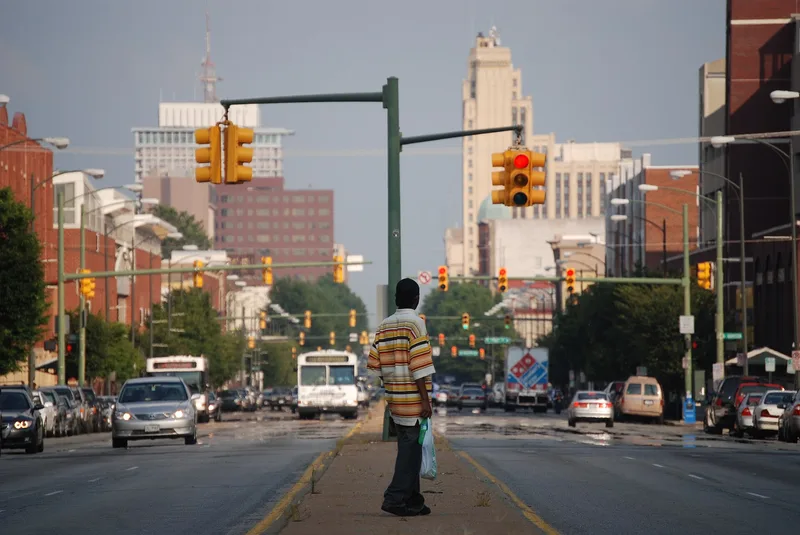

Why it's listed
This boundary increase extends Richmond's Broad Street Commercial Historic District north into two half-blocks bounded by Marshall, First and Second Streets. It holds eight contributing buildings and one non-contributing building, mostly two-story brick structures with storefronts, decorative cornices and revival or vernacular commercial detailing. Maps and directories show the area was largely residential with a few small businesses in 1895 and 1905. Commercial uses then spread, and by 1924 the change from houses to businesses south of Marshall Street was complete. Shops included a bicycle repair shop, an auto garage, billiard parlors, a restaurant and specialty stores, though they were less stylish than those on Broad and Grace Streets. One surviving dwelling at 313 North 2nd Street, with a later storefront addition, recalls the earlier neighborhood. Architects represented include Henry T. Barnham, Luther T. Bengston and Davis Brothers. The demolished St. Luke Penny Savings Bank, designed by Charles Thaddeus Russell, is also part of the area's story. The period of significance runs from 1900 to 1925.
Significance in brief: The area illustrates how mid-nineteenth century residential neighborhoods in Richmond were converted to commercial use as the central business district grew in the early twentieth century. It also embodies late-nineteenth and early-twentieth century revival and vernacular commercial architecture. It includes work by several local and regional architects.
Machine-generated summary. This summary was generated by a language model from the official nomination document and has not been reviewed line by line by an editor. It may contain errors. Check the source document before relying on any detail. Source: nomination document (PDF) · National Archives catalog entry. NRHP reference 07000219, listed March 27, 2007. Summary generated October 2026 (model claude-sonnet-5-5, prompt v1.0-2026-10-29, confidence high).
Key facts
| Address | 100 Blk of E. Marshall St., S side. 300 Blks 1st and 2nd Sts. bet. Broad and Marshall Sts., Richmond (Independent City) |
|---|---|
| County | Richmond (city and county) |
| Listed | March 27, 2007 |
| Reference number | 07000219 |
| Resource type | District |
| Period of significance | 1900-1925 |
| Architect / builder | L.T. Bengston, Marcellus & Wright, Henry T. Barnham, Charles Thaddeus Russell |
| Architectural style | Commercial; Late 19th and 20th Century Revivals |
| Criteria |
|
| Areas of significance | Architecture, Community Planning and Development, Commerce |
| Level of significance | Local |
| Status (as stated in the nomination) | Current functions include multiple dwelling, business, specialty store, restaurant, convenience store and professional uses. The St. Luke Penny Savings Bank and a Marcellus Wright store once stood in the area and have been demolished. |
| Acreage | 2 |
| Within district | James River and Kanawha Canal Historic District |
| Coordinates | 37.54722, -77.43951 (NPS GIS) |
What listing means for this property
This is a historic district. Buildings within its boundary are either contributing (they add to the district's significance) or non-contributing. Owners of contributing income-producing buildings can claim the 20% federal rehabilitation tax credit; homeowners should look at state credits. National Register districts impose no design review by themselves; a local historic district ordinance, if one exists, does (the difference explained).
General information, not legal or tax advice. Rules change; confirm with your State Historic Preservation Office or a qualified adviser.
Sources and further reading
- National Park Service, National Register of Historic Places database (snapshot May 2026), reference 07000219.
- Nomination form (PDF, National Archives) — catalog entry
- Wikipedia article (used for cross-checking only; text not reproduced here)
- Wikidata Q138909162
- This listing as JSON
Last updated October 2026. Found an error? See the editorial policy for how to report it.