Battersea
Also known as: VDHR File # 123-0059

Why it's listed
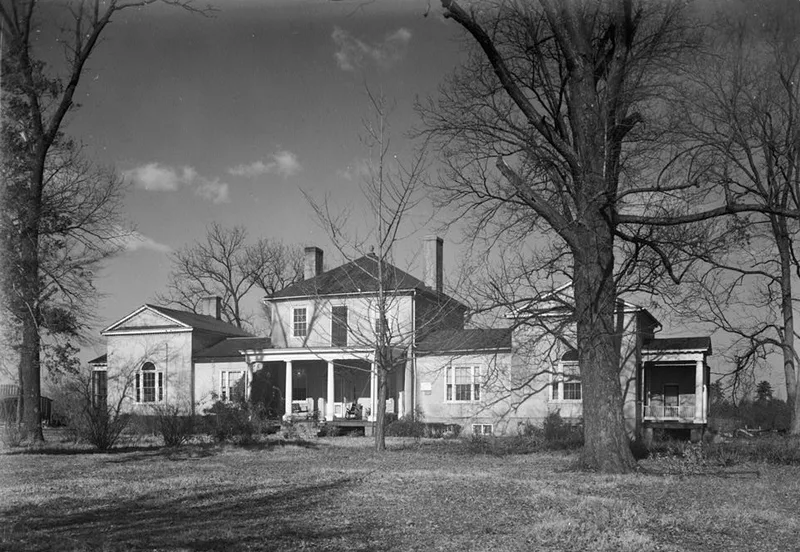
Battersea is a brick mansion on Appomattox Street in Petersburg, Virginia, built around 1765-1770 for Colonel John Banister. Banister served in the House of Burgesses, the State Assembly and the Continental Congress, and became Petersburg's first mayor. He was also a close friend of Thomas Jefferson. The house follows a five-part Palladian plan, with a two-story central block under a pyramidal roof topped by a carved pineapple, one-story hyphens, and pedimented end pavilions. Early-nineteenth-century changes added stucco over the Flemish bond brickwork, Palladian windows in the pavilions, three-part windows in the hyphens and a fan-and-sidelight entrance. These gave the house an Italianate feeling but did not alter its basic design. Strong circumstantial evidence suggests Jefferson designed it, though this has never been confirmed. Inside, the entrance hall keeps its original paneling and a Chinese trellis stair regarded as the finest of its type in Virginia. A French visitor in 1781 praised the house and its three porticoes.
Significance in brief: The nomination calls Battersea one of the finest Palladian houses in Virginia, despite early-nineteenth-century alterations that gave it an Italianate feeling. There is strong circumstantial evidence that Thomas Jefferson designed it, though this was never confirmed. It was built for Banister, a Revolutionary-era political figure and Petersburg's first mayor, and it has a Chinese trellis stair considered the finest of its type in Virginia.
Machine-generated summary. This summary was generated by a language model from the official nomination document and has not been reviewed line by line by an editor. It may contain errors. Check the source document before relying on any detail. Source: nomination document (PDF) · National Archives catalog entry. NRHP reference 69000344, listed November 12, 1969. Summary generated October 2026 (model claude-sonnet-5-5, prompt v1.0-2026-10-29, confidence medium).
Key facts
| Address | 1289 Upper Appomattox St., Petersburg (Independent City) |
|---|---|
| County | Petersburg |
| Listed | November 12, 1969 |
| Reference number | 69000344 |
| Resource type | Building |
| Architect / builder | Possibly designed by Thomas Jefferson (circumstantial evidence only, not authenticated); built for Colonel John Banister |
| Architectural style | Palladian |
| Areas of significance | Architecture, Politics/Government, Military, Historic - Aboriginal, Historic - Non-Aboriginal, Social History |
| Level of significance | National, State, Local |
| Status (as stated in the nomination) | The 1969 form rates condition as fair and integrity as altered, with the property in use as a private residence. A later registration form lists the main house, kitchen and greenhouse as work in progress/vacant. |
| Acreage | 35 |
| Coordinates | 37.22543, -77.42851 (NPS GIS) |
What listing means for this property
National Register listing is honorary: it recognises significance and does not restrict what a private owner may do without federal money or permits. It unlocks the 20% federal rehabilitation tax credit for income-producing buildings, state credits in many states, and Section 106 review when federal agencies are involved. See what listing means in practice.
General information, not legal or tax advice. Rules change; confirm with your State Historic Preservation Office or a qualified adviser.
Sources and further reading
- National Park Service, National Register of Historic Places database (snapshot May 2026), reference 69000344.
- Nomination form (PDF, National Archives) — catalog entry
- Wikipedia article (used for cross-checking only; text not reproduced here)
- Wikidata Q16165317
- This listing as JSON
Last updated October 2026. Found an error? See the editorial policy for how to report it.