Newsome, J. Thomas, House
Also known as: Dhr 121-52

Why it's listed
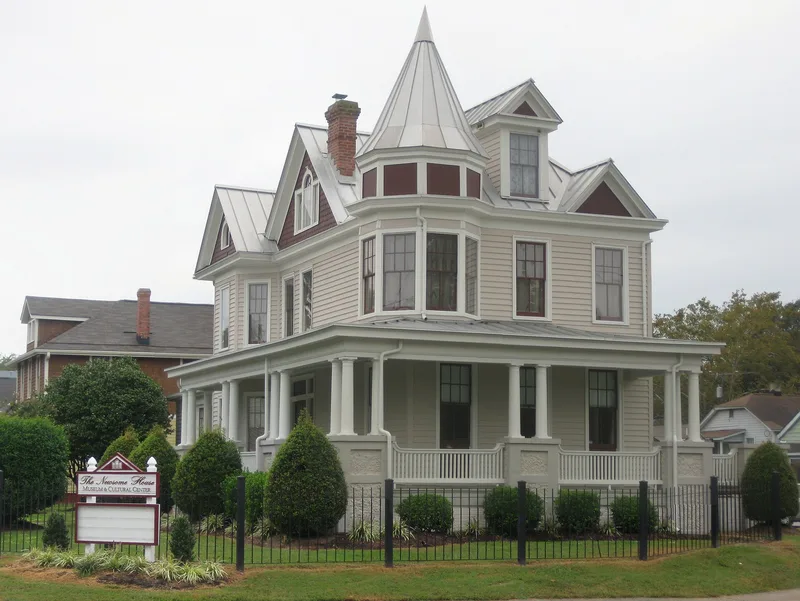
This 1898 frame house at 2803 Oak Avenue in Newport News, Virginia, is a two-and-one-half-story Queen Anne residence with a steeply pitched, irregular roof, a polygonal corner tower, a Palladian window and a wraparound porch on stuccoed brick piers. Inside, spindle latticework and fluted columns frame the openings off the central passage, and a one-story wing holds the kitchen and sun porch. It was listed because of J. Thomas Newsome, who lived here from 1906 until his death in 1942. A black attorney and journalist, he became the first black attorney approved to argue before the Supreme Court of Appeals of Virginia, helped found Trinity Baptist Church, promoted Huntington High School, organized the Colored Voters League of Warwick County and edited the Newport News Star. The house had stood vacant for about six years and was damaged, though it kept its design and setting. A local group planned to turn it into a community center and museum of black history in Newport News.
Significance in brief: The house was the home from 1906 until 1942 of J. Thomas Newsome, a black attorney and journalist who became the first black attorney approved to argue before the Supreme Court of Appeals of Virginia. He was a leader of the Newport News black community through law, church, school advocacy, politics and newspaper editing. The nomination lists it under Ethnic Heritage: Black, with local significance.
Machine-generated summary. This summary was generated by a language model from the official nomination document and has not been reviewed line by line by an editor. It may contain errors. Check the source document before relying on any detail. Source: nomination document (PDF) · National Archives catalog entry. NRHP reference 90001831, listed December 19, 1990. Summary generated October 2026 (model claude-sonnet-5-5, prompt v1.0-2026-10-29, confidence high).
Key facts
| Address | 2803 Oak Ave., Newport News (Independent City) |
|---|---|
| County | Newport News |
| Listed | December 19, 1990 |
| Reference number | 90001831 |
| Resource type | Building |
| Period of significance | 1906-1939 |
| Architectural style | Late Victorian: Queen Anne |
| Criteria |
|
| Areas of significance | Black |
| Level of significance | Local |
| Status (as stated in the nomination) | Vacant and not in use for about six years, with windows and doors boarded up and some deterioration; a nonprofit group planned to acquire it for a community center and history museum. |
| Acreage | 0.3 |
| Coordinates | 36.98999, -76.40473 (NPS GIS) |
What listing means for this property
National Register listing is honorary for a privately owned home: it does not by itself restrict what an owner may do with their own money, and it does not require public access. Restrictions come from local landmark or historic-district ordinances, which are separate (how they differ).
Owner-occupied houses are not eligible for the 20% federal rehabilitation tax credit, which applies to income-producing buildings, but many states offer credits for homeowners. Listing also opens the door to preservation easements and to buying a plaque. Start with what listing means for homeowners, renovating a listed house and selling one.
Noted as vacant in the nomination. Nomination documents can be decades old; current status may differ. If you are considering buying an empty listed property, read the due-diligence checklist.
General information, not legal or tax advice. Rules change; confirm with your State Historic Preservation Office or a qualified adviser.
Sources and further reading
- National Park Service, National Register of Historic Places database (snapshot May 2026), reference 90001831.
- Nomination form (PDF, National Archives) — catalog entry
- Wikipedia article (used for cross-checking only; text not reproduced here)
- Wikidata Q16895849
- This listing as JSON
Last updated October 2026. Found an error? See the editorial policy for how to report it.