Lower Basin Historic District
Also known as: See Also:Wood, J. W., Building

Why it's listed
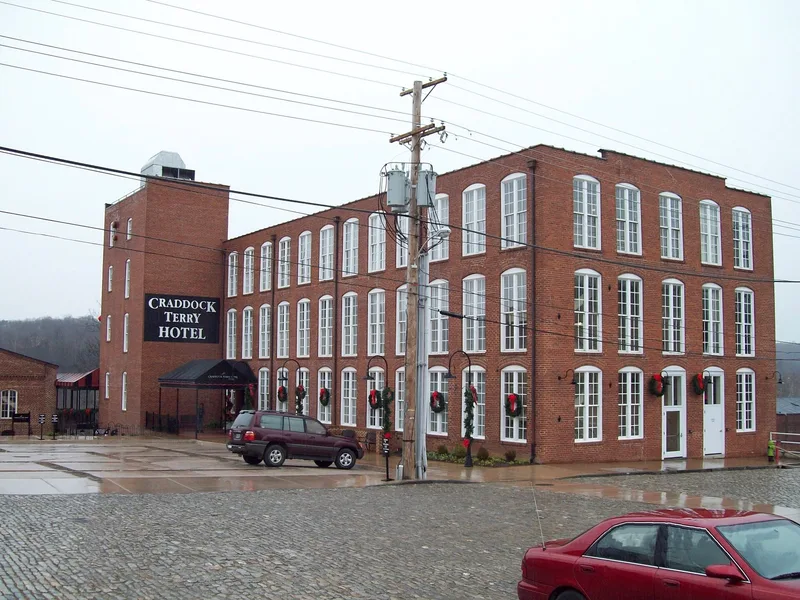
Lynchburg's Lower Basin Historic District is a warehouse and factory area lying between the downtown commercial core and the James River. It takes its name from a widened section of the James River and Kanawha Canal that once ran between Ninth Street and Horseford Road. The district includes 60 contributing buildings, a concrete viaduct, a stone bridge and a monument marking the site of Lynch's Ferry. Most buildings are multi-story brick warehouses, factories and commercial blocks from the late 19th and early 20th centuries. Notable examples include the Norfolk and Western and Chesapeake and Ohio freight depots, the Piedmont Flour Mills, the Craddock-Terry Shoe building and rows of buildings on Commerce Street. The 1839 Ninth Street Bridge is the oldest surviving structure, and the 1,600-foot Williams Viaduct dates from 1916-1918. The area grew with the canal, then the railroads, and became a jobbing and manufacturing center that served southern markets. Its brick buildings document that commercial and industrial history.
Significance in brief: The district reflects the commercial and industrial life of the Lynchburg waterfront, from the James River and Kanawha Canal and railroads to the city's growth as a jobbing and manufacturing center. It preserves rows of brick warehouses, railroad freight depots, the Williams Viaduct and the 1839 Ninth Street Bridge. Criteria and the full statement of significance are not legible in the truncated text.
Machine-generated summary. This summary was generated by a language model from the official nomination document and has not been reviewed line by line by an editor. It may contain errors. Check the source document before relying on any detail. Source: nomination document (PDF) · National Archives catalog entry. NRHP reference 87000601, listed April 24, 1987. Summary generated October 2026 (model claude-sonnet-5-5, prompt v1.0-2026-10-29, confidence medium).
Key facts
| Address | 700--1300 blks. of Jefferson St., 600--1300 blks. of Commerce St., and 1200--1300 Blks. of Main St., Lynchburg (Independent City) |
|---|---|
| County | Lynchburg |
| Listed | April 24, 1987 |
| Reference number | 87000601 |
| Resource type | District |
| Architect / builder | J. S. King (Ninth Street Bridge, 1839); B. H. Davis (Williams Viaduct); Wilson and Seay (Craddock-Terry Shoe building) |
| Architectural style | Late 19th- and early 20th-century commercial and industrial; Greek Revival, Italianate, Victorian Commercial, Romanesque Revival and Neoclassical examples |
| Areas of significance | Industry, Commerce, Architecture |
| Level of significance | State |
| Status (as stated in the nomination) | Condition is mixed (good, fair, deteriorated, altered). Buildings are both occupied and unoccupied, and Piedmont Mills is still in operation. |
| Acreage | 52 |
| Coordinates | 37.41444, -79.13898 (NPS GIS) |
What listing means for this property
This is a historic district. Buildings within its boundary are either contributing (they add to the district's significance) or non-contributing. Owners of contributing income-producing buildings can claim the 20% federal rehabilitation tax credit; homeowners should look at state credits. National Register districts impose no design review by themselves; a local historic district ordinance, if one exists, does (the difference explained).
General information, not legal or tax advice. Rules change; confirm with your State Historic Preservation Office or a qualified adviser.
Sources and further reading
- National Park Service, National Register of Historic Places database (snapshot May 2026), reference 87000601.
- Nomination form (PDF, National Archives) — catalog entry
- Wikipedia article (used for cross-checking only; text not reproduced here)
- Wikidata Q6693314
- This listing as JSON
Last updated October 2026. Found an error? See the editorial policy for how to report it.