Birch House

Approximate location: the National Park Service places this pin arbitrarily within the property, not at a surveyed point (stated accuracy ±12 m).
Why it's listed
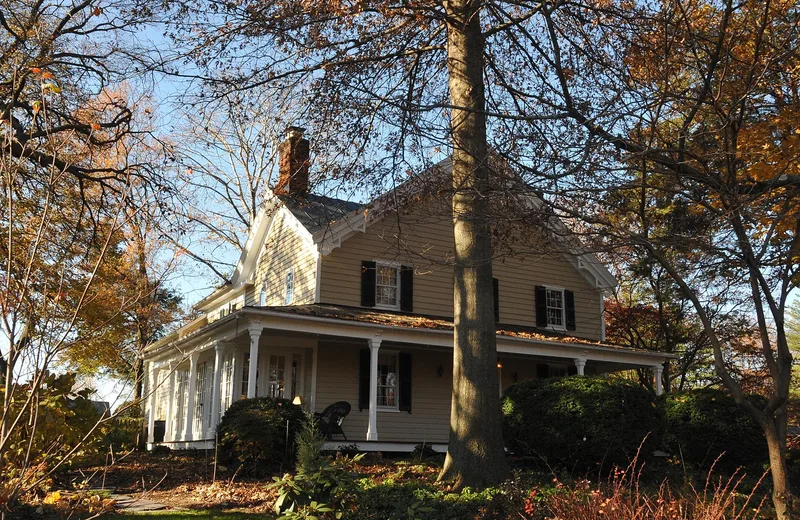
Birch House, at 312 East Broad Street in Falls Church, Virginia, began as a simple one-and-one-half story Greek Revival dwelling standing before 1845. Joseph Edward Birch, a blacksmith and farmer, acquired the property in 1849. The roof was raised to give a full second story, and about 1873 the house was extended across the rear under a new roof, roughly doubling its space. Outbuildings once included a detached kitchen, a smokehouse, a bank barn and a blacksmith shop. Birch and his descendants lived there for over a century. He helped bring about the incorporation of Falls Church as a town in 1875, served on its first council, helped found Jefferson School across the turnpike, and aided in establishing Oakwood Cemetery. His house sheltered many early Jefferson teachers. The nomination also describes the house as the visual centerpiece of a block of five 19th-century houses, and notes the covenants that protect the property.
Significance in brief: The nomination argues the Birch family took a leading part in Falls Church life for over a century. Joseph E. Birch helped incorporate the town, served on its first council, and helped found Jefferson School and Oakwood Cemetery. The house is also presented as the centerpiece of a well-preserved block of five 19th-century houses along the old turnpike.
Machine-generated summary. This summary was generated by a language model from the official nomination document and has not been reviewed line by line by an editor. It may contain errors. Check the source document before relying on any detail. Source: nomination document (PDF) · National Archives catalog entry. NRHP reference 77001534, listed October 26, 1977. Summary generated October 2026 (model claude-sonnet-5-5, prompt v1.0-2026-10-29, confidence medium).
Key facts
| Address | 312 E. Broad St., Falls Church (Independent City) |
|---|---|
| County | Falls Church |
| Listed | October 26, 1977 |
| Reference number | 77001534 |
| Resource type | Building |
| Architect / builder | Uncertain |
| Architectural style | Greek Revival |
| Areas of significance | Historic - Non-Aboriginal, Education, Architecture |
| Level of significance | State |
| Status (as stated in the nomination) | Owned by Historic Falls Church, Inc.; listed as a private residence, unoccupied or in restoration, with restoration and development of the adjacent ground planned. Condition marked fair. |
| Acreage | 1 |
| Coordinates | 38.87934, -77.16708 (NPS GIS) |
What listing means for this property
National Register listing is honorary for a privately owned home: it does not by itself restrict what an owner may do with their own money, and it does not require public access. Restrictions come from local landmark or historic-district ordinances, which are separate (how they differ).
Owner-occupied houses are not eligible for the 20% federal rehabilitation tax credit, which applies to income-producing buildings, but many states offer credits for homeowners. Listing also opens the door to preservation easements and to buying a plaque. Start with what listing means for homeowners, renovating a listed house and selling one.
General information, not legal or tax advice. Rules change; confirm with your State Historic Preservation Office or a qualified adviser.
Sources and further reading
- National Park Service, National Register of Historic Places database (snapshot May 2026), reference 77001534.
- Nomination form (PDF, National Archives) — catalog entry
- Wikipedia article (used for cross-checking only; text not reproduced here)
- Wikidata Q15199372
- This listing as JSON
Last updated October 2026. Found an error? See the editorial policy for how to report it.