Downtown Danville Historic District
Also known as: VDHR File No.l 108-11; See Also:Hotel Danville; Danville Munic

Why it's listed
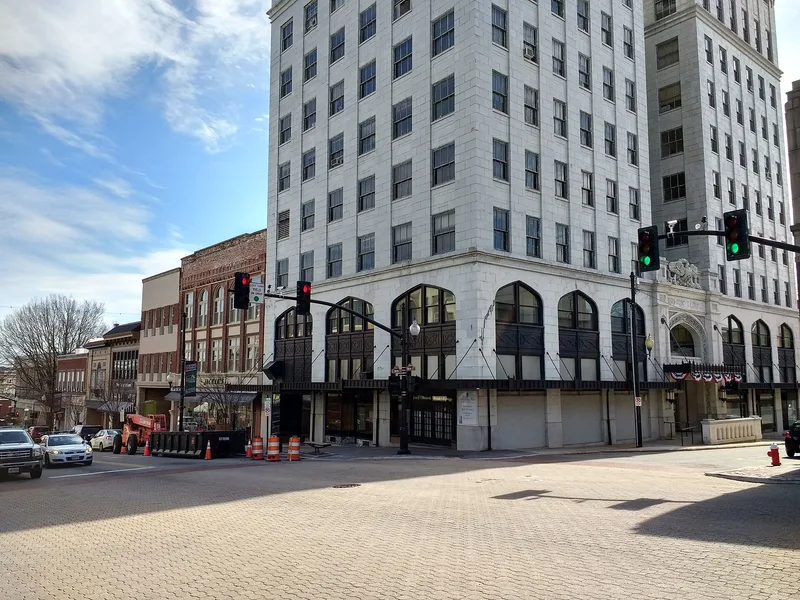
Downtown Danville's historic core is a district of 74 resources along Main Street and neighboring streets, with two additional buildings already individually listed, the Hotel Danville and the Municipal Building. Most buildings are two or more stories of load-bearing masonry, built from the 1870s through the early 1940s. They record the prosperity that tobacco and textiles brought to the city after the Civil War. The Pace Building of 1875 is likely the oldest commercial building, and later structures show Romanesque Revival, Neoclassical, Colonial Revival, Art Deco and other styles. Terra cotta is a notable material, seen on the 1927 Hotel Danville, the 1921 Rorer Memorial Building and the 1922 Masonic Building. Tobacco and textile factories, fraternal halls, a post office and a municipal building add variety, and the district also includes sites tied to Black commercial history, such as the Southern Aid Building. The district was listed for its architecture and its role in the city's commerce, government, industry and social life.
Significance in brief: The district reflects Danville's tobacco- and textile-based prosperity in the decades after the Civil War. It is cited for its architecture, from Romanesque Revival government buildings to 1920s terra-cotta-clad skyscrapers, and for its associations with commerce, government, industry, social history and Black ethnic heritage.
Machine-generated summary. This summary was generated by a language model from the official nomination document and has not been reviewed line by line by an editor. It may contain errors. Check the source document before relying on any detail. Source: nomination document (PDF). NRHP reference 93000830, listed August 12, 1993. Summary generated October 2026 (model claude-sonnet-5-5, prompt v1.0-2026-10-29, confidence medium).
Key facts
| Address | Roughly bounded by Memorial Dr. and High, Patton and Ridge Sts., Danville (Independent City) |
|---|---|
| County | Danville |
| Listed | August 12, 1993 |
| Reference number | 93000830 |
| Resource type | District |
| Period of significance | 1875-1943 |
| Architect / builder | Many, including K. Anderson, P. L. Anderson, William M. Poindexter, Charles G. Pettit, Jr., J. Bryant Heard, Deitrick & Pearson, Fuqua Construction Co., Thomas B. Fitzgerald, Charles Orchard, and others |
| Architectural style | Romanesque Revival, Late Gothic Revival, Tudor Revival, Neoclassical, Colonial Revival, Georgian Revival, Craftsman, Mission, Art Deco, Moderne, Modern, No Style |
| Criteria |
|
| Areas of significance | Architecture, Social History, Politics/Government, Black, Industry, Commerce |
| Level of significance | State |
| Status (as stated in the nomination) | Many buildings retain historic cornices, upper-story windows and decorative finishes. 48 are contributing and 26 are noncontributing; some uses continue as stores, offices, government buildings and apartments. |
| Acreage | 25 |
| Coordinates | 36.58672, -79.39360 (NPS GIS) |
What listing means for this property
This is a historic district. Buildings within its boundary are either contributing (they add to the district's significance) or non-contributing. Owners of contributing income-producing buildings can claim the 20% federal rehabilitation tax credit; homeowners should look at state credits. National Register districts impose no design review by themselves; a local historic district ordinance, if one exists, does (the difference explained).
General information, not legal or tax advice. Rules change; confirm with your State Historic Preservation Office or a qualified adviser.
Sources and further reading
- National Park Service, National Register of Historic Places database (snapshot May 2026), reference 93000830.
- Nomination form (PDF, National Archives)
- Wikipedia article (used for cross-checking only; text not reproduced here)
- Wikidata Q15214951
- This listing as JSON
Last updated October 2026. Found an error? See the editorial policy for how to report it.