Danville Tobacco Warehouse and Residential District

Why it's listed
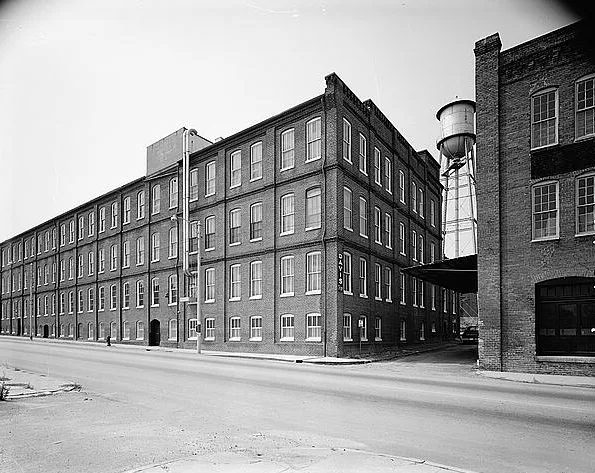
Danville's tobacco warehouse and residential district covers about 260 acres on the south bank of the Dan River in Virginia. Roughly 585 structures remain, among them some 37 tobacco factories, prizeries, auction warehouses and storage buildings put up between 1870 and 1930. Most are three- to five-story brick buildings with repeated window openings and stepped fire walls, and the larger turn-of-the-century complexes have patterned brick cornices. The district also holds the 1899 Southern Railway Passenger Station by Frank P. Milburn, small commercial blocks on Craghead and Lynn Streets, a 1927 neo-classical Municipal Building, and Riverside Cotton Mill No. 1 of 1882. North of Jefferson Street, modest frame houses built between 1880 and 1910 housed railroad, tobacco and mill workers, both black and white. The area matters because it shows how Danville grew as the home of the auction "Danville System" for loose-leaf tobacco and then as a textile center. A 1978 survey also recorded its earlier Native American and colonial land use.
Significance in brief: The district documents Danville's development as a major tobacco market and manufacturing center and its later textile growth. A 1978 Historic American Engineering Record survey found significant architectural, historic and archeological resources. The housing shows how workers in the tobacco, rail and mill trades lived between 1880 and 1910.
Machine-generated summary. This summary was generated by a language model from the official nomination document and has not been reviewed line by line by an editor. It may contain errors. Check the source document before relying on any detail. Source: nomination document (PDF) · National Archives catalog entry. NRHP reference 82004552, listed July 14, 1982. Summary generated October 2026 (model claude-sonnet-5-5, prompt v1.0-2026-10-29, confidence medium).
Key facts
| Address | Off U.S. 58, Danville (Independent City) |
|---|---|
| County | Danville |
| Listed | July 14, 1982 |
| Reference number | 82004552 |
| Resource type | District |
| Architect / builder | Frank P. Milburn (Southern Railway Passenger Station, 1899); T. B. Fitzgerald (Riverside Cotton Mill No. 1, 1882) |
| Architectural style | Late 19th century industrial design; neo-classical municipal buildings; frame worker dwellings |
| Areas of significance | Industry, Prehistoric, Commerce, Transportation, Architecture, Social History |
| Level of significance | State |
| Status (as stated in the nomination) | Condition is marked excellent, good or fair and altered; the district is occupied, with mixed commercial, industrial, educational and residential uses. |
| Acreage | 260 |
| Coordinates | 36.58351, -79.38809 (NPS GIS) |
What listing means for this property
This is a historic district. Buildings within its boundary are either contributing (they add to the district's significance) or non-contributing. Owners of contributing income-producing buildings can claim the 20% federal rehabilitation tax credit; homeowners should look at state credits. National Register districts impose no design review by themselves; a local historic district ordinance, if one exists, does (the difference explained).
General information, not legal or tax advice. Rules change; confirm with your State Historic Preservation Office or a qualified adviser.
Sources and further reading
- National Park Service, National Register of Historic Places database (snapshot May 2026), reference 82004552.
- Nomination form (PDF, National Archives) — catalog entry
- Wikipedia article (used for cross-checking only; text not reproduced here)
- Wikidata Q15212779
- This listing as JSON
Last updated October 2026. Found an error? See the editorial policy for how to report it.