Rapidan Historic District
Also known as: See also:Waddell Memorial Presbyterian Church

Why it's listed
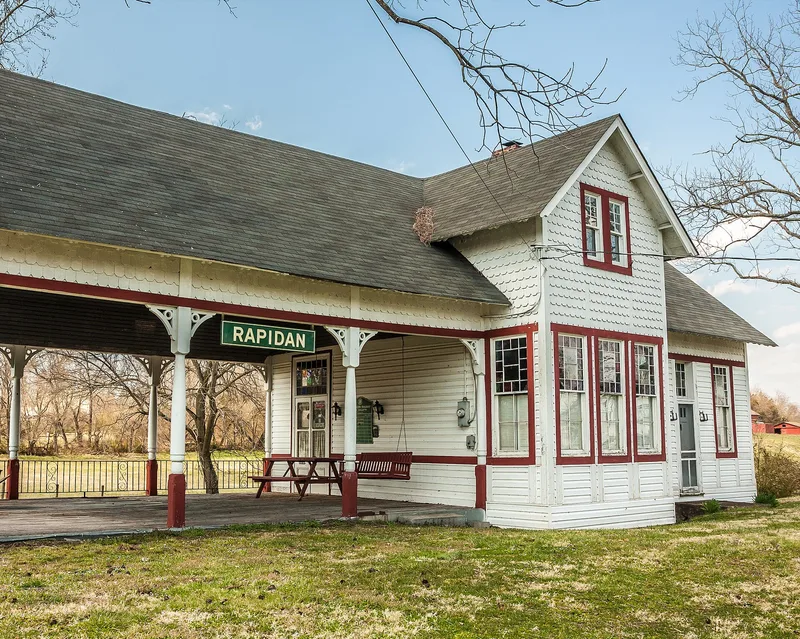
Rapidan is a small crossroads village on both sides of the Rapidan River, in Culpeper and Orange Counties, Virginia. Its historic district takes in 38 buildings: churches, a post office, stores, a meeting hall, two railroad depots, houses and outbuildings. The settlement began in the late 18th century as Waugh's Ford, with a grist mill built around 1772. The Orange and Alexandria Railroad arrived in 1854 and turned the village into a shipping point for lumber and wood products. Several Civil War raids destroyed the mill and most of the buildings. Most of what survives dates from the late 19th and early 20th centuries and ranges from simple frame dwellings to Italianate and Queen Anne houses. Local builder George Q. Peyton built many of them, including most of the houses on Gospel Hill. The two Carpenter Gothic churches of 1874 are the best-known buildings, one designed by Richmond architect J. B. Danforth. Together the buildings preserve the look of a railroad and milling town.
Significance in brief: The district is presented as a well-preserved Virginia Piedmont crossroads and railroad town of the late 19th and early 20th centuries. It grew from an 18th-century milling community into a regional shipping point for lumber after the Orange and Alexandria Railroad arrived in 1854. Its two 1874 Carpenter Gothic churches, Waddell Memorial Presbyterian and Emmanuel Episcopal, are singled out as especially significant.
Machine-generated summary. This summary was generated by a language model from the official nomination document and has not been reviewed line by line by an editor. It may contain errors. Check the source document before relying on any detail. Source: nomination document (PDF) · National Archives catalog entry. NRHP reference 87000723, listed May 8, 1987. Summary generated October 2026 (model claude-sonnet-5-5, prompt v1.0-2026-10-29, confidence medium).
Key facts
| Address | Jct. of VA 614, VA 615, and VA 673, Rapidan |
|---|---|
| County | Culpeper County |
| Listed | May 8, 1987 |
| Reference number | 87000723 |
| Resource type | District |
| Period of significance | Late 18th century to 1920s (1700-1799, 1800-1899, 1900-1920s) |
| Architect / builder | J. B. Danforth, George Q. Peyton |
| Architectural style | Carpenter Gothic, Italianate, Queen Anne, Colonial Revival and Victorian vernacular |
| Areas of significance | Industry, Transportation, Architecture |
| Level of significance | State |
| Status (as stated in the nomination) | Thirty-five of the 38 buildings are contributing and three are noncontributing. Most buildings are in use, though some, such as Annandale and the Tipton-Poole House, are unoccupied. The district is described as having very few modern intrusions. |
| Acreage | 182 |
| Coordinates | 38.30887, -78.06909 (NPS GIS) |
What listing means for this property
This is a historic district. Buildings within its boundary are either contributing (they add to the district's significance) or non-contributing. Owners of contributing income-producing buildings can claim the 20% federal rehabilitation tax credit; homeowners should look at state credits. National Register districts impose no design review by themselves; a local historic district ordinance, if one exists, does (the difference explained).
General information, not legal or tax advice. Rules change; confirm with your State Historic Preservation Office or a qualified adviser.
Sources and further reading
- National Park Service, National Register of Historic Places database (snapshot May 2026), reference 87000723.
- Nomination form (PDF, National Archives) — catalog entry
- Wikipedia article (used for cross-checking only; text not reproduced here)
- Wikidata Q14713114
- This listing as JSON
Last updated October 2026. Found an error? See the editorial policy for how to report it.