University Of Virginia Historic District
Also known as: See Also:Rotunda, University of Virginia

Why it's listed
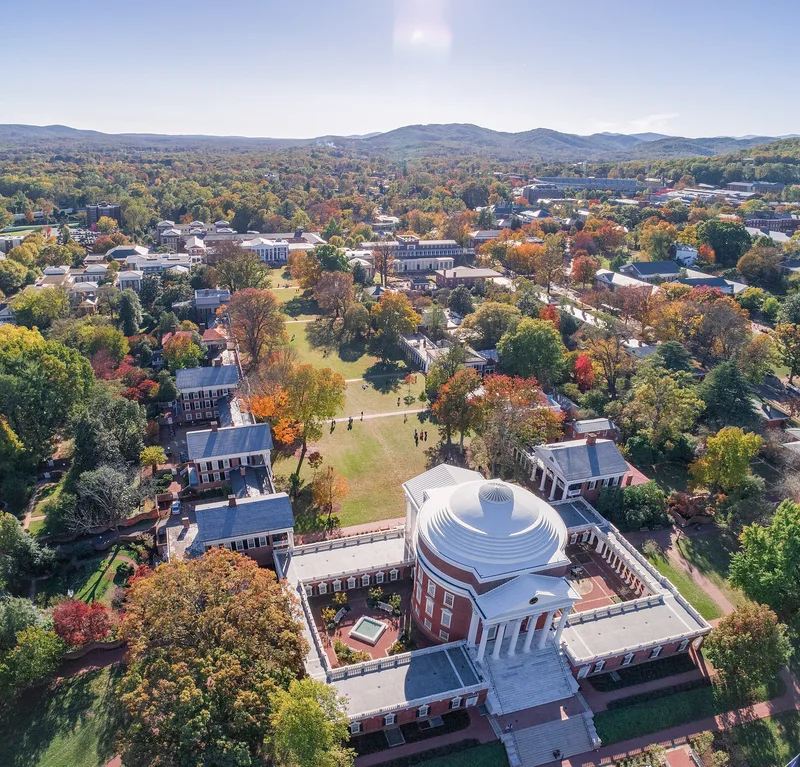
At the center of the University of Virginia in Charlottesville lies a 35-acre core built around Thomas Jefferson's idea of an 'academical village,' a community of scholars living and studying in one unified architectural complex. Construction began after the 1817 cornerstone, and the school was chartered in 1819. Ten two-story pavilions, each showing a different Roman order, line the terraced Lawn and are linked by colonnades fronting student rooms. Arcaded ranges and 'hotels' lie behind, with professors' gardens between. The domed Rotunda, modeled on the Pantheon, anchors the north end. After a fire in 1895, architect Stanford White rebuilt the Rotunda and added Cabell, Cocke and Rouss Halls at the south end of the Lawn. Other notable buildings include Brooks Museum (1876), the University Chapel (1889), Minor Hall and McIntire Amphitheater. The district was listed for Jefferson's original design and its later architecturally distinguished additions.
Significance in brief: The nomination presents the district as Jefferson's architecturally unified university, which he conceived, designed and supervised, and as a major achievement in American educational history with a revolutionary design. It also notes later additions by Stanford White and other buildings of architectural merit, calling the whole one of America's great architectural treasures.
Machine-generated summary. This summary was generated by a language model from the official nomination document and has not been reviewed line by line by an editor. It may contain errors. Check the source document before relying on any detail. Source: nomination document (PDF) · National Archives catalog entry. NRHP reference 70000865, listed November 20, 1970. Summary generated October 2026 (model claude-sonnet-5-5, prompt v1.0-2026-10-29, confidence high).
Key facts
| Address | Bounded by University and Jefferson Park Aves., and Hospital and McCormick Rds., Charlottesville (Independent City) |
|---|---|
| County | Charlottesville |
| Listed | November 20, 1970 |
| Reference number | 70000865 |
| Resource type | District |
| Period of significance | 19th and 20th centuries (no specific dates given) |
| Architect / builder | Thomas Jefferson (original buildings); Stanford White (Rotunda rebuilding, Cabell, Cocke, Rouss and Garrett Halls); J. R. Thomas (Brooks Museum) |
| Architectural style | Jeffersonian Classical; Neo Classic Revival (White's buildings); Gothic-inspired chapel |
| Areas of significance | Education |
| Level of significance | National |
| National Historic Landmark | Yes, designated November 11, 1971 |
| Status (as stated in the nomination) | Listed as occupied, in educational use, in fair condition and altered; owned by the Commonwealth of Virginia. |
| Coordinates | 38.03441, -78.50385 (NPS GIS) |
What listing means for this property
This is a historic district. Buildings within its boundary are either contributing (they add to the district's significance) or non-contributing. Owners of contributing income-producing buildings can claim the 20% federal rehabilitation tax credit; homeowners should look at state credits. National Register districts impose no design review by themselves; a local historic district ordinance, if one exists, does (the difference explained).
General information, not legal or tax advice. Rules change; confirm with your State Historic Preservation Office or a qualified adviser.
Sources and further reading
- National Park Service, National Register of Historic Places database (snapshot May 2026), reference 70000865.
- Nomination form (PDF, National Archives) — catalog entry
- Wikidata Q49573372
- This listing as JSON
Last updated October 2026. Found an error? See the editorial policy for how to report it.