Monroe Hill
Also known as: Brown College; VA DHR File# 104-0124

Why it's listed
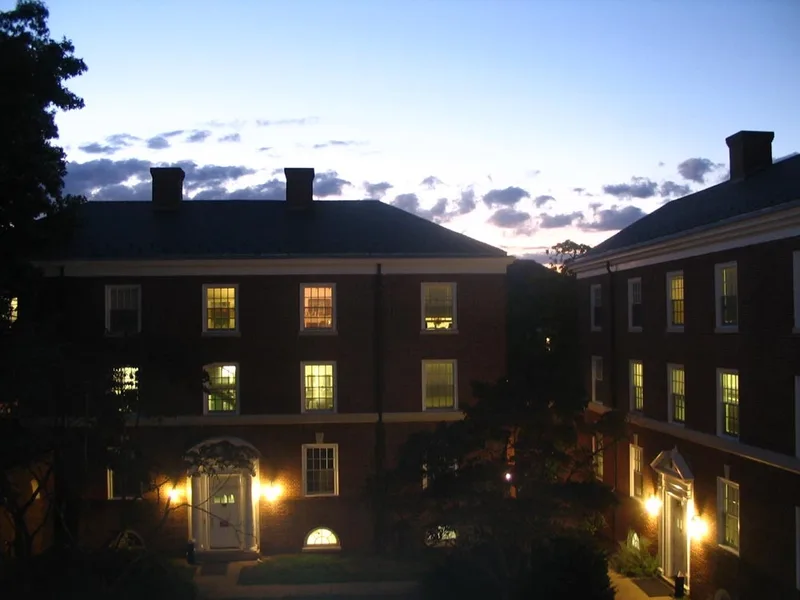
Monroe Hill is a group of four brick buildings on McCormick Road in Charlottesville, overlooking the University of Virginia grounds. The oldest part is a one-and-one-half-story law office built around 1790 for James Monroe, who also built a small dwelling and a frame kitchen there. Monroe spent little time on the property. In 1814 John Perry, a builder who worked under Thomas Jefferson, bought it and enlarged the house into a double-pile, five-bay residence with Greek Revival details. Perry later sold the land to be held for the University of Virginia. The house served as home to the university proctor, and in 1848 two arcaded ranges of six student rooms each, Dawson's Row and Brown Range, were added for students on state scholarships. After the Civil War the main house was remodeled. A residential college was established on the site in 1986 and renamed Brown College in 1994. The complex remains in educational use today, with the law office preserved among the student ranges.
Significance in brief: The complex is argued to be significant for its association with commerce and education, and for its architecture, including an early law office and a Greek Revival main house. It grew from Monroe's small dwelling into housing for the University of Virginia's proctor and for state-funded students.
Machine-generated summary. This summary was generated by a language model from the official nomination document and has not been reviewed line by line by an editor. It may contain errors. Check the source document before relying on any detail. Source: nomination document (PDF) · National Archives catalog entry. NRHP reference 04000575, listed June 2, 2004. Summary generated October 2026 (model claude-sonnet-5-5, prompt v1.0-2026-10-29, confidence high).
Key facts
| Address | 252 and 256 McCormick Rd., Charlottesville (Independent City) |
|---|---|
| County | Charlottesville |
| Listed | June 2, 2004 |
| Reference number | 04000575 |
| Resource type | Building |
| Period of significance | 1790-1953 |
| Architect / builder | Unknown |
| Architectural style | Early Republic; Early Classical Revival - Greek Revival (main house) |
| Criteria |
|
| Areas of significance | Commerce, Education |
| Level of significance | Local |
| Status (as stated in the nomination) | Still used for educational purposes as a residential college, now known as Brown College; the main house serves as the principal's house. |
| Acreage | 2.2 |
| Coordinates | 38.03457, -78.50709 (NPS GIS) |
What listing means for this property
National Register listing is honorary: it recognises significance and does not restrict what a private owner may do without federal money or permits. It unlocks the 20% federal rehabilitation tax credit for income-producing buildings, state credits in many states, and Section 106 review when federal agencies are involved. See what listing means in practice.
General information, not legal or tax advice. Rules change; confirm with your State Historic Preservation Office or a qualified adviser.
Sources and further reading
- National Park Service, National Register of Historic Places database (snapshot May 2026), reference 04000575.
- Nomination form (PDF, National Archives) — catalog entry
- Wikipedia article (used for cross-checking only; text not reproduced here)
- Wikidata Q4976097
- This listing as JSON
Last updated October 2026. Found an error? See the editorial policy for how to report it.