Rotunda, University of Virginia
Also known as: See Also:University of Virginia Historic District

Why it's listed
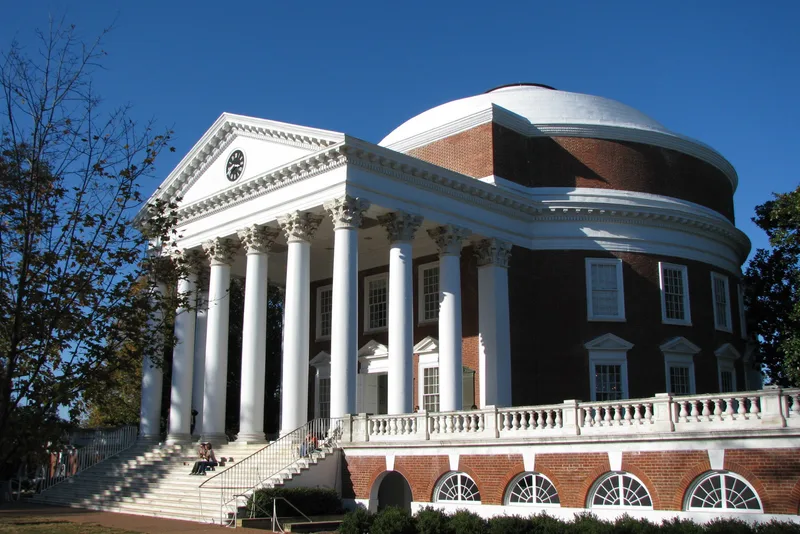
Dominating the head of the Lawn at the University of Virginia in Charlottesville, the Rotunda is the centerpiece of Thomas Jefferson's "academical village." Jefferson submitted completed plans to the University's governing body in 1821, and the building served as the University's chief structure and library. It is a half-scale adaptation of the Pantheon in Rome. Flanking it are rows of pavilions linked by colonnades, built under Jefferson's close supervision, though the Rotunda was unfinished when he died. A multi-story wing added on the north side in the mid-19th century altered its classical lines, and a fire in 1895 destroyed that wing and gutted the building. Stanford White rebuilt it within the original walls and redesigned the interior, finishing in 1898. A 1937 survey reported that it needed substantial repairs and might become a museum. In 1965 federal officials found the Rotunda to have exceptional value for illustrating American history, and it received landmark recognition.
Significance in brief: The documents describe the Rotunda as one of Jefferson's great architectural masterpieces and the dominant feature of his "academical village," a half-scale adaptation of the Pantheon in Rome. Jefferson counted founding the University among his three greatest achievements. The property was found to have exceptional value in illustrating United States history and was declared eligible for Registered National Historic Landmark status in 1965.
Machine-generated summary. This summary was generated by a language model from the official nomination document and has not been reviewed line by line by an editor. It may contain errors. Check the source document before relying on any detail. Source: nomination document (PDF) · National Archives catalog entry. NRHP reference 66000937, listed October 15, 1966. Summary generated October 2026 (model claude-sonnet-5-5, prompt v1.0-2026-10-29, confidence medium).
Key facts
| Address | University of Virginia, Charlottesville (Independent City) |
|---|---|
| County | Charlottesville |
| Listed | October 15, 1966 |
| Reference number | 66000937 |
| Resource type | Building |
| Architect / builder | Thomas Jefferson (designer); Stanford White (rebuilding after the 1895 fire, completed 1898) |
| Architectural style | Classical; half-scale adaptation of the Pantheon in Rome |
| Areas of significance | Education |
| Level of significance | National |
| National Historic Landmark | Yes, designated December 21, 1965 |
| Status (as stated in the nomination) | A 1937 report describes the Rotunda as needing repairs to paint, roof, balustrades, steps and wings, and as likely to become a museum or Jefferson shrine once the books moved to a new library. A 1965 statement says restoration of the academical village was under way. |
| Within district | University Of Virginia Historic District |
| Coordinates | 38.03563, -78.50351 (NPS GIS) |
What listing means for this property
For a publicly owned building or structure, listing mainly matters when federal funds, permits or licences are involved: projects then go through Section 106 review so effects on the property are considered. Listing also strengthens applications for preservation grants and, for leased income-producing uses, can enable the federal rehabilitation tax credit.
General information, not legal or tax advice. Rules change; confirm with your State Historic Preservation Office or a qualified adviser.
Sources and further reading
- National Park Service, National Register of Historic Places database (snapshot May 2026), reference 66000937.
- Nomination form (PDF, National Archives) — catalog entry
- Wikipedia article (used for cross-checking only; text not reproduced here)
- Wikidata Q7761603
- This listing as JSON
Last updated October 2026. Found an error? See the editorial policy for how to report it.