Saint Stephen's Episcopal Church
Also known as: DHL File #09-29

Why it's listed
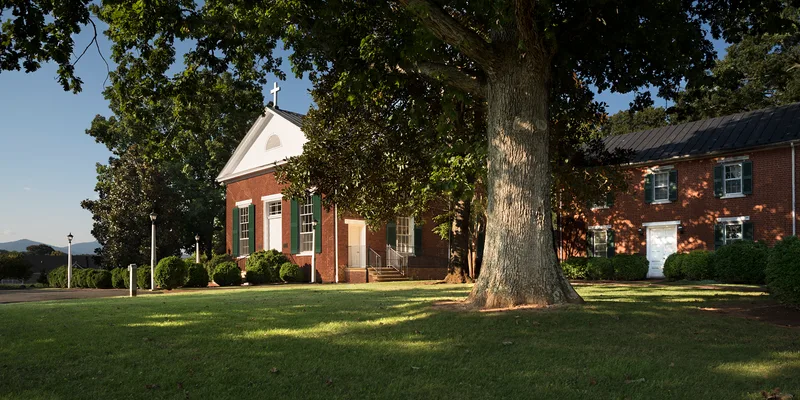
Set in the rolling hills of Bedford County's Western Piedmont, St. Stephen's Episcopal Church is a small brick meeting house of about 36 by 61 feet, built around 1844 in the Greek Revival style. Its three-bay facade is laid in Flemish bond, with wooden lintels and paterae over the openings, and the interior keeps its original box pews. A chancel and robing room were added about 1898, and parish houses were added in 1954-55 and 1980-81, forming a courtyard in front of the graveyard. The parish was established in 1824-25 by the Reverend Nicholas Hamner Cobbs on land once part of Thomas Jefferson's Poplar Forest tract. Cobbs went on to become first Bishop of Alabama, and a later rector, Richard Hooker Wilmer, also became Bishop of Alabama. The church is regarded as a rare, simple, rural example among the Greek Revival brick churches of western Central Virginia, and as a center of the Episcopal revival in the region.
Significance in brief: The nomination argues the church is a well-preserved example of the small, rural Greek Revival parish church built in the Virginia Piedmont in the second quarter of the 19th century. It was also a focal point in the Lower Piedmont for the reorganization of the Anglican Church into the Episcopal Church. It is associated with the Reverend Nicholas Hamner Cobbs, who founded the parish and later became first Bishop of Alabama.
Machine-generated summary. This summary was generated by a language model from the official nomination document and has not been reviewed line by line by an editor. It may contain errors. Check the source document before relying on any detail. Source: nomination document (PDF) · National Archives catalog entry. NRHP reference 85002766, listed November 7, 1985. Summary generated October 2026 (model claude-sonnet-5-5, prompt v1.0-2026-10-29, confidence high).
Key facts
| Address | VA 663, Forest |
|---|---|
| County | Bedford (city and county) |
| Listed | November 7, 1985 |
| Reference number | 85002766 |
| Resource type | Building |
| Period of significance | 1800-1899 |
| Architectural style | Greek Revival |
| Areas of significance | Architecture, Religion |
| Level of significance | State |
| Status (as stated in the nomination) | Occupied and in excellent condition, with an active congregation; used as a religious property. |
| Acreage | 3.8 |
| Coordinates | 37.37792, -79.30819 (NPS GIS) |
What listing means for this property
Religious properties are listed for their architectural or historical significance, not their religious use. Listing is honorary and does not restrict the congregation's use of the building. The federal rehabilitation credit is generally unavailable unless part of the building is income-producing; some state programmes and preservation grants do cover religious buildings. Federal funding or permits trigger Section 106 review.
General information, not legal or tax advice. Rules change; confirm with your State Historic Preservation Office or a qualified adviser.
Sources and further reading
- National Park Service, National Register of Historic Places database (snapshot May 2026), reference 85002766.
- Nomination form (PDF, National Archives) — catalog entry
- Wikipedia article (used for cross-checking only; text not reproduced here)
- Wikidata Q7402188
- This listing as JSON
Last updated October 2026. Found an error? See the editorial policy for how to report it.