Gantt-Jones House

Why it's listed
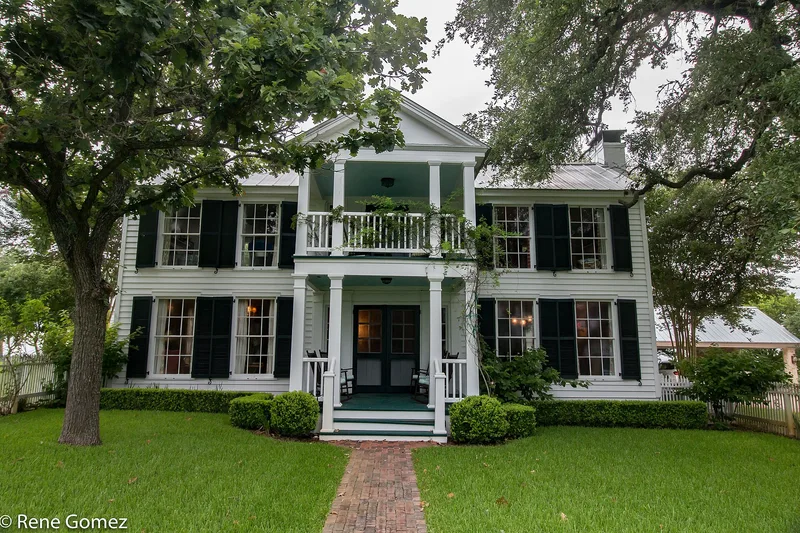
Built around 1860 northwest of Burton, this two-story Greek Revival house was the home of Dr. William Henry Gantt, a physician and scientist at Union Hill. Gantt served as a meteorological observer for the Smithsonian Institution, and the site was chosen for its breezes and suitability for an observatory. The house is built almost entirely of cedar on a native stone foundation, with a central two-story portico on square wooden columns, a central hall and four rooms on each floor. The Gantts sold in 1865 and moved to Galveston. Henry B. "Joe-He" Jones, who made a patented medicinal ointment, then owned the estate and added a factory and office that were later removed. The Prenzer family lived there from 1908 to 1973. A restoration after 1973 rebuilt the west chimney, replaced rotted boards and added modern conveniences at the rear without greatly changing the exterior. The house remains a residence and is one of the earliest fine homes in the Burton area.
Significance in brief: The house was built for Dr. William Henry Gantt, a physician and scientist who served as a meteorological observer for the Smithsonian Institution. It is a well-proportioned Greek Revival residence and one of the few remaining early homesteads in the Union Hill community. It was later owned by Henry B. "Joe-He" Jones, a local figure known for a patented medicinal ointment.
Machine-generated summary. This summary was generated by a language model from the official nomination document and has not been reviewed line by line by an editor. It may contain errors. Check the source document before relying on any detail. Source: nomination document (PDF) · National Archives catalog entry. NRHP reference 79003022, listed November 16, 1979. Summary generated October 2026 (model claude-sonnet-5-5, prompt v1.0-2026-10-29, confidence medium).
Key facts
| Address | 1.5 mi. NW of Burton off SR 1697, Burton |
|---|---|
| County | Washington County |
| Listed | November 16, 1979 |
| Reference number | 79003022 |
| Resource type | Building |
| Period of significance | 1800-1899 |
| Architect / builder | Unknown |
| Architectural style | Greek Revival |
| Areas of significance | Science, Architecture |
| Level of significance | State |
| Status (as stated in the nomination) | Restored after 1973 purchase; in use as a private residence, with a kitchen, three bathrooms and a family room added at the rear. |
| Acreage | 1 |
| Coordinates | 30.20549, -96.61806 (NPS GIS) |
What listing means for this property
National Register listing is honorary for a privately owned home: it does not by itself restrict what an owner may do with their own money, and it does not require public access. Restrictions come from local landmark or historic-district ordinances, which are separate (how they differ).
Owner-occupied houses are not eligible for the 20% federal rehabilitation tax credit, which applies to income-producing buildings, but many states offer credits for homeowners. Listing also opens the door to preservation easements and to buying a plaque. Start with what listing means for homeowners, renovating a listed house and selling one.
General information, not legal or tax advice. Rules change; confirm with your State Historic Preservation Office or a qualified adviser.
Sources and further reading
- National Park Service, National Register of Historic Places database (snapshot May 2026), reference 79003022.
- Nomination form (PDF, National Archives) — catalog entry
- Wikidata Q110002506
- This listing as JSON
Last updated October 2026. Found an error? See the editorial policy for how to report it.