Browning, W. W., House
Why it's listed
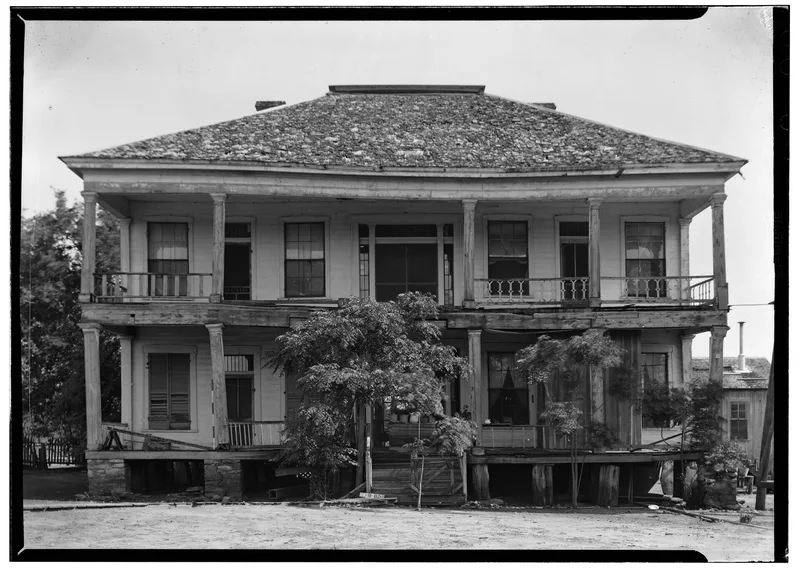
Built around 1858 near Chappell Hill in Washington County, Texas, this plantation house was home to Colonel William Westcott Browning, a South Carolina-born planter and early settler. The two-story raised frame house is a large, nearly square Greek Revival block under a hipped roof with a flat central deck. Family tradition says the first framing blew down in a storm, so Browning rebuilt with heavy timbers, mortised and pegged. A two-story portico shelters a broad double-door entrance with sidelights and a divided transom, and a two-story gallery runs across the rear. Four nearly square rooms flank the central hall on each floor. Its size and roof line recall Virginia Georgian houses, while the detailing is fine and delicate. Chappell Hill was a prosperous agricultural and Methodist center, and Browning supported its institute. Though in poor repair and unoccupied when documented, the house still appeared sound and showed the quality of its design.
Significance in brief: The nomination cites the house as one of the most impressive Greek Revival residences built by prosperous planters around Chappell Hill in the 1840s and 1850s. Its massive timber frame and very fine interior and exterior detailing show superior design quality. It is also tied to Colonel William Westcott Browning, a successful planter and supporter of the Chappell Hill Male and Female Institute.
Machine-generated summary. This summary was generated by a language model from the official nomination document and has not been reviewed line by line by an editor. It may contain errors. Check the source document before relying on any detail. Source: nomination document (PDF) · National Archives catalog entry. NRHP reference 72001376, listed January 20, 1972. Summary generated October 2026 (model claude-sonnet-5-5, prompt v1.0-2026-10-29, confidence high).
Key facts
| Address | S of Chappell Hill near jct. of U.S. 290 and FM 1155, Chappell Hill |
|---|---|
| County | Washington County |
| Listed | January 20, 1972 |
| Reference number | 72001376 |
| Resource type | Building |
| Period of significance | 1858 |
| Architect / builder | W. W. Browning (builder-owner); blinds made by H. Journeay of Galveston |
| Architectural style | Greek Revival |
| Areas of significance | Architecture |
| Level of significance | State |
| Status (as stated in the nomination) | Condition listed as deteriorated and unoccupied, though the structure still appears sound; the plantation has remained in the family. |
| Acreage | 3 |
| Coordinates | 30.12647, -96.25762 (NPS GIS) |
What listing means for this property
National Register listing is honorary for a privately owned home: it does not by itself restrict what an owner may do with their own money, and it does not require public access. Restrictions come from local landmark or historic-district ordinances, which are separate (how they differ).
Owner-occupied houses are not eligible for the 20% federal rehabilitation tax credit, which applies to income-producing buildings, but many states offer credits for homeowners. Listing also opens the door to preservation easements and to buying a plaque. Start with what listing means for homeowners, renovating a listed house and selling one.
Noted as vacant in the nomination. Nomination documents can be decades old; current status may differ. If you are considering buying an empty listed property, read the due-diligence checklist.
General information, not legal or tax advice. Rules change; confirm with your State Historic Preservation Office or a qualified adviser.
Sources and further reading
- National Park Service, National Register of Historic Places database (snapshot May 2026), reference 72001376.
- Nomination form (PDF, National Archives) — catalog entry
- Wikidata Q110002497
- This listing as JSON
Last updated October 2026. Found an error? See the editorial policy for how to report it.