Hofheintz-Reissig Store
Also known as: Waterloo Compound

Why it's listed
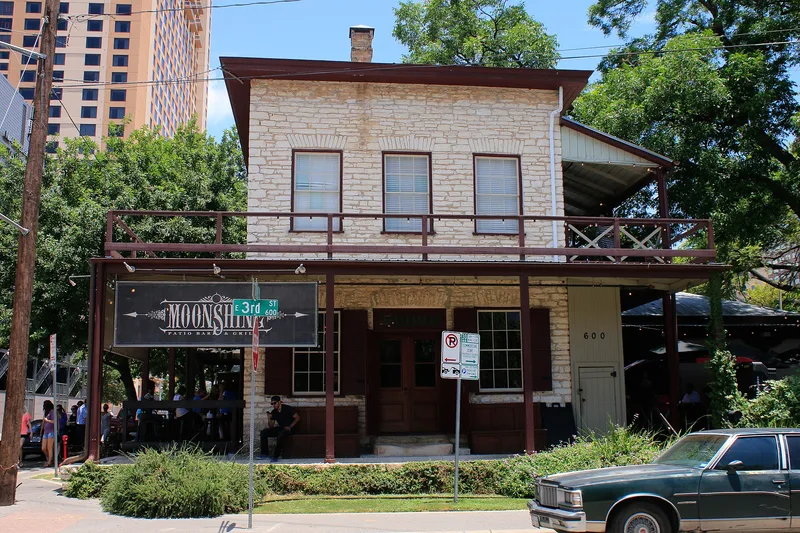
Near Waller Creek in downtown Austin, this ell-shaped limestone complex at Third and Red River streets combines a two-story store with an adjoining single-story saloon and residence. Henry Hofheintz, a German emigrant and freight teamster, acquired the lots in 1854. The store was built between 1850 and 1875, reportedly just after the Civil War, and he ran it as a grocery until his death in 1880. His daughter and her husband, Adolph Reissig, later added the stone saloon, residence and domino parlor, completed by 1892. The family kept the store open until 1952. Its random-coursed and smooth ashlar walls, segmental arches, quoins and symmetrical facades reflect German-influenced vernacular building in Texas. The complex is described as the only surviving one of its kind in the city and as a reminder of small neighborhood commerce near the central business district. Restoration after 1966 kept the exterior largely unaltered, and the buildings now hold an antiques business.
Significance in brief: The nomination argues the complex is the only surviving one of its kind in Austin, combining a store, saloon and residence. It shows how larger commercial establishments once related to small businesses in early residential neighborhoods. It is also an intact example of German-influenced vernacular stone architecture common in Texas in the later 19th century.
Machine-generated summary. This summary was generated by a language model from the official nomination document and has not been reviewed line by line by an editor. It may contain errors. Check the source document before relying on any detail. Source: nomination document (PDF) · National Archives catalog entry. NRHP reference 83003165, listed June 23, 1983. Summary generated October 2026 (model claude-sonnet-5-5, prompt v1.0-2026-10-29, confidence high).
Key facts
| Address | 600 E. 3rd St., Austin |
|---|---|
| County | Travis County |
| Listed | June 23, 1983 |
| Reference number | 83003165 |
| Resource type | Building |
| Period of significance | 1855, 1873-1892 |
| Architect / builder | Unknown |
| Architectural style | Vernacular, German-influenced 19th-century commercial architecture in native limestone ashlar |
| Areas of significance | Commerce, Architecture |
| Level of significance | Local |
| Status (as stated in the nomination) | Restored and in use as an antiques and interiors business (Waterloo Compound) with an upstairs apartment; described as in excellent condition. |
| Acreage | 0.9 |
| Coordinates | 30.26391, -97.73778 (NPS GIS) |
What listing means for this property
For an income-producing building, listing (individually or as a contributing building in a district) is the gateway to the 20% federal rehabilitation tax credit on qualified rehabilitation costs, often stackable with state credits. Work claiming the credit must follow the Secretary of the Interior's Standards and be approved in advance.
Listing does not restrict a private owner acting without federal money or permits; where federal funding or licensing is involved, Section 106 review applies.
General information, not legal or tax advice. Rules change; confirm with your State Historic Preservation Office or a qualified adviser.
Sources and further reading
- National Park Service, National Register of Historic Places database (snapshot May 2026), reference 83003165.
- Nomination form (PDF, National Archives) — catalog entry
- Wikidata Q110002314
- This listing as JSON
Last updated October 2026. Found an error? See the editorial policy for how to report it.