Fairmount-Southside Historic District
Also known as: See Also:South Side Masonic Lodge; Benton, Meredith, House; J

Why it's listed
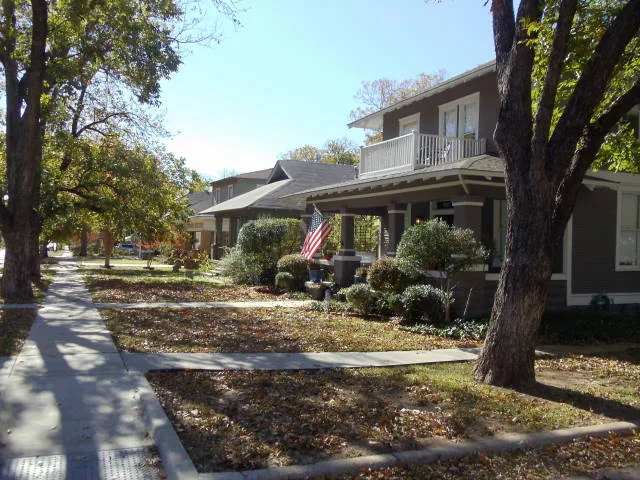
Fairmount/Southside is a large neighborhood of about 340 acres south of downtown Fort Worth, built mostly between 1905 and 1920 as a middle-class streetcar suburb. Wood-frame bungalows dominate, with Four Square houses, Queen Anne cottages, apartment blocks, small commercial strips along former streetcar lines, churches and schools mixed in. Chase Court, a private deed-restricted street begun in 1906, holds the grandest houses, with Prairie School, Renaissance Revival, Tudor and Colonial Revival influences. The area grew after the Texas & Pacific Railroad arrived in 1876, annexation in 1891, and the arrival of meatpacking plants in 1902, which drove a population boom. Residents included clerks, tradesmen, teachers, business owners and professionals. Most houses were built on contract to standard designs without architects, with details varied by owners and carpenters. The district was listed for its architecture and its intact collection of quality, modest homes, with boundaries drawn to exclude edges that lost historic fabric.
Significance in brief: The district is argued to be a remarkably intact streetcar suburb that grew with Fort Worth's railroad and meatpacking boom. Its significance lies in a collection of quality, modest houses, mainly bungalows and Four Squares, with a diversity of house forms and related institutional and commercial buildings. Most houses were built to standard designs by contractors without architects.
Machine-generated summary. This summary was generated by a language model from the official nomination document and has not been reviewed line by line by an editor. It may contain errors. Check the source document before relying on any detail. Source: nomination document (PDF) · National Archives catalog entry. NRHP reference 90000490, listed April 5, 1990. Summary generated October 2026 (model claude-sonnet-5-5, prompt v1.0-2026-10-29, confidence medium).
Key facts
| Address | Roughly bounded by Magnolia, Hemphill, Eighth, and Jessamine, Fort Worth |
|---|---|
| County | Tarrant County |
| Listed | April 5, 1990 |
| Reference number | 90000490 |
| Resource type | District |
| Period of significance | 1890-1930 |
| Architect / builder | Unknown |
| Architectural style | Bungalow, Tudor Revival, Queen Anne, Prairie School |
| Criteria |
|
| Areas of significance | Community Planning and Development, Architecture |
| Level of significance | Local |
| Status (as stated in the nomination) | Most buildings remain in use as houses, apartments and businesses; the edges along Magnolia and Hemphill have deteriorated, and two churches are no longer used as churches. |
| Acreage | 340 |
| Within district | Fairmount-Southside Historic District (Boundary Increase) |
| Coordinates | 32.72501, -97.33786 (NPS GIS) |
What listing means for this property
This is a historic district. Buildings within its boundary are either contributing (they add to the district's significance) or non-contributing. Owners of contributing income-producing buildings can claim the 20% federal rehabilitation tax credit; homeowners should look at state credits. National Register districts impose no design review by themselves; a local historic district ordinance, if one exists, does (the difference explained).
General information, not legal or tax advice. Rules change; confirm with your State Historic Preservation Office or a qualified adviser.
Sources and further reading
- National Park Service, National Register of Historic Places database (snapshot May 2026), reference 90000490.
- Nomination form (PDF, National Archives) — catalog entry
- Wikipedia article (used for cross-checking only; text not reproduced here)
- Wikidata Q5430622
- This listing as JSON
Last updated October 2026. Found an error? See the editorial policy for how to report it.