Montana Avenue Historic District

Why it's listed
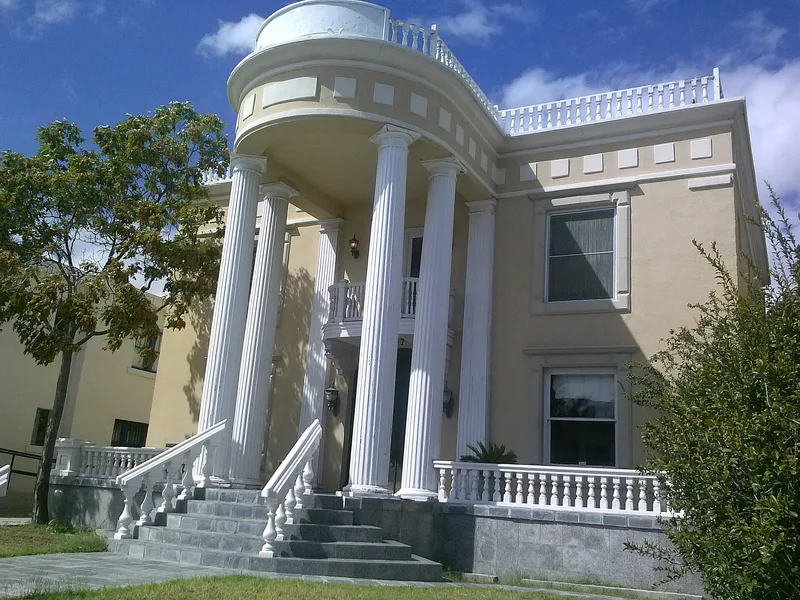
Montana Avenue in El Paso, Texas, was developed as a residential street in the Franklin Heights Addition, at the foothills of the Franklin Mountains about a mile northeast of downtown. The district covers six continuous blocks with 104 resources, of which 69 contribute, including 51 houses, two churches and 13 garages. Two-story brick houses in Prairie, Classical Revival and Queen Anne styles dominate, and each accounts for about a quarter of the housing. Front porches, uniform setbacks, stone retaining walls and original concrete curbs and sidewalks give the streets a cohesive look. The neighborhood was nearly built out by 1910. Its location near the rail lines, its brick construction using materials and ornament shipped by railroad, and its changing architectural fashions illustrate El Paso's early 20th century boom. Over time, many homes were converted to apartments and professional offices, yet most still keep their residential character.
Significance in brief: The district is argued to reflect El Paso's early 20th century growth, with its location near the rail lines and business district and the grand homes showing the economic boom. The houses show a shift to brick and railroad-shipped ornamental details, and changing style fashions reflect builders following national trends. It meets Criterion A (Community Planning and Development) and Criterion C (Architecture) at the local level.
Machine-generated summary. This summary was generated by a language model from the official nomination document and has not been reviewed line by line by an editor. It may contain errors. Check the source document before relying on any detail. Source: nomination document (PDF) · National Archives catalog entry. NRHP reference 04001232, listed November 13, 2004. Summary generated October 2026 (model claude-sonnet-5-5, prompt v1.0-2026-10-29, confidence medium).
Key facts
| Address | 1000 through 1500 Blks of Montana Ave., El Paso |
|---|---|
| County | El Paso County |
| Listed | November 13, 2004 |
| Reference number | 04001232 |
| Resource type | District |
| Architectural style | Late Victorian (Queen Anne, Romanesque), Prairie School, and Late 19th/20th Century Revivals (Mission, Classical, Colonial, Dutch Colonial, Italian Renaissance, Late Gothic, Spanish Eclectic); mixed |
| Criteria |
|
| Areas of significance | Architecture, Community Planning and Development |
| Level of significance | Local |
| Status (as stated in the nomination) | Largely intact early 20th century neighborhood; 69 of 104 resources contribute. Many former houses are now used as offices, apartments or other commercial uses. |
| Acreage | 26 |
| Within district | Rio Grande Avenue Historic District |
| Coordinates | 31.77250, -106.48197 (NPS GIS) |
What listing means for this property
This is a historic district. Buildings within its boundary are either contributing (they add to the district's significance) or non-contributing. Owners of contributing income-producing buildings can claim the 20% federal rehabilitation tax credit; homeowners should look at state credits. National Register districts impose no design review by themselves; a local historic district ordinance, if one exists, does (the difference explained).
General information, not legal or tax advice. Rules change; confirm with your State Historic Preservation Office or a qualified adviser.
Sources and further reading
- National Park Service, National Register of Historic Places database (snapshot May 2026), reference 04001232.
- Nomination form (PDF, National Archives) — catalog entry
- Wikipedia article (used for cross-checking only; text not reproduced here)
- Wikidata Q65098908
- This listing as JSON
Last updated October 2026. Found an error? See the editorial policy for how to report it.