Franklin Institute
Also known as: Franklin Institute of the State of Pennsylvania for the Prom

Why it's listed
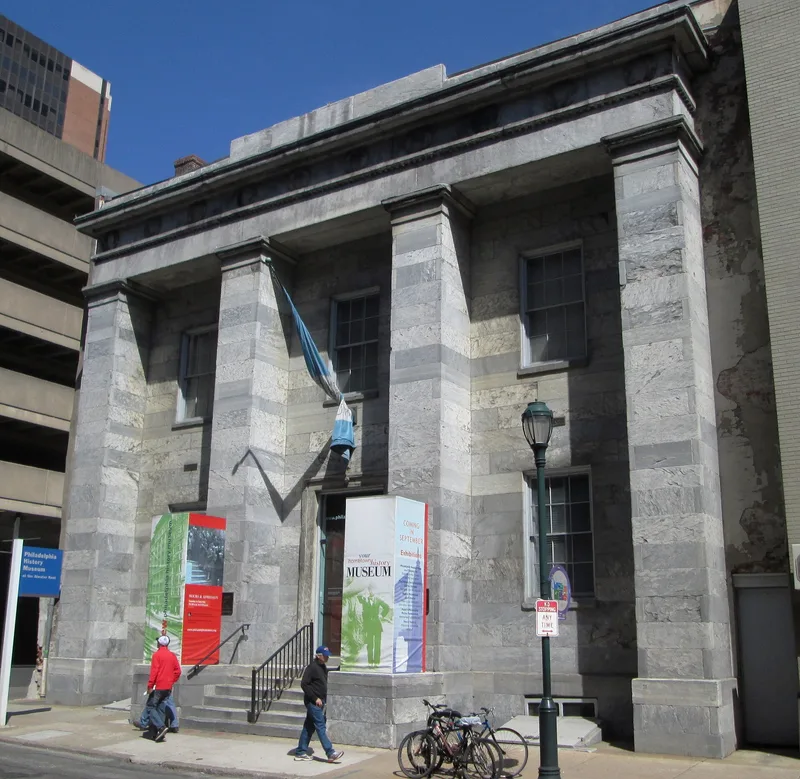
Built in 1825-26 on South 7th Street in Philadelphia, this three-story brick building has a marble porch of four Tuscan-styled piers, modeled loosely on the Choragic Monument of Thrasyllus. Architect John Haviland designed it for the Franklin Institute, which had been organized the previous year by Samuel V. Merrick and William H. Keating. Its austere, monumental facade is regarded as an early major example of the Greek Revival style in America, and its urban street-front design influenced later classical buildings, including Thomas U. Walter's Philadelphia Saving Fund Society building. Inside, the plan was an I-shape with a sunken lecture hall. The institute used the building for much of its early history, and the 1930s saw a move to the Parkway and a shift to museum use. The building is also associated with firsts in American science and technology, such as a weather bureau, coal gasification, machine-part standardization, and early public demonstrations of motion pictures and the transcontinental telephone.
Significance in brief: The nomination argues the building is an early and influential monument of the Greek Revival style in America, helping to establish its classical vocabulary for urban street-front architecture. It also argues the building is associated with many inventions and scientific and educational events that the Franklin Institute fostered, and so is of national significance in architecture, education, industry, science and commerce.
Machine-generated summary. This summary was generated by a language model from the official nomination document and has not been reviewed line by line by an editor. It may contain errors. Check the source document before relying on any detail. Source: nomination document (PDF) · National Archives catalog entry. NRHP reference 79002319, listed August 1, 1979. Summary generated October 2026 (model claude-haiku-5-5, prompt v1.1-2026-10-29, confidence high).
Key facts
| Address | 15 S. 7th St., Philadelphia |
|---|---|
| County | Philadelphia |
| Listed | August 1, 1979 |
| Reference number | 79002319 |
| Resource type | Building |
| Period of significance | 1825-1826 |
| Architect / builder | John Haviland (architect) |
| Architectural style | Greek Revival |
| Criteria |
|
| Areas of significance | Industry, Education, Science, Architecture, Invention |
| Level of significance | National |
| Status (as stated in the nomination) | Moved to the Benjamin Franklin Parkway in 1933, sold in 1938 to A. Atwater Kent for use as a city-run museum, and adapted over time for museum use while retaining much original detailing. |
| Acreage | 0.1 |
| Within district | East Center City Commercial Historic District |
| Coordinates | 39.95030, -75.15204 (NPS GIS) |
What listing means for this property
National Register listing is honorary: it recognises significance and does not restrict what a private owner may do without federal money or permits. It unlocks the 20% federal rehabilitation tax credit for income-producing buildings, state credits in many states, and Section 106 review when federal agencies are involved. See what listing means in practice.
General information, not legal or tax advice. Rules change; confirm with your State Historic Preservation Office or a qualified adviser.
Sources and further reading
- National Park Service, National Register of Historic Places database (snapshot May 2026), reference 79002319.
- Nomination form (PDF, National Archives) — catalog entry
- Wikipedia article (used for cross-checking only; text not reproduced here)
- Wikidata Q2870183
- This listing as JSON
Last updated October 2026. Found an error? See the editorial policy for how to report it.