Callowhill Industrial Historic District

Why it's listed
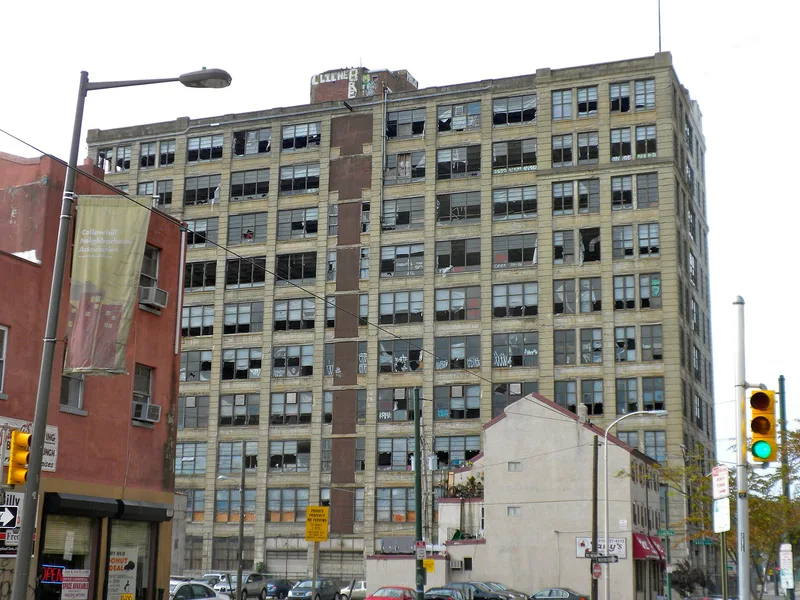
Located about one mile north of Philadelphia City Hall, the Callowhill Industrial Historic District covers roughly fourteen blocks, mostly filled with multi-story industrial loft buildings of reinforced concrete and brick, many dating from the 1890s through the 1930s. Its earliest surviving houses are brick row houses from around 1830 along Callowhill, Wood and Carlton Streets. The district developed after the Reading Railroad reached the area in 1838, drawing foundries, factories and light manufacturers. The Philadelphia & Reading Railroad built an elevated viaduct between 1890 and 1893 to carry freight and passengers. Industries in the district included automobile showrooms and repair, printing and publishing, and apparel, with several thousand workers employed there through the 1970s. Notable buildings include the Lasher Building of 1927, with its concrete Art Deco ornament, and the 1931 Terminal Commerce Building.
Significance in brief: The district is argued to be significant for its diversified specialty manufacturing, which characterized Philadelphia industry in the nineteenth and twentieth centuries, and for its concentration of industrial buildings showing the evolution of industrial architecture from the late nineteenth to early twentieth century. The Lasher Building and Terminal Commerce Building are cited for Art Deco detailing, and the Reading Railroad Viaduct for its engineering.
Machine-generated summary. This summary was generated by a language model from the official nomination document and has not been reviewed line by line by an editor. It may contain errors. Check the source document before relying on any detail. Source: nomination document (PDF) · National Archives catalog entry. NRHP reference 10000403, listed June 28, 2010. Summary generated October 2026 (model claude-haiku-5-5, prompt v1.1-2026-10-29, confidence medium).
Key facts
| Address | Roughly bounded by Pearl St, N Broad St, Hamilton St, and the Reading Railroad Viaduct, Philadelphia |
|---|---|
| County | Philadelphia |
| Listed | June 28, 2010 |
| Reference number | 10000403 |
| Resource type | District |
| Period of significance | 1830-1959 |
| Architectural style | Commercial style; Greek Revival and Italianate (row houses); Art Deco (Lasher and Terminal Commerce buildings); Mission/Spanish Colonial Revival (Philadelphia City Morgue); Colonial Revival (Overland Motor Company Building) |
| Criteria |
|
| Areas of significance | Industry, Architecture, Engineering, Commerce, Transportation |
| Level of significance | Local |
| Status (as stated in the nomination) | The Reading Railroad Viaduct has remained in a state of disuse after 1984; the multi-story loft buildings have been converted into offices and residential units. |
| Acreage | 5.7 |
| Coordinates | 39.96100, -75.15854 (NPS GIS) |
What listing means for this property
This is a historic district. Buildings within its boundary are either contributing (they add to the district's significance) or non-contributing. Owners of contributing income-producing buildings can claim the 20% federal rehabilitation tax credit; homeowners should look at state credits. National Register districts impose no design review by themselves; a local historic district ordinance, if one exists, does (the difference explained).
General information, not legal or tax advice. Rules change; confirm with your State Historic Preservation Office or a qualified adviser.
Sources and further reading
- National Park Service, National Register of Historic Places database (snapshot May 2026), reference 10000403.
- Nomination form (PDF, National Archives) — catalog entry
- Wikipedia article (used for cross-checking only; text not reproduced here)
- Wikidata Q5022937
- This listing as JSON
Last updated October 2026. Found an error? See the editorial policy for how to report it.