Hovenden House, Barn and Abolition Hall
Also known as: See Also:Plymouth Meeting Historic District
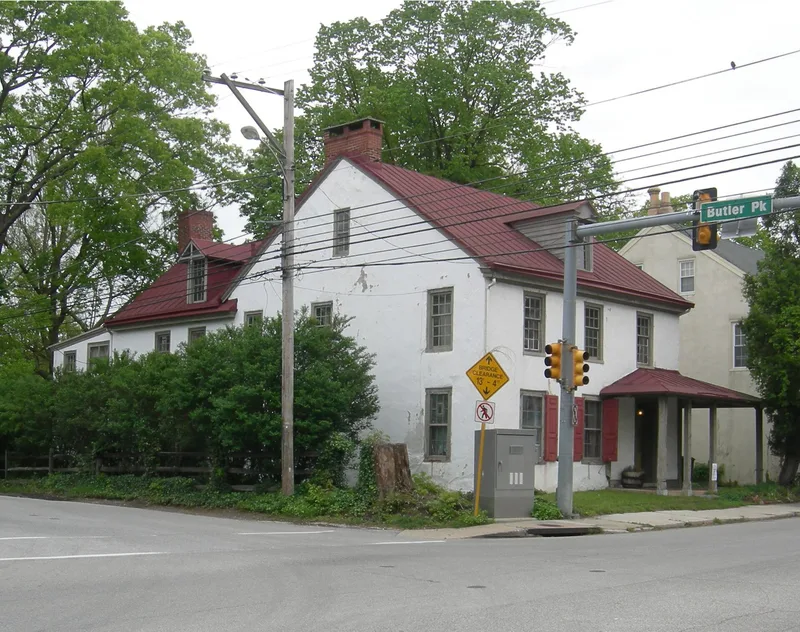

Why it's listed
Along the northeast corner of Germantown and Butler Pikes in Plymouth Meeting stands a stone house first recorded in a deed of February 3, 1794, when Samuel Maulsby acquired a messuage and lot in Whitemarsh Township. Its walls are eighteen inches thick rubble and mortar, and it has a large kitchen fireplace with ovens and an arched brick root cellar. Behind the barn stands Abolition Hall, a former open carriage shed that was enclosed and given a full-length upper hall in 1856 by George Corson, an abolitionist who hosted meetings and lectures there before the Civil War. Speakers included William Lloyd Garrison, Lucretia Mott, and John Greenleaf Whittier. From 1881 to 1895 the artist Thomas Hovenden used the hall as his studio. The property is significant for these associations with the anti-slavery movement and with Hovenden, and for the reported use of its barn in sheltering escaping slaves.
Significance in brief: The nomination cites the house's association with the artist Thomas Hovenden, who used Abolition Hall as a studio from 1881 to 1895, and with George Corson, who built the hall in 1856 for anti-slavery meetings and lectures. It also cites the barn's reported use in sheltering escaping slaves and the property's typical Federal-period Pennsylvania construction.
Machine-generated summary. This summary was generated by a language model from the official nomination document and has not been reviewed line by line by an editor. It may contain errors. Check the source document before relying on any detail. Source: nomination document (PDF) · National Archives catalog entry. NRHP reference 71000713, listed February 18, 1971. Summary generated October 2026 (model claude-haiku-5-5, prompt v1.1-2026-10-29, confidence medium).
Key facts
| Address | 1 E. Germantown Pike, Plymouth Meeting |
|---|---|
| County | Montgomery County |
| Listed | February 18, 1971 |
| Reference number | 71000713 |
| Resource type | Building |
| Architectural style | Typical Pennsylvania dwelling of the Federal Period |
| Areas of significance | Art, Politics/Government, Social History |
| Level of significance | National |
| Status (as stated in the nomination) | Listed in 1971; the description marks the condition as fair and the site as original; the property was converted to two apartments in 1957, and the document notes threat from proposed highway re-routing. |
| Acreage | 9 |
| Within district | Plymouth Meeting Historic District |
| Coordinates | 40.10287, -75.27768 (NPS GIS) |
What listing means for this property
National Register listing is honorary for a privately owned home: it does not by itself restrict what an owner may do with their own money, and it does not require public access. Restrictions come from local landmark or historic-district ordinances, which are separate (how they differ).
Owner-occupied houses are not eligible for the 20% federal rehabilitation tax credit, which applies to income-producing buildings, but many states offer credits for homeowners. Listing also opens the door to preservation easements and to buying a plaque. Start with what listing means for homeowners, renovating a listed house and selling one.
General information, not legal or tax advice. Rules change; confirm with your State Historic Preservation Office or a qualified adviser.
Sources and further reading
- National Park Service, National Register of Historic Places database (snapshot May 2026), reference 71000713.
- Nomination form (PDF, National Archives) — catalog entry
- Wikipedia article (used for cross-checking only; text not reproduced here)
- Wikidata Q5917056
- This listing as JSON
Last updated October 2026. Found an error? See the editorial policy for how to report it.