Waterloo Mills Historic District
Also known as: Cabbage Town

Why it's listed
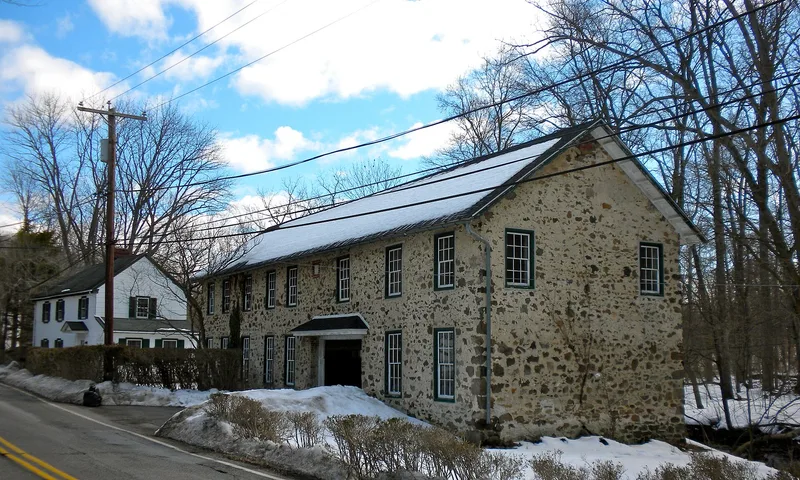
Waterloo Mills is a cluster of stone and stuccoed buildings lining Waterloo Road in Easttown Township, Chester County, on land that was farmed and milled from the late 1790s. Its anchor is a stone gristmill built between 1796 and 1798 by millwright Richard Thomas, who also built a house in 1804. Mordecai Davis developed a farmhouse, springhouse, barn and tenant houses around 1800 and 1823, and the farm later became a dairy operation with an elaborate concrete cooling system in its springhouse basement. In the mid-nineteenth century the mill housed the township's first post office, between 1853 and 1867. The district is regarded as an unusually complete example of vernacular agricultural settlement, with dry-laid stone walls along the road and surrounding fields and forest that remain largely undeveloped. The period from 1798 to 1909 reflects the rise and decline of local farming, milling and blacksmithing before the land was sold to estate owners.
Significance in brief: The nomination argues the district is significant under Criterion A for its association with agriculture and the milling industry in Chester County from 1798 to 1909, when it functioned as a nearly self-contained farming and blacksmith community with the township's only gristmill and an early post office. It also argues under Criterion C that the intact vernacular stone architecture illustrates the county's rural agricultural history.
Machine-generated summary. This summary was generated by a language model from the official nomination document and has not been reviewed line by line by an editor. It may contain errors. Check the source document before relying on any detail. Source: nomination document (PDF) · National Archives catalog entry. NRHP reference 95000889, listed July 21, 1995. Summary generated October 2026 (model claude-haiku-5-5, prompt v1.1-2026-10-29, confidence high).
Key facts
| Address | 815, 840, 855 and 860 Waterloo Rd., Easttown Township, Waterloo Mills |
|---|---|
| County | Chester County |
| Listed | July 21, 1995 |
| Reference number | 95000889 |
| Resource type | District |
| Period of significance | 1798-1909 |
| Architectural style | Colonial; Other: Vernacular |
| Criteria |
|
| Areas of significance | Architecture, Agriculture |
| Level of significance | Local |
| Status (as stated in the nomination) | The mill and four houses are used as residences; the rebuilt millpond is noncontributing; the farm and mill buildings have been preserved although the district is no longer farmed. |
| Acreage | 159 |
| Coordinates | 40.02130, -75.41747 (NPS GIS) |
What listing means for this property
This is a historic district. Buildings within its boundary are either contributing (they add to the district's significance) or non-contributing. Owners of contributing income-producing buildings can claim the 20% federal rehabilitation tax credit; homeowners should look at state credits. National Register districts impose no design review by themselves; a local historic district ordinance, if one exists, does (the difference explained).
General information, not legal or tax advice. Rules change; confirm with your State Historic Preservation Office or a qualified adviser.
Sources and further reading
- National Park Service, National Register of Historic Places database (snapshot May 2026), reference 95000889.
- Nomination form (PDF, National Archives) — catalog entry
- Wikipedia article (used for cross-checking only; text not reproduced here)
- Wikidata Q7974257
- This listing as JSON
Last updated October 2026. Found an error? See the editorial policy for how to report it.