Strode's Mill Historic District
Also known as: See Also:Strode's Mill; East Bradford Boarding School for Boy

Why it's listed
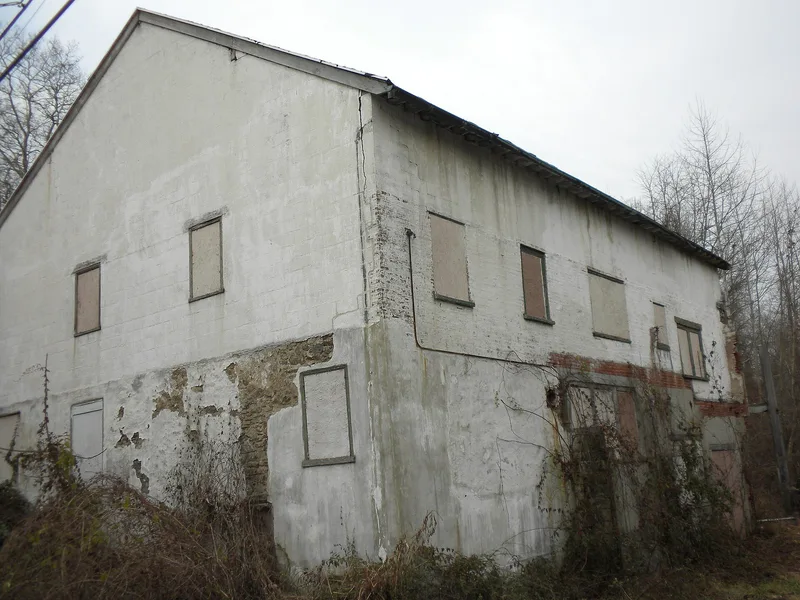
Strode's Mill is a crossroads village in East Bradford Township, Chester County, whose core buildings date from 1721 onward. The stone mill, built by John Willis and neighbors on Plum Run, is a first-period mill and one of the oldest surviving in the Brandywine area. Richard Strode's farmhouse, begun about 1772, and the East Bradford Boarding School for Boys, a serpentine stone mansion completed in 1798, show Georgian and late Georgian/early Federal styling. The boarding school operated from 1816 to 1856 under Joseph C. Strode. In the later nineteenth century, the Strode family became known for sausage and scrapple, sold at Philadelphia's Reading Terminal Market from 1893. The village has kept its four-corner layout and much of its early fabric, and it is regarded as a rare survivor among the region's eighteenth-century service villages.
Significance in brief: The nomination argues the village is one of the last in south central Chester County to retain its 18th-century configuration. The Strode's Mill is regarded as one of the oldest surviving first-period mills in the Brandywine area. The East Bradford Boarding School and the Strode family's pork products business are presented as important to local education and commerce, and the vernacular architecture is described as high quality and well preserved.
Machine-generated summary. This summary was generated by a language model from the official nomination document and has not been reviewed line by line by an editor. It may contain errors. Check the source document before relying on any detail. Source: nomination document (PDF) · National Archives catalog entry. NRHP reference 89000354, listed May 5, 1989. Summary generated October 2026 (model claude-haiku-5-5, prompt v1.1-2026-10-29, confidence high).
Key facts
| Address | Jct. PA 52/100 and Birmingham Rd., West Chester |
|---|---|
| County | Chester County |
| Listed | May 5, 1989 |
| Reference number | 89000354 |
| Resource type | District |
| Period of significance | 1721-1939 |
| Architectural style | Vernacular Georgian and Federal |
| Criteria |
|
| Areas of significance | Commerce, Education, Architecture |
| Level of significance | Local |
| Status (as stated in the nomination) | Most buildings are private residences; the mill is used as a decoy carving workshop and a huntsman store; the slaughterhouse has been vacant since 1985; the blacksmith/wheelwright shop is used for storage. |
| Acreage | 12 |
| Coordinates | 39.92912, -75.61743 (NPS GIS) |
What listing means for this property
This is a historic district. Buildings within its boundary are either contributing (they add to the district's significance) or non-contributing. Owners of contributing income-producing buildings can claim the 20% federal rehabilitation tax credit; homeowners should look at state credits. National Register districts impose no design review by themselves; a local historic district ordinance, if one exists, does (the difference explained).
Noted as vacant in the nomination. Nomination documents can be decades old; current status may differ. If you are considering buying an empty listed property, read the due-diligence checklist.
General information, not legal or tax advice. Rules change; confirm with your State Historic Preservation Office or a qualified adviser.
Sources and further reading
- National Park Service, National Register of Historic Places database (snapshot May 2026), reference 89000354.
- Nomination form (PDF, National Archives) — catalog entry
- Wikipedia article (used for cross-checking only; text not reproduced here)
- Wikidata Q7624225
- This listing as JSON
Last updated October 2026. Found an error? See the editorial policy for how to report it.