Bull, Thomas, House
Also known as: Robert's Plantation; Redding Plantation; Mt. Pleasant

Why it's listed
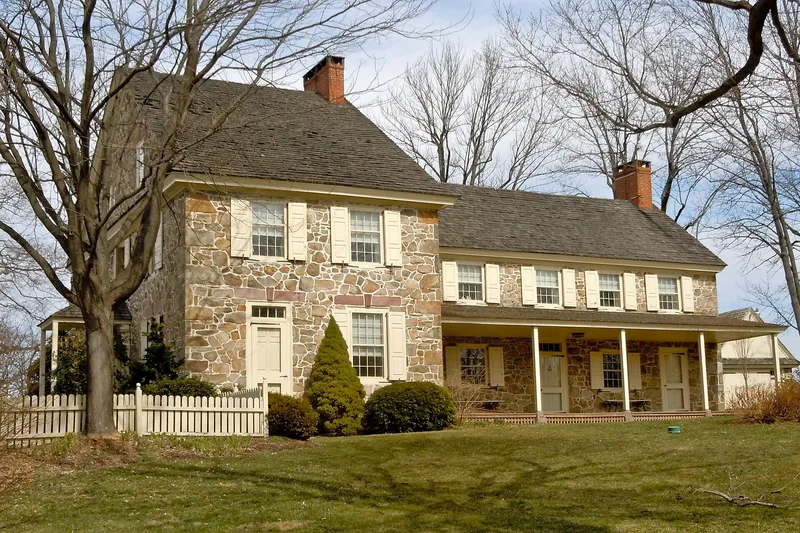
Stone house in Elverson, Chester County, built in three sections between about 1715 and the late 1790s. The oldest section has a Dutch door, a bee-hive bake oven and a circular stair around an interior chimney. A first addition extended the south facade, and a larger three-bay addition of about 1783-1796, built by Thomas Bull, a stonemason who managed Warwick Furnace, added a central hall and stairway and a doorway with a semicircular fanlight and Doric pilasters. Bull purchased 515 acres in 1783, and the 1798 Chester County glass tax records the dimensions of the house, which match the present building. The house is valued as an unusual, little-altered example of Late Georgian-Early Federal design in the area. Bull also served in the Continental Army, sat in the 1789-90 state constitutional conventions, and represented Chester and Delaware Counties in the state assembly from 1793 to 1801.
Significance in brief: The house is regarded as an unusual and well-preserved example of Late Georgian-Early Federal architecture in the area, with a semicircular fanlight, Doric pilasters and little alteration. It is also tied to Thomas Bull, a stonemason and manager of Warwick Furnace who served in the Revolutionary Army and in the state assembly.
Machine-generated summary. This summary was generated by a language model from the official nomination document and has not been reviewed line by line by an editor. It may contain errors. Check the source document before relying on any detail. Source: nomination document (PDF) · National Archives catalog entry. NRHP reference 79002198, listed August 3, 1979. Summary generated October 2026 (model claude-haiku-5-5, prompt v1.1-2026-10-29, confidence high).
Key facts
| Address | E of Elverson on Bulltown Rd., East Nantmeal Township, Elverson |
|---|---|
| County | Chester County |
| Listed | August 3, 1979 |
| Reference number | 79002198 |
| Resource type | Building |
| Period of significance | c. 1715-1796 |
| Architect / builder | Thomas Bull (builder/mason) |
| Architectural style | Late Georgian-Early Federal |
| Criteria |
|
| Areas of significance | Commerce, Architecture |
| Level of significance | Local |
| Status (as stated in the nomination) | Not occupied since 1942; changes due to vacancy and neglect. |
| Acreage | 2.5 |
| Coordinates | 40.15094, -75.79253 (NPS GIS) |
What listing means for this property
National Register listing is honorary for a privately owned home: it does not by itself restrict what an owner may do with their own money, and it does not require public access. Restrictions come from local landmark or historic-district ordinances, which are separate (how they differ).
Owner-occupied houses are not eligible for the 20% federal rehabilitation tax credit, which applies to income-producing buildings, but many states offer credits for homeowners. Listing also opens the door to preservation easements and to buying a plaque. Start with what listing means for homeowners, renovating a listed house and selling one.
Noted as vacant in the nomination. Nomination documents can be decades old; current status may differ. If you are considering buying an empty listed property, read the due-diligence checklist.
General information, not legal or tax advice. Rules change; confirm with your State Historic Preservation Office or a qualified adviser.
Sources and further reading
- National Park Service, National Register of Historic Places database (snapshot May 2026), reference 79002198.
- Nomination form (PDF, National Archives) — catalog entry
- Wikipedia article (used for cross-checking only; text not reproduced here)
- Wikidata Q7788017
- This listing as JSON
Last updated October 2026. Found an error? See the editorial policy for how to report it.