Lahr Farm

Why it's listed
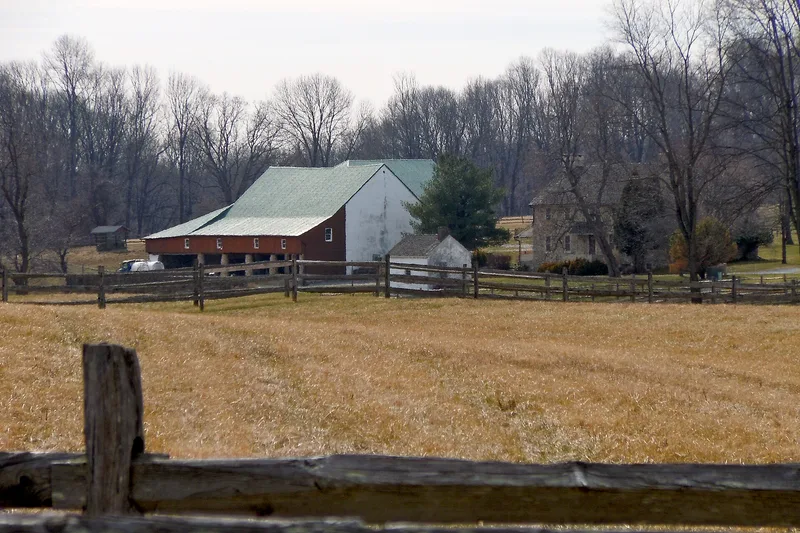
Random field stone with large cover quoins forms the main house on the Lahr Farm near Elverson, Chester County, a two-and-a-half-story dwelling built in two sections. The earlier northwest section has the only cellar and a six-panel door with a transom beneath a pent roof. A large chimney in the attached addition appears older than the house and may have belonged to an earlier log building. Inside, a cooking fireplace and a large shimmer beam dominate the principal room. The grounds also include a stuccoed stone latch house with a bake oven and a bank barn with stone piers. The property is part of the Reading Furnace Tract of Quaker ironmaster William Branson. Partitioned in the early 1780s, its land passed through several owners before the Lahr family held it from 1834 until 1938. The farm is noted for its surviving original fabric and retained boundaries, and it is still worked as farmland today.
Significance in brief: The nomination argues the farm is a well-preserved example of an early nineteenth-century Chester County farmstead, with fine stonework and original interior details that set it apart from lesser examples. It is tied to the Reading Furnace Tract of the Quaker ironmaster William Branson, and its land was among the early partitions sold off as the tract was cleared for farming. The farm retains its rural setting and remains in agricultural use.
Machine-generated summary. This summary was generated by a language model from the official nomination document and has not been reviewed line by line by an editor. It may contain errors. Check the source document before relying on any detail. Source: nomination document (PDF) · National Archives catalog entry. NRHP reference 79002199, listed September 7, 1979. Summary generated October 2026 (model claude-haiku-5-5, prompt v1.1-2026-10-29, confidence medium).
Key facts
| Address | E of Elverson on PA 23, Elverson |
|---|---|
| County | Chester County |
| Listed | September 7, 1979 |
| Reference number | 79002199 |
| Resource type | Building |
| Areas of significance | Architecture |
| Level of significance | Local |
| Status (as stated in the nomination) | Still a productive agricultural enterprise, according to the document. |
| Acreage | 10 |
| Coordinates | 40.16109, -75.76916 (NPS GIS) |
What listing means for this property
National Register listing is honorary for a privately owned home: it does not by itself restrict what an owner may do with their own money, and it does not require public access. Restrictions come from local landmark or historic-district ordinances, which are separate (how they differ).
Owner-occupied houses are not eligible for the 20% federal rehabilitation tax credit, which applies to income-producing buildings, but many states offer credits for homeowners. Listing also opens the door to preservation easements and to buying a plaque. Start with what listing means for homeowners, renovating a listed house and selling one.
General information, not legal or tax advice. Rules change; confirm with your State Historic Preservation Office or a qualified adviser.
Sources and further reading
- National Park Service, National Register of Historic Places database (snapshot May 2026), reference 79002199.
- Nomination form (PDF, National Archives) — catalog entry
- Wikipedia article (used for cross-checking only; text not reproduced here)
- Wikidata Q6473458
- This listing as JSON
Last updated October 2026. Found an error? See the editorial policy for how to report it.