Hanitch-Huffman House

Why it's listed
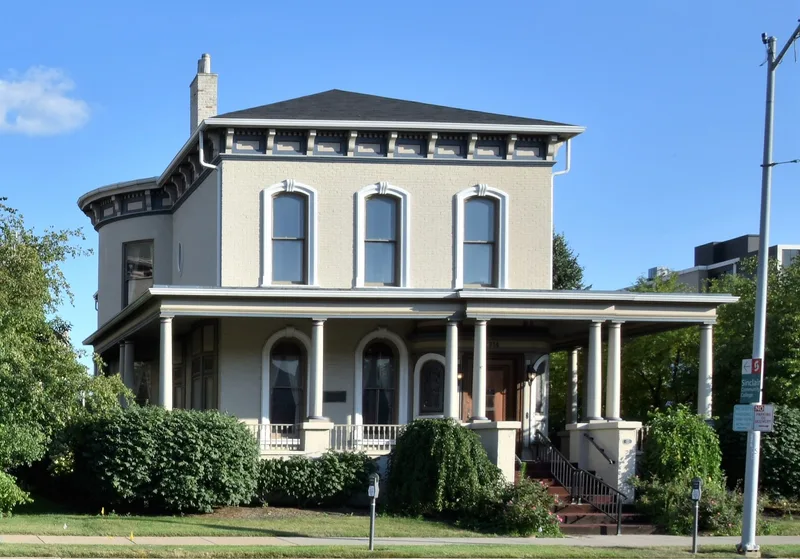
Built around 1863 for John Hanitch and his wife, wholesalers of groceries and liquor, this brick house on West Monument Avenue in downtown Dayton is a Victorian Italianate residence set on a high stone foundation. An oval one-story projecting bay holds the entry, and a classical revival veranda with pairs of slender Doric pillars wraps the front and sides. Inside, carved solid walnut and cherry woodwork, an elaborate mantel with cherub heads, a grand staircase and heavy ceiling beams survive. In 1895 Colonel Frank T. Huffman, a noted Dayton developer and promoter, bought it as his residence, and it stayed in his family until 1945, when the YMCA acquired it and leased it to the Knights of Columbus. The house was listed as one of the last vestiges of residential downtown Dayton, for its architecture, and for its link to a leading citizen. Empty and surrounded by parking lots, it faced demolition, and a move across the street was planned.
Significance in brief: The nomination argues the house is one of the few remaining nineteenth-century residences in downtown Dayton and a typical example of Victorian Italianate architecture. It was also the home of Colonel Frank T. Huffman, a prominent Dayton developer and promoter. Its carved walnut and cherry interior woodwork is described as a rarity in Dayton.
Machine-generated summary. This summary was generated by a language model from the official nomination document and has not been reviewed line by line by an editor. It may contain errors. Check the source document before relying on any detail. Source: nomination document (PDF) · National Archives catalog entry. NRHP reference 82003617, listed March 29, 1982. Summary generated October 2026 (model claude-sonnet-5-5, prompt v1.0-2026-10-29, confidence high).
Key facts
| Address | 139 W. Monument Ave., Dayton |
|---|---|
| County | Montgomery County |
| Listed | March 29, 1982 |
| Reference number | 82003617 |
| Resource type | Building |
| Period of significance | 1800-1899 |
| Architectural style | Victorian Italianate |
| Criteria |
|
| Areas of significance | Community Planning and Development, Architecture |
| Level of significance | Local |
| Status (as stated in the nomination) | Described as empty and surrounded by parking lots, and threatened with demolition; plans called for moving it to the empty lot across the street. |
| Acreage | 0.9 |
| Within district | Downtown Dayton Historic District |
| Coordinates | 39.76329, -84.19614 (NPS GIS) |
What listing means for this property
National Register listing is honorary for a privately owned home: it does not by itself restrict what an owner may do with their own money, and it does not require public access. Restrictions come from local landmark or historic-district ordinances, which are separate (how they differ).
Owner-occupied houses are not eligible for the 20% federal rehabilitation tax credit, which applies to income-producing buildings, but many states offer credits for homeowners. Listing also opens the door to preservation easements and to buying a plaque. Start with what listing means for homeowners, renovating a listed house and selling one.
Noted as vacant in the nomination. Nomination documents can be decades old; current status may differ. If you are considering buying an empty listed property, read the due-diligence checklist.
General information, not legal or tax advice. Rules change; confirm with your State Historic Preservation Office or a qualified adviser.
Sources and further reading
- National Park Service, National Register of Historic Places database (snapshot May 2026), reference 82003617.
- Nomination form (PDF, National Archives) — catalog entry
- Wikidata Q138634331
- This listing as JSON
Last updated October 2026. Found an error? See the editorial policy for how to report it.