Brown, Samuel N., House

Why it's listed
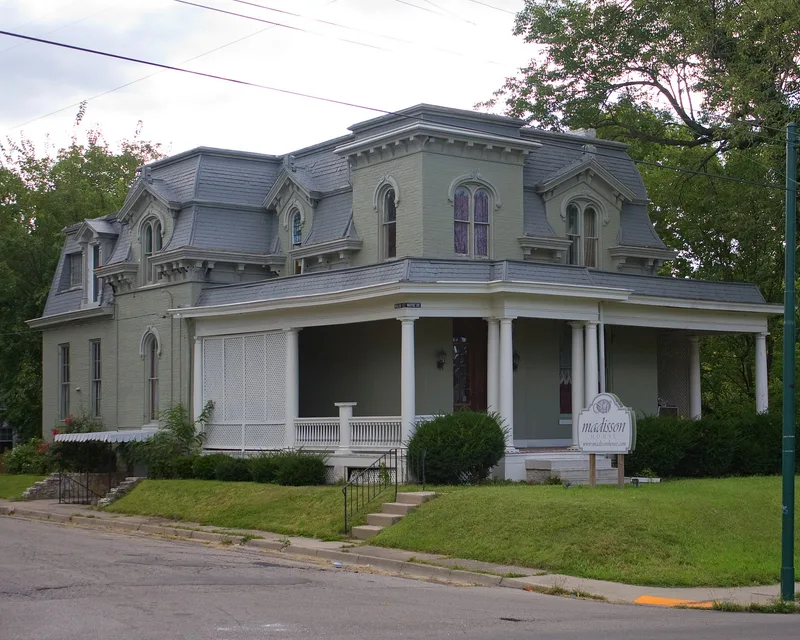
Built in 1875 at 1633 Wayne Avenue in Dayton, this Second Empire house was commissioned by Samuel N. Brown, whose company made wheels, hubs, spokes and bent metal products for buggies. Founded in 1847, the firm was one of the city's oldest industrial businesses. The house has a T-shaped plan on a stone foundation, a bellcast mansard roof with railing and cresting, a straight-sided corner tower, and wall dormers with bracketed gable cornices. A veranda wraps the facade; it was remodeled in Classical Revival style around 1900, with a board-and-batten enclosure and art glass windows on one side. Rear additions are largely compatible or hidden from view. The nomination judged it the most picturesque Second Empire home in Dayton and said the veranda change adds to the facade's charm. After serving as a short-lived hospital beginning in 1920, it became an antique shop in 1958, and a former owner received the City Beautiful Award in 1972.
Significance in brief: The nomination calls it the most picturesque Second Empire home in Dayton, noting its bellcast mansard roof, corner tower and altered veranda. It is also tied to Samuel Brown, whose buggy-parts company, organized in 1847, was among Dayton's oldest industrial firms.
Machine-generated summary. This summary was generated by a language model from the official nomination document and has not been reviewed line by line by an editor. It may contain errors. Check the source document before relying on any detail. Source: nomination document (PDF) · National Archives catalog entry. NRHP reference 77001075, listed April 11, 1977. Summary generated October 2026 (model claude-sonnet-5-5, prompt v1.0-2026-10-29, confidence medium).
Key facts
| Address | 1633 Wayne Ave., Dayton |
|---|---|
| County | Montgomery County |
| Listed | April 11, 1977 |
| Reference number | 77001075 |
| Resource type | Building |
| Period of significance | 1875-1920 |
| Architectural style | Second Empire |
| Areas of significance | Commerce, Transportation, Architecture |
| Level of significance | Local |
| Status (as stated in the nomination) | Occupied; used as an antique shop in the basement with rented living quarters. It served as a hospital from 1920 for under three years. Described as altered but retaining enough integrity. |
| Acreage | 0.9 |
| Within district | Woodland Cemetery Association of Dayton Historic District |
| Coordinates | 39.74509, -84.16992 (NPS GIS) |
What listing means for this property
National Register listing is honorary for a privately owned home: it does not by itself restrict what an owner may do with their own money, and it does not require public access. Restrictions come from local landmark or historic-district ordinances, which are separate (how they differ).
Owner-occupied houses are not eligible for the 20% federal rehabilitation tax credit, which applies to income-producing buildings, but many states offer credits for homeowners. Listing also opens the door to preservation easements and to buying a plaque. Start with what listing means for homeowners, renovating a listed house and selling one.
General information, not legal or tax advice. Rules change; confirm with your State Historic Preservation Office or a qualified adviser.
Sources and further reading
- National Park Service, National Register of Historic Places database (snapshot May 2026), reference 77001075.
- Nomination form (PDF, National Archives) — catalog entry
- Wikipedia article (used for cross-checking only; text not reproduced here)
- Wikidata Q7412254
- This listing as JSON
Last updated October 2026. Found an error? See the editorial policy for how to report it.