Langston, John Mercer, House

Approximate location: the National Park Service places this pin arbitrarily within the property, not at a surveyed point (stated accuracy ±12 m).
Why it's listed
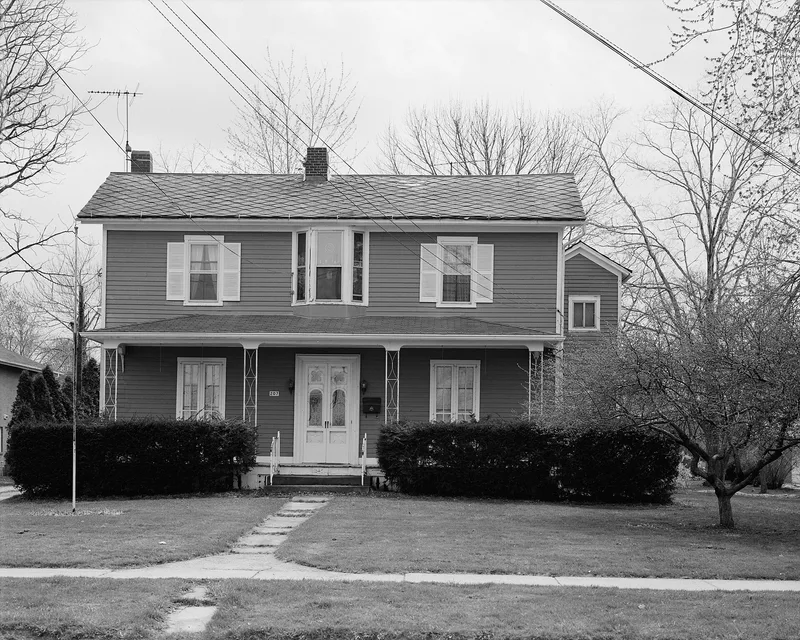
Built in 1855, this clapboard house at 207 East College Street in Oberlin, Ohio, was home to John Mercer Langston from 1856 to 1867. The house follows a vernacular tradition, with a front door bearing an elaborate Gothic revival quatrefoil carving. A central hall with a stairway leads to spacious front sitting rooms with tall French windows, original baseboards, chair rails and trim. Later additions include a brick shed, a screened porch and a two-story bathroom wing. Langston was born in Virginia in 1829 and educated at Oberlin. In 1855 he became the first known Black person elected to office in the United States, as a township clerk. He later served on the Oberlin council and school board, recruited Black troops for Massachusetts regiments, led Howard University's law department, served as minister to Haiti, and was elected to Congress from Virginia. The house was nominated because it is the only surviving residence tied to him.
Significance in brief: The nomination argues the house commemorates John Mercer Langston, who in 1855 became the first known Black person elected to office in the United States. He also organized Howard University's law department, served as a diplomat to Haiti, and was the first Black congressman elected from Virginia. The house is described as the only remaining extant residence connected with him.
Machine-generated summary. This summary was generated by a language model from the official nomination document and has not been reviewed line by line by an editor. It may contain errors. Check the source document before relying on any detail. Source: nomination document (PDF) · National Archives catalog entry. NRHP reference 75001464, listed May 15, 1975. Summary generated October 2026 (model claude-sonnet-5-5, prompt v1.0-2026-10-29, confidence medium).
Key facts
| Address | 207 E. College St., Oberlin |
|---|---|
| County | Lorain County |
| Listed | May 15, 1975 |
| Reference number | 75001464 |
| Resource type | Building |
| Period of significance | 1829-1897 (19th century) |
| Architectural style | Vernacular tradition with Gothic revival details, such as the quatrefoil carving on the front door |
| Areas of significance | Black, Politics/Government, Social History |
| Level of significance | National |
| National Historic Landmark | Yes, designated May 15, 1975 |
| Status (as stated in the nomination) | Described as in good condition on its original site, altered by additions, and in use as a private residence. |
| Acreage | 0.9 |
| Coordinates | 41.29127, -82.20979 (NPS GIS) |
What listing means for this property
National Register listing is honorary for a privately owned home: it does not by itself restrict what an owner may do with their own money, and it does not require public access. Restrictions come from local landmark or historic-district ordinances, which are separate (how they differ).
Owner-occupied houses are not eligible for the 20% federal rehabilitation tax credit, which applies to income-producing buildings, but many states offer credits for homeowners. Listing also opens the door to preservation easements and to buying a plaque. Start with what listing means for homeowners, renovating a listed house and selling one.
General information, not legal or tax advice. Rules change; confirm with your State Historic Preservation Office or a qualified adviser.
Sources and further reading
- National Park Service, National Register of Historic Places database (snapshot May 2026), reference 75001464.
- Nomination form (PDF, National Archives) — catalog entry
- Wikipedia article (used for cross-checking only; text not reproduced here)
- Wikidata Q1701068
- This listing as JSON
Last updated October 2026. Found an error? See the editorial policy for how to report it.