Cincinnati Music Hall

Why it's listed
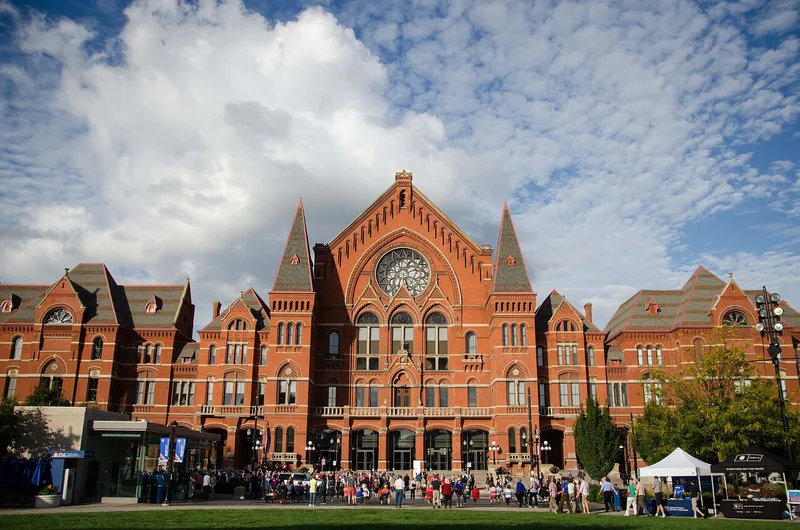
Cincinnati Music Hall is a large red brick building at 1243 Elm Street, facing Washington Park. Designed by local architects Samuel Hannaford and Henry Proctor, it was built between 1876 and 1878 and opened on May 14, 1878. A central auditorium with two balconies is flanked by wings that once held exposition space; a rose window and a 150-foot center gable mark the front, between towers with steep caps. Reuben Springer and about 600 contributors funded it as a combined concert hall and exhibition center. The hall hosted the 1880 Democratic national convention and the 1888 Centennial Exposition, and a 1895 renovation added a stage and proscenium arch for the symphony orchestra. It became the home of the Cincinnati Symphony Orchestra, May Festival and Summer Opera. After decline in the 1960s, a 1969 restoration funded largely by the Corbett family and others cost more than $3,000,000. The building is regarded as the city's musical center.
Significance in brief: The nomination cites its role as the musical center of Cincinnati and home of the Cincinnati Symphony Orchestra, May Festival and Summer Opera. It also notes the hall's architecture and its long use for public gatherings, including the 1880 Democratic national convention and major expositions. The cost and community effort of its renovation are cited as evidence of local importance.
Machine-generated summary. This summary was generated by a language model from the official nomination document and has not been reviewed line by line by an editor. It may contain errors. Check the source document before relying on any detail. Source: nomination document (PDF) · National Archives catalog entry. NRHP reference 70000496, listed January 26, 1970. Summary generated October 2026 (model claude-sonnet-5-5, prompt v1.0-2026-10-29, confidence high).
Key facts
| Address | 1243 Elm St., Cincinnati |
|---|---|
| County | Hamilton County |
| Listed | January 26, 1970 |
| Reference number | 70000496 |
| Resource type | Building |
| Period of significance | 1878 (19th and 20th centuries checked) |
| Architect / builder | S. Hannaford & Henry Proctor (architects); James Griffith (builder) |
| Architectural style | High Victorian Gothic; described in 1878 as "Italianesque Gothic" and later as eclectic |
| Areas of significance | Architecture, Performing Arts |
| Level of significance | National |
| National Historic Landmark | Yes, designated December 2, 1974 |
| Status (as stated in the nomination) | Condition listed as excellent inside and out; in use for concerts, meetings, expositions and conventions; stage remodeled in 1969. |
| Acreage | 0.9 |
| Within district | Over-the-Rhine Historic District |
| Coordinates | 39.10946, -84.51897 (NPS GIS) |
What listing means for this property
National Register listing is honorary for a privately owned home: it does not by itself restrict what an owner may do with their own money, and it does not require public access. Restrictions come from local landmark or historic-district ordinances, which are separate (how they differ).
Owner-occupied houses are not eligible for the 20% federal rehabilitation tax credit, which applies to income-producing buildings, but many states offer credits for homeowners. Listing also opens the door to preservation easements and to buying a plaque. Start with what listing means for homeowners, renovating a listed house and selling one.
General information, not legal or tax advice. Rules change; confirm with your State Historic Preservation Office or a qualified adviser.
Sources and further reading
- National Park Service, National Register of Historic Places database (snapshot May 2026), reference 70000496.
- Nomination form (PDF, National Archives) — catalog entry
- Wikipedia article (used for cross-checking only; text not reproduced here)
- Wikidata Q9289351
- This listing as JSON
Last updated October 2026. Found an error? See the editorial policy for how to report it.