East Town Street Historic District

Why it's listed
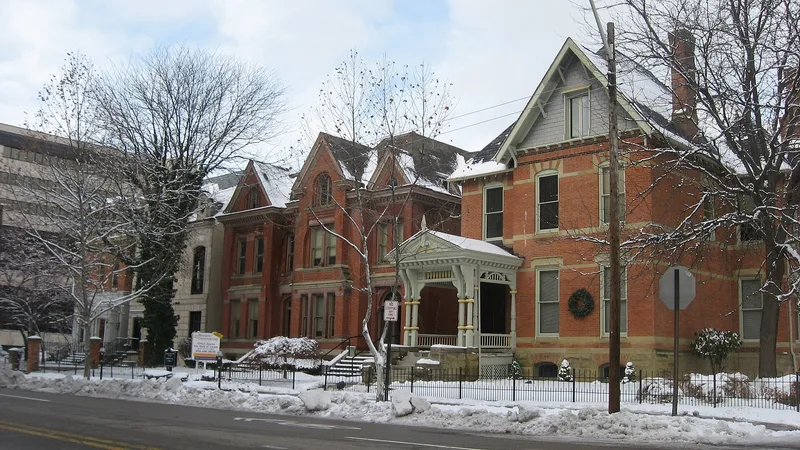
East Town Street Historic District covers about 45 acres east of downtown Columbus. It is made up mainly of residences from the mid- to late nineteenth century, some now used as offices, apartments or shops. The houses show a range of styles, including Italianate, Second Empire, Greek Revival and Queen Anne. Among them are an Italianate mansion built around 1852 that served as a temporary Governor's Mansion during the Civil War, the 1852 Kelton House, and the 1873 Spahr House designed by George Bellows, Sr. The district is also linked to national figures. Harry M. Daugherty, later U.S. Attorney General, built a house here in 1904, and Allen G. Thurman, a U.S. Senator and vice-presidential candidate, built one on East Rich Street in 1879. The area has seen some infill and modern intrusions, including small apartment buildings and one high-rise, but the townhouses still dominate its character. It was listed for its architectural distinction and its historical associations.
Significance in brief: The nomination argues the district contains some of the finest and most lavish mid-nineteenth-century residential architecture in Columbus and Central Ohio, in a variety of styles. It also notes ties to notable figures, including Harry M. Daugherty, Allen G. Thurman and Governor David Todd. Much of the neighborhood remains intact despite some infill and intrusions.
Machine-generated summary. This summary was generated by a language model from the official nomination document and has not been reviewed line by line by an editor. It may contain errors. Check the source document before relying on any detail. Source: nomination document (PDF) · National Archives catalog entry. NRHP reference 76001425, listed July 30, 1976. Summary generated October 2026 (model claude-sonnet-5-5, prompt v1.0-2026-10-29, confidence medium).
Key facts
| Address | Roughly bounded by Grant and Franklin Aves., Lester Dr., and E. Rich St., Columbus |
|---|---|
| County | Franklin County |
| Listed | July 30, 1976 |
| Reference number | 76001425 |
| Resource type | District |
| Architect / builder | George Bellows, Sr. (Spahr House, 1873); Miller and Reeves (1924 portico); Abram B. Cohen (Trimmers Manor, 1888); W.H. Richards (565 East Town Street, 1882); W.C. Halliday (Queen Anne house, 1896); Philp T. Snowden (Kappa Kappa Gamma house) |
| Architectural style | Varied Victorian-era styles: Italianate, Second Empire, Greek Revival, Queen Anne |
| Areas of significance | Politics/Government, Architecture |
| Level of significance | State |
| Status (as stated in the nomination) | Mostly residential, with some houses converted to offices, apartments or retail. A few are in disrepair or vacant, such as 579 East Rich Street. |
| Acreage | 45 |
| Coordinates | 39.96024, -82.98515 (NPS GIS) |
What listing means for this property
This is a historic district. Buildings within its boundary are either contributing (they add to the district's significance) or non-contributing. Owners of contributing income-producing buildings can claim the 20% federal rehabilitation tax credit; homeowners should look at state credits. National Register districts impose no design review by themselves; a local historic district ordinance, if one exists, does (the difference explained).
General information, not legal or tax advice. Rules change; confirm with your State Historic Preservation Office or a qualified adviser.
Sources and further reading
- National Park Service, National Register of Historic Places database (snapshot May 2026), reference 76001425.
- Nomination form (PDF, National Archives) — catalog entry
- Wikipedia article (used for cross-checking only; text not reproduced here)
- Wikidata Q49485346
- This listing as JSON
Last updated October 2026. Found an error? See the editorial policy for how to report it.