Jefferson Avenue Historic District

Why it's listed
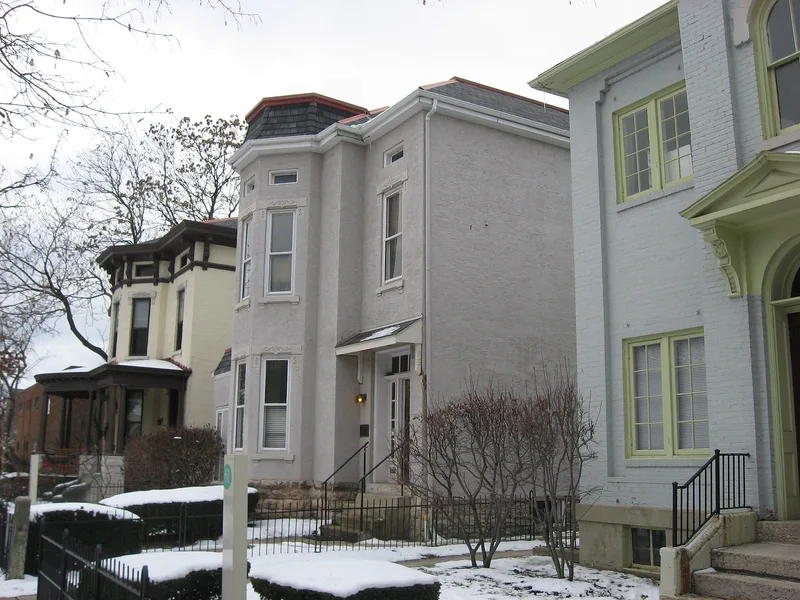
Jefferson Avenue Historic District is a single block of late nineteenth-century brick houses on the eastern edge of downtown Columbus, Ohio. About nine structures line both sides of a street divided by an elliptical green space with mature shade trees, which gives the avenue a boulevard effect. The street was platted in 1870 as part of the East Park Place Addition, and development was complete by 1900. Most buildings are two or two-and-a-half-story brick residences in the Italianate manner, with stone lintels, stained or art glass, interior woodwork and iron fencing. Many have been stuccoed, altered or added to, and some are deteriorated, yet the group keeps a cohesive feel. Interstate 71 destroyed the neighboring Lexington Avenue, leaving Jefferson Avenue as a rare downtown remnant of its kind. The district is also tied to humorist James Thurber, who lived at 77 Jefferson Avenue from 1913 to 1915 and set a well-known short story there.
Significance in brief: The district is significant as a compact, planned group of late nineteenth-century residences next to downtown, where few such neighborhoods remain. Its boulevard plan with a central elliptical park was unique in the city. The buildings share scale, massing, style and materials, and 77 Jefferson Avenue was the home of writer James Thurber from 1913 to 1915.
Machine-generated summary. This summary was generated by a language model from the official nomination document and has not been reviewed line by line by an editor. It may contain errors. Check the source document before relying on any detail. Source: nomination document (PDF) · National Archives catalog entry. NRHP reference 82001459, listed December 2, 1982. Summary generated October 2026 (model claude-sonnet-5-5, prompt v1.0-2026-10-29, confidence medium).
Key facts
| Address | Roughly bounded by I-71, E. Broad, 11th, and Long Sts., Columbus |
|---|---|
| County | Franklin County |
| Listed | December 2, 1982 |
| Reference number | 82001459 |
| Resource type | District |
| Period of significance | 1800-1899 (specific dates 1870, 1880s-1900) |
| Architectural style | Italianate, residential in character |
| Areas of significance | Literature, Architecture |
| Level of significance | Local |
| Status (as stated in the nomination) | Buildings are somewhat deteriorated and altered, with some west-side structures lost. Most are owned by a non-profit educational organization planning rehabilitation; one building is in use as a church and under rehabilitation. |
| Acreage | 5.5 |
| Coordinates | 39.96552, -82.98508 (NPS GIS) |
What listing means for this property
This is a historic district. Buildings within its boundary are either contributing (they add to the district's significance) or non-contributing. Owners of contributing income-producing buildings can claim the 20% federal rehabilitation tax credit; homeowners should look at state credits. National Register districts impose no design review by themselves; a local historic district ordinance, if one exists, does (the difference explained).
General information, not legal or tax advice. Rules change; confirm with your State Historic Preservation Office or a qualified adviser.
Sources and further reading
- National Park Service, National Register of Historic Places database (snapshot May 2026), reference 82001459.
- Nomination form (PDF, National Archives) — catalog entry
- Wikipedia article (used for cross-checking only; text not reproduced here)
- Wikidata Q97354809
- This listing as JSON
Last updated October 2026. Found an error? See the editorial policy for how to report it.