Cable, Laurence House

Why it's listed
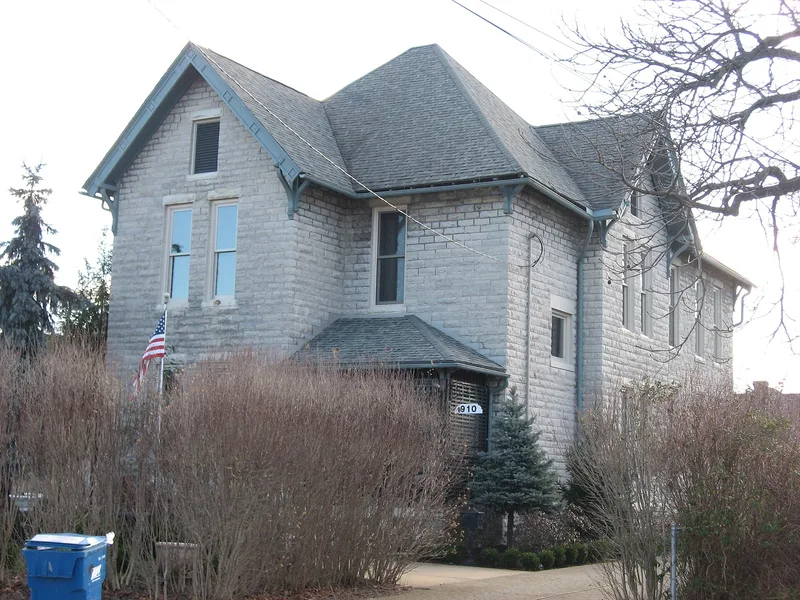
This two-and-a-half-story house at 910 W. Monroe Street in Sandusky was built in 1878 in the Eastlake style. Its walls and foundation are rock-faced limestone, and a hipped shingle roof with gables covers the irregular plan. Wooden trim and corner brackets decorate the gables and eaves, the windows have stone lintels and sills, and a heavily ornamented bay window faces east. Double front doors carry iron grillwork, and the front porch, with turned wooden posts and spindles, rests on a single slab of native limestone measuring six by twelve feet. A side porch was enclosed in the 1950s. The house was home to Laurence Cable, a German who settled in Sandusky in 1844. He worked as a carpenter, built railroad cars, owned a shoe store, helped found the Third National Bank and presided over it for more than thirty years. He also funded the purchase of the house that started Providence Hospital. It remains a private dwelling in a well-kept neighborhood.
Significance in brief: The house is significant as the home of Laurence Cable, a German immigrant who became one of Sandusky's leading citizens. He settled in Sandusky in 1844, worked as a carpenter and railroad car builder, ran a shoe store, helped found the Third National Bank and served as its president for over thirty years. He also gave the money to buy the house that began Providence Hospital.
Machine-generated summary. This summary was generated by a language model from the official nomination document and has not been reviewed line by line by an editor. It may contain errors. Check the source document before relying on any detail. Source: nomination document (PDF) · National Archives catalog entry. NRHP reference 82001383, listed October 20, 1982. Summary generated October 2026 (model claude-sonnet-5-5, prompt v1.0-2026-10-29, confidence medium).
Key facts
| Address | 910 W. Monroe St., Sandusky |
|---|---|
| County | Erie County |
| Listed | October 20, 1982 |
| Reference number | 82001383 |
| Resource type | Building |
| Period of significance | 1878 |
| Architectural style | Eastlake |
| Areas of significance | Architecture, Social History |
| Level of significance | Local |
| Status (as stated in the nomination) | Used as a dwelling; interior in very good condition and exterior in excellent condition. A side porch was enclosed in the 1950s. |
| Acreage | 0.9 |
| Coordinates | 41.44762, -82.71454 (NPS GIS) |
What listing means for this property
National Register listing is honorary for a privately owned home: it does not by itself restrict what an owner may do with their own money, and it does not require public access. Restrictions come from local landmark or historic-district ordinances, which are separate (how they differ).
Owner-occupied houses are not eligible for the 20% federal rehabilitation tax credit, which applies to income-producing buildings, but many states offer credits for homeowners. Listing also opens the door to preservation easements and to buying a plaque. Start with what listing means for homeowners, renovating a listed house and selling one.
General information, not legal or tax advice. Rules change; confirm with your State Historic Preservation Office or a qualified adviser.
Sources and further reading
- National Park Service, National Register of Historic Places database (snapshot May 2026), reference 82001383.
- Nomination form (PDF, National Archives) — catalog entry
- Wikidata Q137771532
- This listing as JSON
Last updated October 2026. Found an error? See the editorial policy for how to report it.