Pennsylvania House

Why it's listed
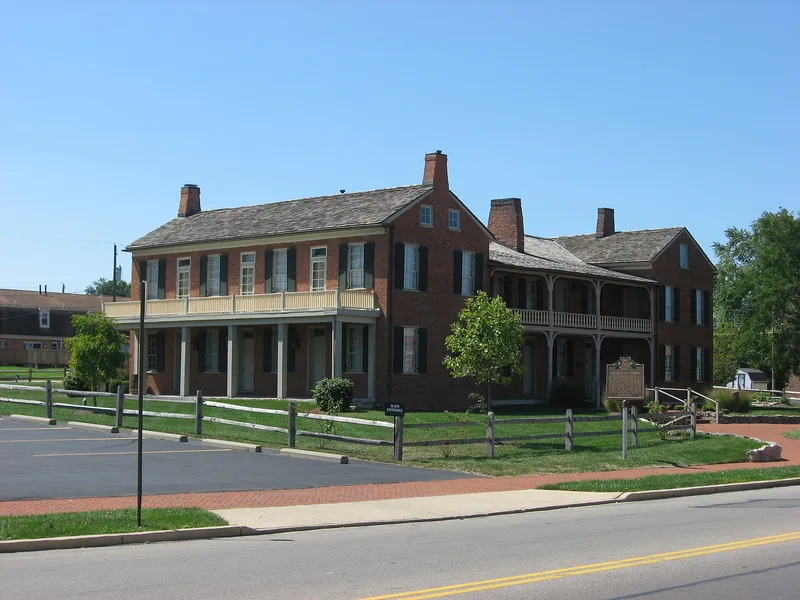
Built around 1822 in Springfield, Ohio, the Pennsylvania House is a three-story Federal style inn and tavern of white brick with a gabled roof, set between the National Road and the Old Dayton-Springfield Pike. Its walls are made of local clay brick on rubble stone foundations. The original T-shaped plan gained a matching west wing in the mid-1850s. Inside, a large central stairway, paneled storage walls, fireplaces and woodwork show fine craftsmanship. The inn served pioneers, wagon men, stagecoach traffic and drovers heading to Cincinnati, with drovers typically lodged in third-floor dormitory rooms. Dr. Isaac K. Funk, later a publisher, spent six childhood years there, and his letters helped prevent demolition in 1910. The inn closed in 1869 after the railroad drew traffic away from the National Road. After years of varied uses and disrepair, a local chapter of the Daughters of the American Revolution acquired it in 1937, repaired it and opened it as a museum. Further improvements were carried out in 1971.
Significance in brief: It is presented as a typical Federal style inn that served travelers on the National Road, including pioneers, wagon men, stagecoach passengers and drovers. It is tied to Dr. Isaac K. Funk, who spent part of his childhood there, and its preservation was won through campaigns against demolition in 1910 and 1937.
Machine-generated summary. This summary was generated by a language model from the official nomination document and has not been reviewed line by line by an editor. It may contain errors. Check the source document before relying on any detail. Source: nomination document (PDF) · National Archives catalog entry. NRHP reference 73001396, listed April 11, 1973. Summary generated October 2026 (model claude-sonnet-5-5, prompt v1.0-2026-10-29, confidence high).
Key facts
| Address | 1311 W. Main St., Springfield |
|---|---|
| County | Clark County |
| Listed | April 11, 1973 |
| Reference number | 73001396 |
| Resource type | Building |
| Period of significance | 19th Century (ca. 1822) |
| Architectural style | Federal |
| Areas of significance | Transportation, Architecture |
| Level of significance | State |
| Status (as stated in the nomination) | Operated as a museum filled with antiques and period pieces by the owning Daughters of the American Revolution chapter; fourteen of twenty-three rooms are on display. The form lists the status as both occupied and unoccupied, with a resident caretaker's apartment on the second floor of the west wing. |
| Acreage | 0.9 |
| Coordinates | 39.92554, -83.83259 (NPS GIS) |
What listing means for this property
National Register listing is honorary for a privately owned home: it does not by itself restrict what an owner may do with their own money, and it does not require public access. Restrictions come from local landmark or historic-district ordinances, which are separate (how they differ).
Owner-occupied houses are not eligible for the 20% federal rehabilitation tax credit, which applies to income-producing buildings, but many states offer credits for homeowners. Listing also opens the door to preservation easements and to buying a plaque. Start with what listing means for homeowners, renovating a listed house and selling one.
General information, not legal or tax advice. Rules change; confirm with your State Historic Preservation Office or a qualified adviser.
Sources and further reading
- National Park Service, National Register of Historic Places database (snapshot May 2026), reference 73001396.
- Nomination form (PDF, National Archives) — catalog entry
- Wikipedia article (used for cross-checking only; text not reproduced here)
- Wikidata Q7163762
- This listing as JSON
Last updated October 2026. Found an error? See the editorial policy for how to report it.