Rogers-Bagley-Daniels-Pegues House

Why it's listed
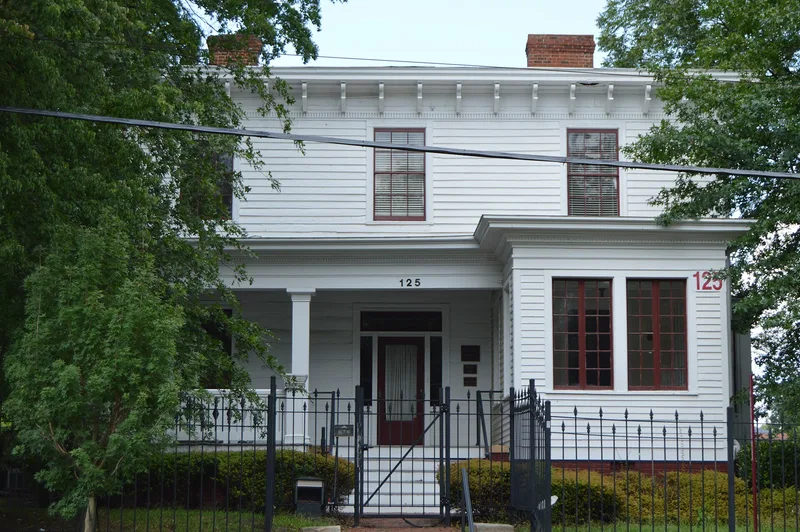
Built around 1855 on the northwest corner of Blount and East South Streets in Raleigh, this boxy frame house combines Greek Revival design with Italianate touches. Its low hip roof, scrolled S-shaped brackets, carved anthemions, and a fluted-pilaster corner treatment give it unusual detail. Inside, a center hall is divided by a doorway and screen with sidelights and a carved anthemion and honeysuckle frieze. Sion Hart Rogers, a congressman and North Carolina attorney general, built it. Major William H. Bagley, a state senator and clerk of the state Supreme Court, bought it in 1873; his son Worth Bagley was the first American officer killed in the Spanish-American War. His son-in-law Josephus Daniels, the newspaper editor, later Navy secretary and ambassador to Mexico, lived there, and his son Jonathan was born in the house. In 1919 it passed to Albert W. Pegues, a Black educator at Shaw University. It is one of few antebellum buildings left in the area.
Significance in brief: The house is a distinctive example of Greek Revival architecture with Italianate accents and one of the few surviving antebellum buildings in the original city limits of Raleigh. It is also tied to a series of prominent residents: Sion Hart Rogers, Major William H. Bagley, Josephus Daniels, and Dr. Albert W. Pegues, a noted Black educator at Shaw University.
Machine-generated summary. This summary was generated by a language model from the official nomination document and has not been reviewed line by line by an editor. It may contain errors. Check the source document before relying on any detail. Source: nomination document (PDF) · National Archives catalog entry. NRHP reference 79001759, listed March 21, 1979. Summary generated October 2026 (model claude-sonnet-5-5, prompt v1.0-2026-10-29, confidence high).
Key facts
| Address | 125 E. South St., Raleigh |
|---|---|
| County | Wake County |
| Listed | March 21, 1979 |
| Reference number | 79001759 |
| Resource type | Building |
| Period of significance | 1800-1899 |
| Architect / builder | Sion Hart Rogers (builder) |
| Architectural style | Greek Revival with Italianate accents |
| Criteria |
|
| Areas of significance | Politics/Government, Architecture |
| Level of significance | National, State, Local |
| Status (as stated in the nomination) | Occupied private residence in good condition, with some exterior and interior alterations. |
| Acreage | 0.9 |
| Within district | East Raleigh-South Park Historic District |
| Coordinates | 35.77220, -78.63725 (NPS GIS) |
What listing means for this property
National Register listing is honorary for a privately owned home: it does not by itself restrict what an owner may do with their own money, and it does not require public access. Restrictions come from local landmark or historic-district ordinances, which are separate (how they differ).
Owner-occupied houses are not eligible for the 20% federal rehabilitation tax credit, which applies to income-producing buildings, but many states offer credits for homeowners. Listing also opens the door to preservation easements and to buying a plaque. Start with what listing means for homeowners, renovating a listed house and selling one.
General information, not legal or tax advice. Rules change; confirm with your State Historic Preservation Office or a qualified adviser.
Sources and further reading
- National Park Service, National Register of Historic Places database (snapshot May 2026), reference 79001759.
- Nomination form (PDF, National Archives) — catalog entry
- Wikipedia article (used for cross-checking only; text not reproduced here)
- Wikidata Q21016134
- This listing as JSON
Last updated October 2026. Found an error? See the editorial policy for how to report it.