Raleigh, Sir Walter, Hotel

Why it's listed
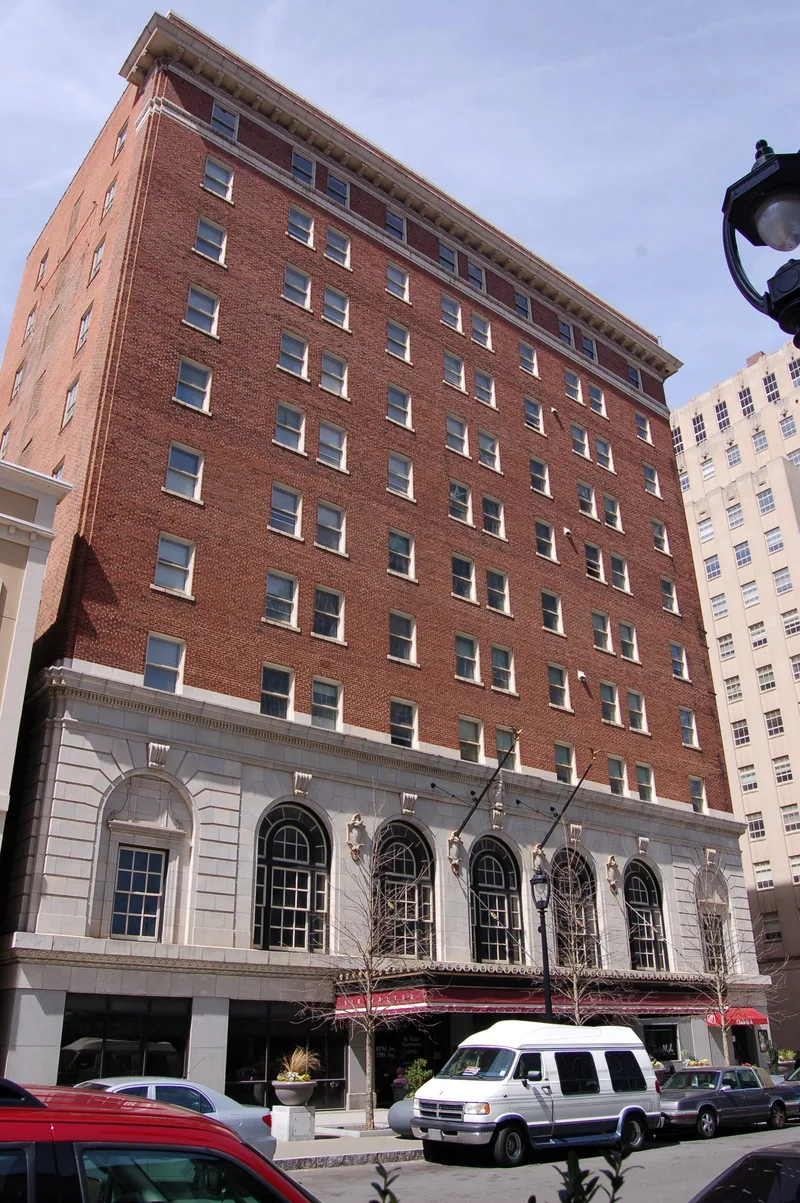
Rising ten stories at the corner of Fayetteville and Davie Streets in Raleigh, the Sir Walter Hotel opened in January 1924 as a large, convention-oriented hotel designed by J. A. Salter. Its brick, L-shaped form carries classical ornament: a gray striated stone base with arched openings and scroll keystones, modillioned cornices, and a stone-capped parapet. Six bays were added at the west end in 1938-1939 to match the original block. The hotel's importance lies in state politics. Legislators, lobbyists, newspapermen and others gathered there through the 1930s, 1940s and 1950s, since offices near the Capitol were scarce, and it came to be called the "third house of state government." It was also a mainstay of Raleigh's convention trade and was the largest hotel in the state after its late-1930s expansion. Falling revenues, motels and a new Legislative Building in 1963 reduced its role, and conversion to apartments was under consideration.
Significance in brief: The nomination argues the hotel is a Raleigh landmark as the chief surviving major hotel of the city's earlier hotels. Its statewide significance lies in its role in twentieth-century North Carolina politics: through the 1930s to 1950s it served as an unofficial headquarters for legislators, lobbyists and newspapermen, earning the label "third house of state government."
Machine-generated summary. This summary was generated by a language model from the official nomination document and has not been reviewed line by line by an editor. It may contain errors. Check the source document before relying on any detail. Source: nomination document (PDF) · National Archives catalog entry. NRHP reference 78001980, listed August 11, 1978. Summary generated October 2026 (model claude-sonnet-5-5, prompt v1.0-2026-10-29, confidence high).
Key facts
| Address | 400--412 Fayetteville St., Raleigh |
|---|---|
| County | Wake County |
| Listed | August 11, 1978 |
| Reference number | 78001980 |
| Resource type | Building |
| Period of significance | 1900- |
| Architect / builder | Architect J. A. Salter; built by B. H. Griffin, contracted by C. N. York |
| Architectural style | 1920s hotel with classical ornament at street and roof levels |
| Areas of significance | Politics/Government, Architecture |
| Level of significance | State |
| Status (as stated in the nomination) | Listed as in good condition and occupied; the ground floor and interior have been remodeled. Conversion into apartments was being considered at the time of nomination. |
| Acreage | 0.9 |
| Coordinates | 35.77540, -78.63981 (NPS GIS) |
What listing means for this property
For an income-producing building, listing (individually or as a contributing building in a district) is the gateway to the 20% federal rehabilitation tax credit on qualified rehabilitation costs, often stackable with state credits. Work claiming the credit must follow the Secretary of the Interior's Standards and be approved in advance.
Listing does not restrict a private owner acting without federal money or permits; where federal funding or licensing is involved, Section 106 review applies.
General information, not legal or tax advice. Rules change; confirm with your State Historic Preservation Office or a qualified adviser.
Sources and further reading
- National Park Service, National Register of Historic Places database (snapshot May 2026), reference 78001980.
- Nomination form (PDF, National Archives) — catalog entry
- Wikipedia article (used for cross-checking only; text not reproduced here)
- Wikidata Q7529401
- This listing as JSON
Last updated October 2026. Found an error? See the editorial policy for how to report it.