Dodd-Hinsdale House

Why it's listed
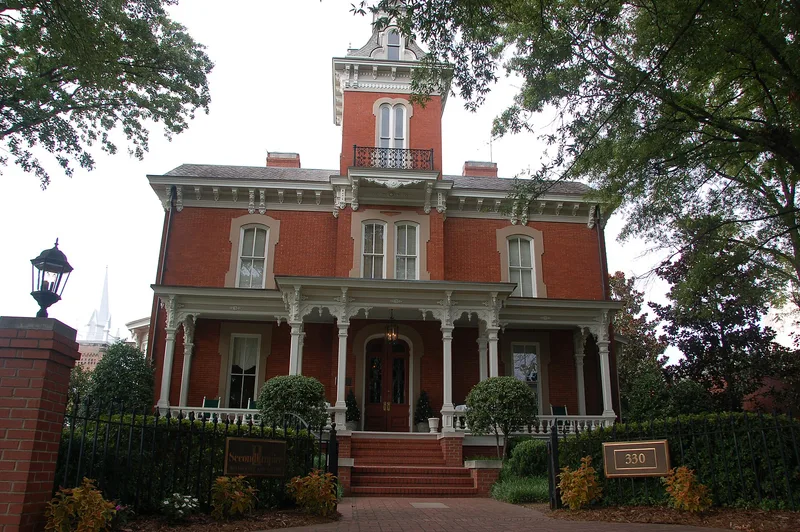
Set well back from busy Hillsborough Street in Raleigh, this red brick townhouse was probably built around 1887 for William H. Dodd, a city mayor. Financial trouble led to its sale in 1889, and John W. Hinsdale, a lawyer for the Seaboard Airline Railroad system in North Carolina, bought it in 1890. It stayed in the Hinsdale family for decades. The house combines a rigidly symmetrical gabled block with a three-and-one-half story tower topped by a mansard roof, slate shingles and cast-iron balcony details. Italianate windows, Eastlake-style labels and bracketed eaves add to the mix, and angular brick window surrounds contrast with the wooden trim. Inside, a center-hall plan, inlaid marble mantels, plaster medallions and many original furnishings survive, and interior walls are solid brick. The nomination values it chiefly for architecture, noting it remains a Victorian presence despite commercial buildings on three sides and a high-rise tower to the east.
Significance in brief: The nomination argues the house is significant mainly for its architecture rather than its history. Its effect comes from the red pressed brick, the ornamental wooden trim and the Second Empire mansard tower, with brick window surrounds as an ingenious decorative use of masonry. It survives as a Victorian landmark amid commercial development.
Machine-generated summary. This summary was generated by a language model from the official nomination document and has not been reviewed line by line by an editor. It may contain errors. Check the source document before relying on any detail. Source: nomination document (PDF) · National Archives catalog entry. NRHP reference 71000623, listed November 12, 1971. Summary generated October 2026 (model claude-sonnet-5-5, prompt v1.0-2026-10-29, confidence high).
Key facts
| Address | 330 Hillsborough St., Raleigh |
|---|---|
| County | Wake County |
| Listed | November 12, 1971 |
| Reference number | 71000623 |
| Resource type | Building |
| Period of significance | 19th Century |
| Architect / builder | Builder possibly Thomas Briggs, a Raleigh merchant (no proof found); built for William H. Dodd |
| Architectural style | High Victorian (Second Empire tower with Italianate and Eastlake influences) |
| Areas of significance | Architecture |
| Level of significance | Local |
| Status (as stated in the nomination) | Described as in good condition and altered, with a private residence use. It stands on a commercially encroached site, and its original interior is largely intact. |
| Acreage | 0.3 |
| Within district | Depot Historic District |
| Coordinates | 35.77987, -78.64056 (NPS GIS) |
What listing means for this property
National Register listing is honorary for a privately owned home: it does not by itself restrict what an owner may do with their own money, and it does not require public access. Restrictions come from local landmark or historic-district ordinances, which are separate (how they differ).
Owner-occupied houses are not eligible for the 20% federal rehabilitation tax credit, which applies to income-producing buildings, but many states offer credits for homeowners. Listing also opens the door to preservation easements and to buying a plaque. Start with what listing means for homeowners, renovating a listed house and selling one.
General information, not legal or tax advice. Rules change; confirm with your State Historic Preservation Office or a qualified adviser.
Sources and further reading
- National Park Service, National Register of Historic Places database (snapshot May 2026), reference 71000623.
- Nomination form (PDF, National Archives) — catalog entry
- Wikipedia article (used for cross-checking only; text not reproduced here)
- Wikidata Q5287722
- This listing as JSON
Last updated October 2026. Found an error? See the editorial policy for how to report it.