Carolina Coach Garage and Shop
Carolina Coach Garage and Shop is a building in Raleigh, Wake County, North Carolina, listed on the National Register of Historic Places on August 27, 2009 (reference number 09000661). The National Park Service records its significance in Transportation at the local level.
Facts from the NPS National Register database (); nomination summary October 2026. Last updated . Sources for each fact.

Approximate location: the National Park Service places this pin arbitrarily within the property, not at a surveyed point (stated accuracy ±12 m).
Why it's listed
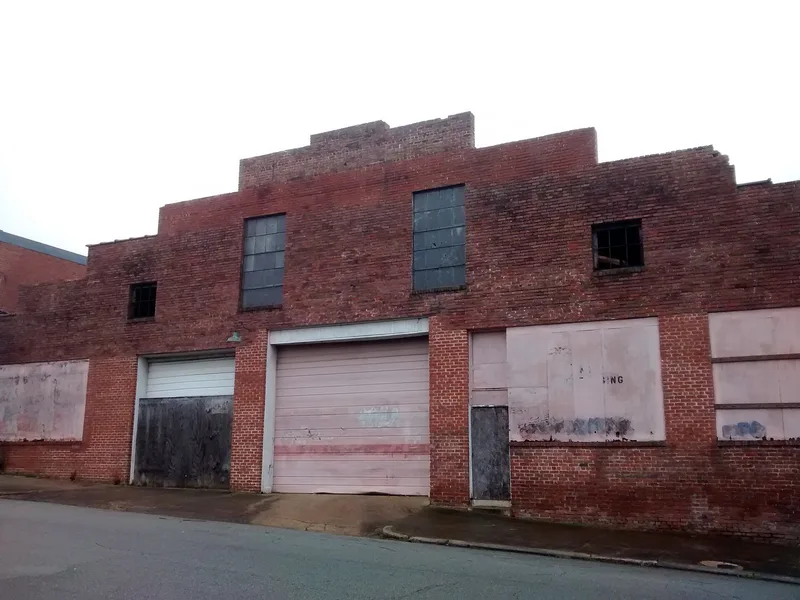
Built in 1926 at 510 East Davie Street in Raleigh, this brick garage and repair shop served the Carolina Coach Company, which had been incorporated in the city in 1925. The building cost $100,000 and housed buses, repair work and company headquarters until the company moved to a larger complex on South Blount Street in 1939. Its roughly 12,500-square-foot interior is open and unbroken by interior walls, spanned by steel I-beam posts and prefabricated roof trusses that rise about thirty feet at the apex. The stepped parapet, terra cotta coping and skylights mark its exterior. The building is linked to the growth of intercity bus service in North Carolina, especially the Trailways network Carolina Coach joined. Its open plan is regarded as an uncommon survivor among early Raleigh automotive buildings, and it retains a high degree of integrity of form, plan and materials.
Significance in brief: The nomination argues the building is significant for its local association with intercity bus transportation, the Carolina Coach Company's operations in Raleigh from 1926 to 1939. It is described as one of two surviving Raleigh buildings tied to intercity busing and one of few surviving early automotive garages in the city with an open floor plan. Its unobstructed interior, supported by a clear-span truss system, is presented as its main character-defining feature.
Machine-generated summary. This summary was generated by a language model from the official nomination document and has not been reviewed line by line by an editor. It may contain errors. Check the source document before relying on any detail. Source: nomination document (PDF) · National Archives catalog entry. NRHP reference 09000661, listed August 27, 2009. Summary generated October 2026 (model claude-haiku-5-5, prompt v1.1-2026-10-29, confidence high).
Key facts
| Official database NPS National Register database, ref. 09000661 , checked | |
|---|---|
| Address | 510 E. Davie St., Raleigh |
| County | Wake County |
| Listed | August 27, 2009 |
| Reference number | 09000661 |
| Resource type | Building |
| Areas of significance | Transportation |
| Level of significance | Local |
| National Historic Landmark | No |
| Acreage | 0.6 |
| Official document, machine-extracted Nomination form (National Archives) , checked | |
| Period of significance | c. 1926-1939 |
| Architectural style | No style |
| Criteria |
|
| Status (as stated in the nomination) | Deteriorated in places; the roof is described as rotten and failing at the northwest corner. The building was vacant between 1939 and 1944 and later used for other purposes. |
| Official dataset NPS cultural-resource GIS (NRHP locations) | |
| Coordinates | 35.77714, -78.63179 |
| Computed Computed from NPS GIS district boundaries | |
| Within district | East Raleigh-South Park Historic District |
What listing means for this property
For an income-producing building, listing (individually or as a contributing building in a district) is the gateway to the 20% federal rehabilitation tax credit on qualified rehabilitation costs, often stackable with state credits. Work claiming the credit must follow the Secretary of the Interior's Standards and be approved in advance.
Listing does not restrict a private owner acting without federal money or permits; where federal funding or licensing is involved, Section 106 review applies.
General information, not legal or tax advice. Rules change; confirm with your State Historic Preservation Office or a qualified adviser.
Questions about Carolina Coach Garage and Shop
When was Carolina Coach Garage and Shop added to the National Register of Historic Places?
Carolina Coach Garage and Shop was listed on August 27, 2009. Its National Register reference number is 09000661.
Is Carolina Coach Garage and Shop a National Historic Landmark?
No. The National Park Service database (snapshot of May 2026) lists Carolina Coach Garage and Shop on the National Register but does not record it as a National Historic Landmark.
Where is Carolina Coach Garage and Shop?
510 E. Davie St., Raleigh, Wake County, North Carolina; coordinates 35.77714, -78.63179.
Why is Carolina Coach Garage and Shop historically significant?
According to a machine-generated summary of its nomination form: The nomination argues the building is significant for its local association with intercity bus transportation, the Carolina Coach Company's operations in Raleigh from 1926 to 1939. It is described as one of two surviving Raleigh buildings tied to intercity busing and one of few surviving early automotive garages in the city with an open floor plan. Its unobstructed interior, supported by a clear-span truss system, is presented as its main character-defining feature. Check the nomination document before relying on any detail.
Is Carolina Coach Garage and Shop in a historic district?
Yes. Its location falls within the East Raleigh-South Park Historic District, itself listed on the National Register. (Computed from National Park Service boundary data; the district nomination's own list of contributing resources may differ.)
Where can I read the original nomination for Carolina Coach Garage and Shop?
The nomination form is a public record held by the National Archives: nomination document (PDF).
Sources and further reading
- National Park Service, National Register of Historic Places database (snapshot May 2026), reference 09000661.
- Nomination form (PDF, National Archives) — catalog entry
- Wikipedia article (used for cross-checking only; text not reproduced here)
- Wikidata Q20708415
- This listing as JSON
Last updated November 2026. Found an error? See the editorial policy for how to report it.