Haywood Hall
Also known as: Treasurer John Haywood House; See Also:78001978

Why it's listed
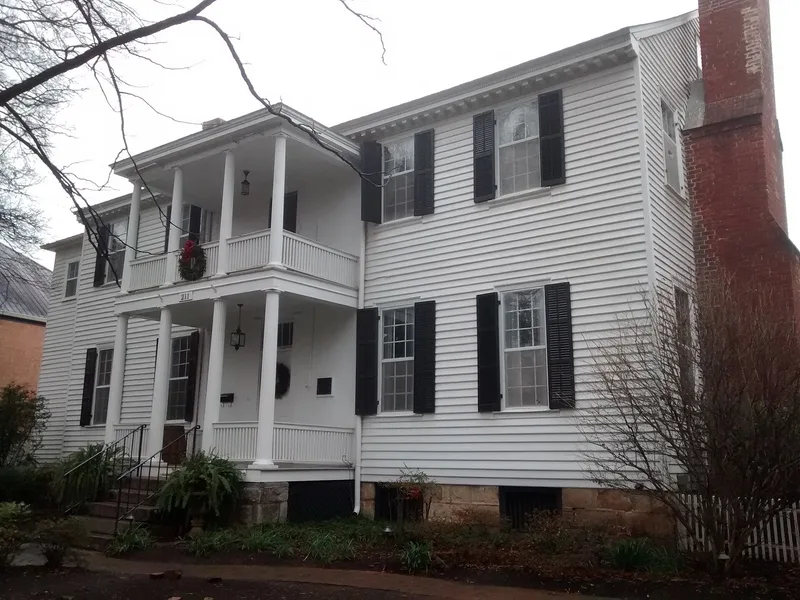
Haywood Hall is a two-story Federal-style house on New Bern Avenue in Raleigh, begun in 1792 by John Haywood. Haywood served as North Carolina's state treasurer for forty years and moved to Raleigh when a law required state officers to live in the new capital. The five-bay south front has a two-story portico with slender fluted Doric columns, and the walls are beaded weatherboard under a modillion cornice. Inside, the parlor has a paneled dado, a chair rail with incised Wall of Troy decoration, and an elaborate mantel and overmantel. The stair hall is unusual, partly enclosed with sheathed walls and a pointed-arch ceiling. A former kitchen and two stables survive in the garden. Haywood also helped found the University of North Carolina, the Raleigh Academy and Christ Church. The house is ranked among Raleigh's best Federal houses and belongs to a group with similar woodwork, apparently by one unidentified builder, which makes it important for studying the state's early architecture.
Significance in brief: It is described as one of the best and most interesting Federal style houses in Raleigh, with elaborate vernacular interior woodwork shared with a small group of nearby houses. It is also tied to John Haywood, who served as state treasurer for forty years and helped found the University of North Carolina and other institutions. The form says it is essential to the study of the state's early architecture.
Machine-generated summary. This summary was generated by a language model from the official nomination document and has not been reviewed line by line by an editor. It may contain errors. Check the source document before relying on any detail. Source: nomination document (PDF) · National Archives catalog entry. NRHP reference 70000470, listed July 28, 1970. Summary generated October 2026 (model claude-sonnet-5-5, prompt v1.0-2026-10-29, confidence high).
Key facts
| Address | 211 New Bern Ave., Raleigh |
|---|---|
| County | Wake County |
| Listed | July 28, 1970 |
| Reference number | 70000470 |
| Resource type | Building |
| Period of significance | 1790's |
| Architectural style | Federal |
| Areas of significance | Politics/Government, Architecture |
| Level of significance | State |
| Status (as stated in the nomination) | Listed in good condition, altered, on its original site; preservation work in progress. Used as a private residence, with original furnishings still in the house. |
| Acreage | 1 |
| Within district | Capitol Area Historic District |
| Coordinates | 35.78084, -78.63577 (NPS GIS) |
What listing means for this property
National Register listing is honorary for a privately owned home: it does not by itself restrict what an owner may do with their own money, and it does not require public access. Restrictions come from local landmark or historic-district ordinances, which are separate (how they differ).
Owner-occupied houses are not eligible for the 20% federal rehabilitation tax credit, which applies to income-producing buildings, but many states offer credits for homeowners. Listing also opens the door to preservation easements and to buying a plaque. Start with what listing means for homeowners, renovating a listed house and selling one.
General information, not legal or tax advice. Rules change; confirm with your State Historic Preservation Office or a qualified adviser.
Sources and further reading
- National Park Service, National Register of Historic Places database (snapshot May 2026), reference 70000470.
- Nomination form (PDF, National Archives) — catalog entry
- Wikipedia article (used for cross-checking only; text not reproduced here)
- Wikidata Q20065099
- This listing as JSON
Last updated October 2026. Found an error? See the editorial policy for how to report it.