Monroe Downtown Historic District
Also known as: See Also:Old Union County Courthouse

Why it's listed
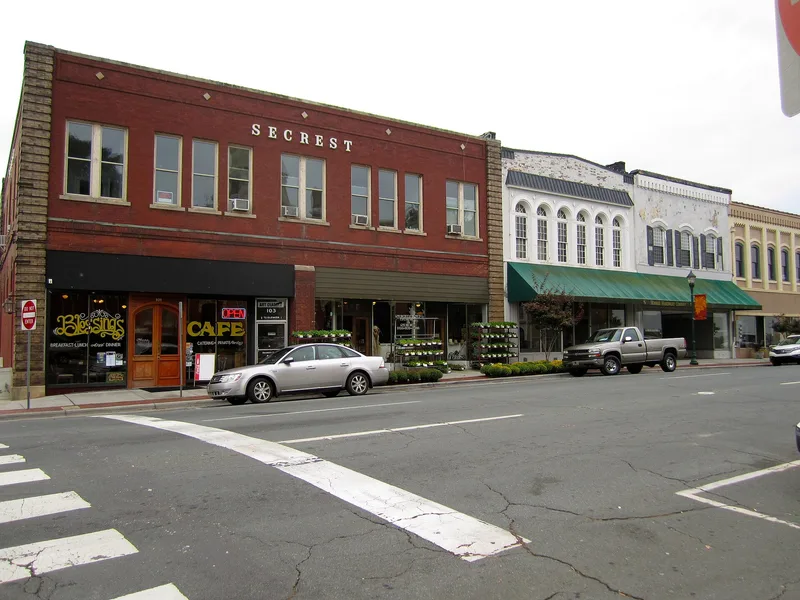
Downtown Monroe's commercial core, grouped around a landscaped courthouse square, is made up of about six blocks of masonry buildings from 1875 to the early 1930s. The 1888 Old Union County Courthouse, designed by Raleigh architect Thomas Holt, anchors the square. The railroad reached Monroe in December 1874, and the town became a market for cotton and manufactured goods and a hub on the Seaboard Air Line route. Key properties include the 1875 People's Bank Building, the Belk/Bundy Building of 1911 and the Hotel Joffre of 1917-1919, which had 100 guest rooms. Many buildings were erected by the Shute and Belk families and by the Monroe Hardware Company, which by 1919 was the largest hardware jobber in the Carolinas. Alterations at street level are common, but most upper floors survive. The district is considered locally significant for its commercial history and architecture.
Significance in brief: The district is argued to represent the growth of Monroe as a railroad and cotton-market town after the railroad arrived in 1874, under Criterion A in commerce. It is also argued to contain well-preserved late-Victorian eclectic brick commercial buildings and buildings of unusual sophistication for a small turn-of-the-century city, under Criterion C in architecture.
Machine-generated summary. This summary was generated by a language model from the official nomination document and has not been reviewed line by line by an editor. It may contain errors. Check the source document before relying on any detail. Source: nomination document (PDF) · National Archives catalog entry. NRHP reference 87002202, listed January 6, 1988. Summary generated October 2026 (model claude-haiku-5-5, prompt v1.1-2026-10-29, confidence medium).
Key facts
| Address | Roughly bounded by Jefferson, Church, Windsor & Stewart Sts., Monroe |
|---|---|
| County | Union County |
| Listed | January 6, 1988 |
| Reference number | 87002202 |
| Resource type | District |
| Period of significance | 1874-ca. 1935 |
| Architect / builder | Thomas Holt (architect of the county courthouse); Charles Christian Hook (courthouse renovation); Victor W. Breeze and Associates (Monroe Hardware Company Warehouse) |
| Architectural style | Classical Revival, Italianate, Italian Renaissance Revival, Victorian Eclectic |
| Criteria |
|
| Areas of significance | Commerce, Architecture |
| Level of significance | Local |
| Status (as stated in the nomination) | Recently restored Old Union County Courthouse now used for county offices; many surviving buildings are described as maintained at a nominal level and some modified at the first floor. |
| Acreage | 11 |
| Within district | Monroe Residential Historic District |
| Coordinates | 34.98100, -80.54975 (NPS GIS) |
What listing means for this property
This is a historic district. Buildings within its boundary are either contributing (they add to the district's significance) or non-contributing. Owners of contributing income-producing buildings can claim the 20% federal rehabilitation tax credit; homeowners should look at state credits. National Register districts impose no design review by themselves; a local historic district ordinance, if one exists, does (the difference explained).
General information, not legal or tax advice. Rules change; confirm with your State Historic Preservation Office or a qualified adviser.
Sources and further reading
- National Park Service, National Register of Historic Places database (snapshot May 2026), reference 87002202.
- Nomination form (PDF, National Archives) — catalog entry
- Wikipedia article (used for cross-checking only; text not reproduced here)
- Wikidata Q19987147
- This listing as JSON
Last updated October 2026. Found an error? See the editorial policy for how to report it.