Alexander Manufacturing Company Mill Village Historic District

Why it's listed
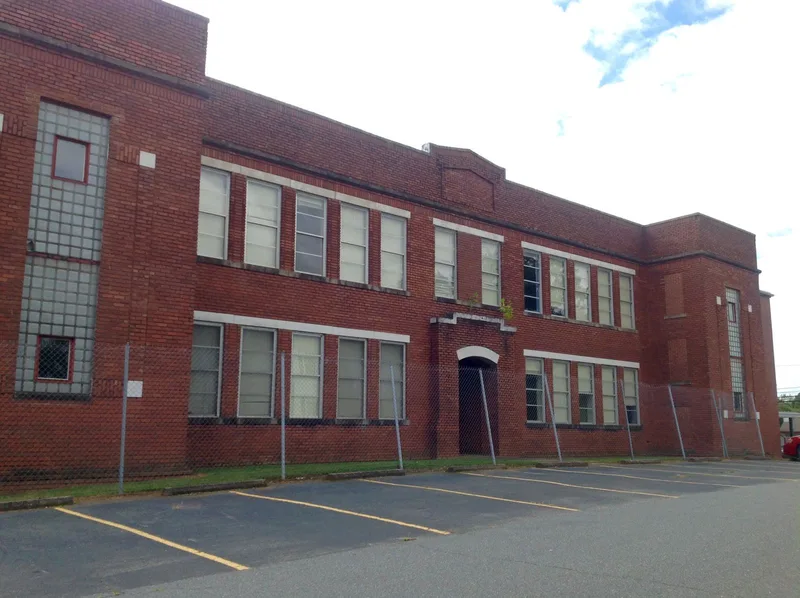
This mill village southeast of downtown Forest City grew around the Alexander Manufacturing Company textile mill, begun in 1918. The district covers roughly sixty-five acres and 102 primary resources, including the brick mill complex, worker housing, the former Alexander School, and Alexander Baptist Church. The eastern section, probably built in 1918, follows a curvilinear plan by landscape architect Earle Sumner Draper, while the western section, built around 1920, runs in straight rows beside the railroad tracks. Most homes are one-story frame Craftsman bungalows with brick foundations and porches on tapered posts; eleven house types are identified, and some may have been built from Minter Homes kits. A few larger houses served a supervisor, boarders, and teachers. The company sold the houses to individuals beginning in 1956, and many now have vinyl or aluminum siding. The mill once ranked among the county's largest and most productive textile operations. It closed in 2005 and is now used for storage. The district was recognized for industry, community planning, and architecture.
Significance in brief: The form lists Industry, Community Planning and Development, and Architecture as areas of significance. The village follows a planned layout by landscape architect Earle Sumner Draper and contains eleven types of Craftsman bungalow mill houses, possibly built from Minter Homes kits. It represents the operations of one of the county's largest textile manufacturers.
Machine-generated summary. This summary was generated by a language model from the official nomination document and has not been reviewed line by line by an editor. It may contain errors. Check the source document before relying on any detail. Source: nomination document (PDF) · National Archives catalog entry. NRHP reference 08000413, listed May 15, 2008. Summary generated October 2026 (model claude-sonnet-5-5, prompt v1.0-2026-10-29, confidence medium).
Key facts
| Address | Roughly bounded by Victory & Wilson Drs., Allen & S. Broadway Sts., Forest City |
|---|---|
| County | Rutherford County |
| Listed | May 15, 2008 |
| Reference number | 08000413 |
| Resource type | District |
| Architect / builder | Earle Sumner Draper (landscape architect, village plan) |
| Architectural style | Bungalow/Craftsman; Colonial Revival; Classical Revival |
| Criteria |
|
| Areas of significance | Industry, Community Planning and Development, Architecture |
| Level of significance | Local |
| Status (as stated in the nomination) | The mill complex is dormant; production ceased in March 2005 and the buildings are used for storage. The village remains primarily residential, and the houses have been privately owned since 1956. |
| Acreage | 65 |
| Coordinates | 35.30923, -81.85349 (NPS GIS) |
What listing means for this property
This is a historic district. Buildings within its boundary are either contributing (they add to the district's significance) or non-contributing. Owners of contributing income-producing buildings can claim the 20% federal rehabilitation tax credit; homeowners should look at state credits. National Register districts impose no design review by themselves; a local historic district ordinance, if one exists, does (the difference explained).
General information, not legal or tax advice. Rules change; confirm with your State Historic Preservation Office or a qualified adviser.
Sources and further reading
- National Park Service, National Register of Historic Places database (snapshot May 2026), reference 08000413.
- Nomination form (PDF, National Archives) — catalog entry
- Wikipedia article (used for cross-checking only; text not reproduced here)
- Wikidata Q19870660
- This listing as JSON
Last updated October 2026. Found an error? See the editorial policy for how to report it.