Playmakers Theatre
Also known as: Smith Hall

Why it's listed
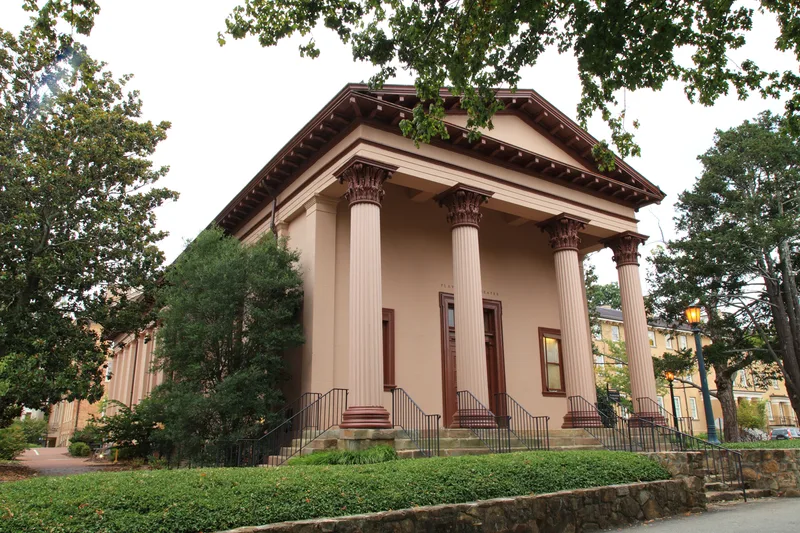
Playmakers Theatre began as Smith Hall, a ballroom and meeting building requested in 1848 by the Di and Phi Literary Societies of the University of North Carolina. Completed in 1850 for $10,363.63, it was probably designed by A. J. Davis of Town and Davis, with John Berry of Hillsborough as contractor. It is a temple-form building of rusticated stucco on brick, fronted by a four-column Corinthian portico. The column capitals are sculpted with corn, wheat and tobacco rather than classical acanthus leaves, and the entablature is unusually plain. Over the following century the building served as a library, chemistry laboratory, bath house and law school. In 1925 it was dedicated as the Playmakers Theatre, home of the Carolina Playmakers, whose alumni include Thomas Wolfe, Andy Griffith and Paul Green. Interior alterations have erased most of the original layout, but the exterior remains a distinctive example of regional Classical design on one of the university's oldest buildings.
Significance in brief: The building is architecturally notable for its Corinthian capitals decorated with corn, wheat and tobacco instead of acanthus leaves, and for a very simple entablature. It is one of the oldest buildings on the campus. Since 1925 it has housed the nationally recognized Carolina Playmakers.
Machine-generated summary. This summary was generated by a language model from the official nomination document and has not been reviewed line by line by an editor. It may contain errors. Check the source document before relying on any detail. Source: nomination document (PDF) · National Archives catalog entry. NRHP reference 71000605, listed June 24, 1971. Summary generated October 2026 (model claude-sonnet-5-5, prompt v1.0-2026-10-29, confidence high).
Key facts
| Address | Cameron Ave., University of North Carolina campus, Chapel Hill |
|---|---|
| County | Orange County |
| Listed | June 24, 1971 |
| Reference number | 71000605 |
| Resource type | Building |
| Period of significance | 19th Century (specific date 1850) |
| Architect / builder | Thought to be designed by A. J. Davis of Town and Davis; contractor John Berry of Hillsborough |
| Architectural style | Temple-form building with prostyle tetrastyle Corinthian portico |
| Areas of significance | Architecture, Performing Arts |
| Level of significance | National |
| National Historic Landmark | Yes, designated November 7, 1973 |
| Status (as stated in the nomination) | Occupied and in use as the home of the Playmakers Theatre; condition marked as altered, original site. |
| Acreage | 0.5 |
| Coordinates | 35.90670, -79.05019 (NPS GIS) |
What listing means for this property
For an income-producing building, listing (individually or as a contributing building in a district) is the gateway to the 20% federal rehabilitation tax credit on qualified rehabilitation costs, often stackable with state credits. Work claiming the credit must follow the Secretary of the Interior's Standards and be approved in advance.
Listing does not restrict a private owner acting without federal money or permits; where federal funding or licensing is involved, Section 106 review applies.
General information, not legal or tax advice. Rules change; confirm with your State Historic Preservation Office or a qualified adviser.
Sources and further reading
- National Park Service, National Register of Historic Places database (snapshot May 2026), reference 71000605.
- Nomination form (PDF, National Archives) — catalog entry
- Wikipedia article (used for cross-checking only; text not reproduced here)
- Wikidata Q7203490
- This listing as JSON
Last updated October 2026. Found an error? See the editorial policy for how to report it.