Audubon Trolley Station

Why it's listed
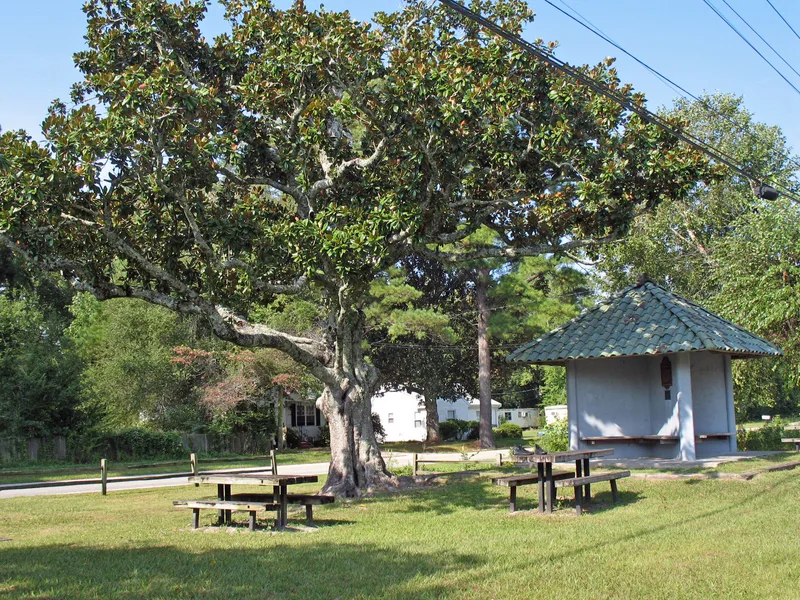
Sixty feet west of the corner of Park Avenue and Audubon Boulevard in Wilmington stands a small trolley shelter built in 1911 for the Tidewater Power Company. Its reinforced concrete walls radiate from a center in a Greek cross plan beneath a pyramidal roof of green-glazed terra cotta tile, with wooden bench seats set into the walls. It served the Audubon suburb, developed by Hugh MacRae along the eleven-mile line to Wrightsville Beach. Trolley service ended in 1940, the rails were removed, and the other twenty stations along the route disappeared. The shelter decayed and lost its roof and wooden parts. A new roof in 1985 was inaccurate. After original tile fragments were found in 1990, matching tiles were obtained and a correct roof was installed in 1992. It is the only surviving station on the line and keeps a quiet, residential setting beside the old right-of-way.
Significance in brief: It is the only surviving passenger station of the twenty stops on the electric trolley line between Wilmington and Wrightsville Beach. It is a tangible reminder of the role of public rail service in the growth of Wilmington, Wrightsville Beach and the suburbs between them. Its setting still keeps a rural character, and the community drove its restoration.
Machine-generated summary. This summary was generated by a language model from the official nomination document and has not been reviewed line by line by an editor. It may contain errors. Check the source document before relying on any detail. Source: nomination document (PDF) · National Archives catalog entry. NRHP reference 93000736, listed August 5, 1993. Summary generated October 2026 (model claude-sonnet-5-5, prompt v1.0-2026-10-29, confidence high).
Key facts
| Address | Jct. of Park Ave. and Audubon Blvd., Wilmington |
|---|---|
| County | New Hanover County |
| Listed | August 5, 1993 |
| Reference number | 93000736 |
| Resource type | Structure |
| Period of significance | 1911-1940 |
| Architect / builder | Tidewater Power Co. |
| Architectural style | Mission/Spanish Colonial Revival |
| Criteria |
|
| Areas of significance | Transportation |
| Level of significance | Local |
| Status (as stated in the nomination) | Restored in 1992 with a reconstructed terra cotta tile roof; the site now serves as a small landscaped plaza on city-owned land. |
| Acreage | 0.9 |
| Coordinates | 34.21558, -77.89603 (NPS GIS) |
What listing means for this property
For an income-producing building, listing (individually or as a contributing building in a district) is the gateway to the 20% federal rehabilitation tax credit on qualified rehabilitation costs, often stackable with state credits. Work claiming the credit must follow the Secretary of the Interior's Standards and be approved in advance.
Listing does not restrict a private owner acting without federal money or permits; where federal funding or licensing is involved, Section 106 review applies.
General information, not legal or tax advice. Rules change; confirm with your State Historic Preservation Office or a qualified adviser.
Sources and further reading
- National Park Service, National Register of Historic Places database (snapshot May 2026), reference 93000736.
- Nomination form (PDF, National Archives) — catalog entry
- Wikipedia article (used for cross-checking only; text not reproduced here)
- Wikidata Q19460313
- This listing as JSON
Last updated October 2026. Found an error? See the editorial policy for how to report it.